
Ibotta’s Revenue and Profitability Struggles Contrast With Enlarged Buybacks and Technology Investments
Ibotta, Inc. faces operational challenges amid shifting profitability and aggressive share repurchases while advancing its digital promotions platform.
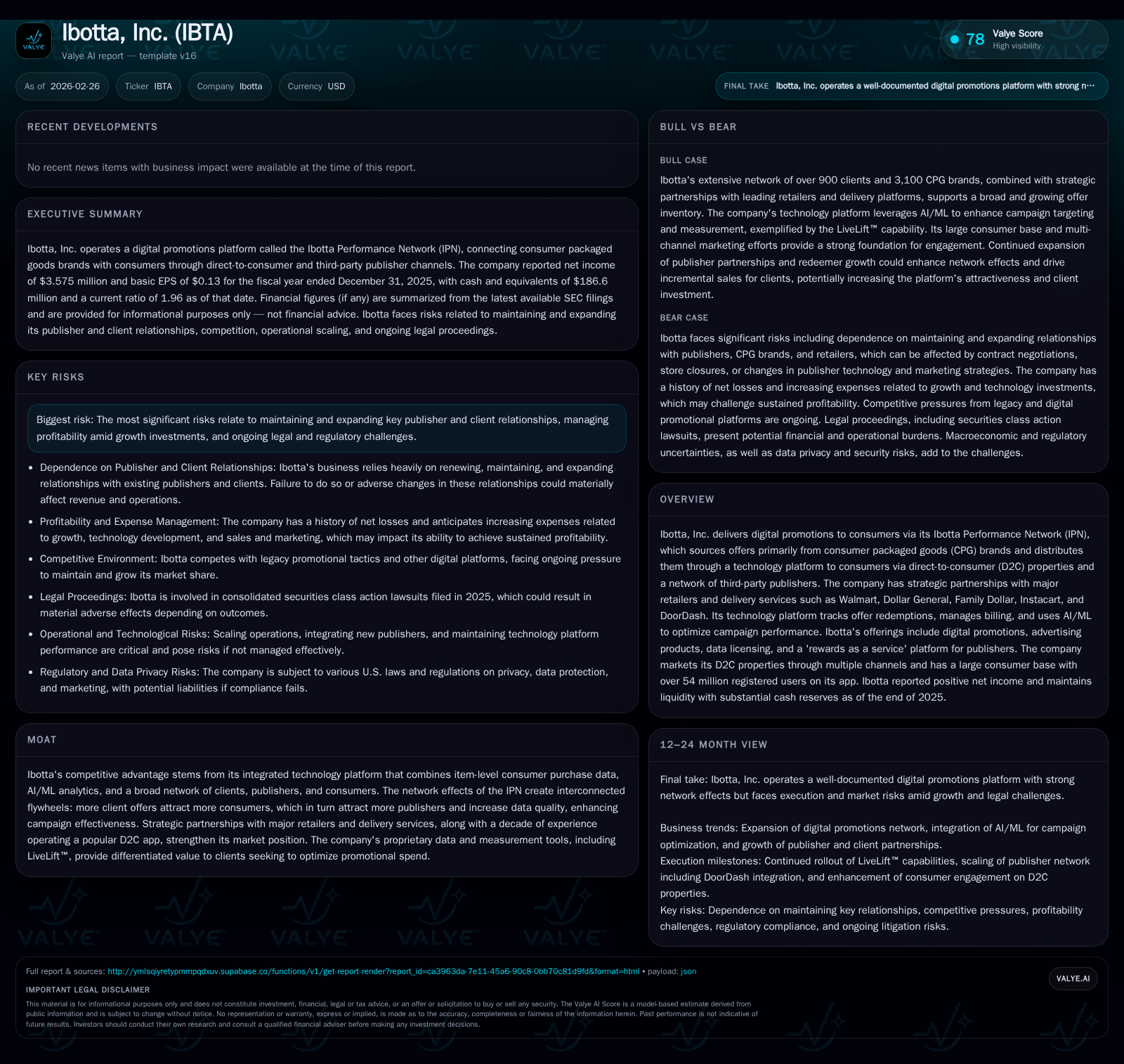
Ibotta, a technology-driven digital promotions company serving consumer packaged goods brands and major retailers, reported a sharp swing to operating losses in 2025 despite modest net income, reflecting rising expenses and investments in AI-enhanced advertising capabilities. The company’s extensive publisher network, with major retailers as partners, underpins its integrated Ibotta Performance Network (IPN), yet growth prospects hinge critically on maintaining and expanding these relationships amid regulatory and macroeconomic risks. Capital return via repurchases surged dramatically in 2025, even as operating cash flow declined from prior year levels. Future performance depends on effective monetization of new offerings like LiveLift™, managing client retention, and navigating an evolving competitive landscape.
Company Overview
Ibotta, Inc., founded in 2011 and public since April 2024 (NYSE: IBTA), delivers digital promotions primarily sourced from consumer packaged goods (CPG) brand clients through its proprietary Ibotta Performance Network (IPN). The IPN integrates offers from over 900 clients covering more than 3,100 brands with distribution to consumers via Ibotta’s own direct-to-consumer (D2C) app ecosystem alongside a growing network of well-known third-party publishers such as Walmart, Dollar General, Family Dollar, Instacart, and DoorDash.
This integrated approach allows for precise tracking of offer redemptions at the item level, detailed campaign management through AI/ML-driven analytics including their LiveLift™ offering launched in 2025, and seamless reward fulfillment. Ibotta combines technological innovation with deep industry relationships to provide scalable success-based marketing solutions for clients aiming to drive incremental sales.
Historical Financial Performance
The company exhibited significant volatility in profitability metrics through recent periods rooted mainly in rising expenses tied to technology development and market expansion efforts.
Historical performance (annual)
| FY | Net ($mm) | CFO ($mm) | OpInc ($mm) | Capex ($mm) | Net YoY |
|---|---|---|---|---|---|
| 2025 | 4 | 95 | -1 | 20 | -94.8% |
| 2024 | 69 | 116 | 28 | 1 |
Source: SEC companyfacts cache [F1].
Capital returns and efficiency (annual)
| FY | Buybacks ($mm) | FCF ($mm) | ROE% |
|---|---|---|---|
| 2025 | 233 | 75 | 1.2 |
| 2024 | 31 | 115 | 15.0 |
Source: SEC companyfacts cache [F1].
Note: Revenue details were not explicitly provided in available data.
From FY2024 to FY2025:
- Operating income plummeted by approximately 103%, swinging into slight operating loss territory.
- Net income declined precipitously by nearly 95%, reflecting higher operational costs despite positive bottom-line results.
- Operating cash flow decreased roughly by 18%, remaining substantial but highlighting lower conversion efficiency than prior years.
- Capital expenditures surged over twentyfold as the company invested heavily into platform enhancements presumably linked to AI/ML capabilities rollout.
- Share repurchase activity expanded dramatically by over seven times the previous year’s amount signaling aggressive capital return efforts despite tightened earnings.
Business Model & Strategic Positioning
Ibotta Performance Network Dynamics
At its core lies the IPN which monetizes success-based marketing campaigns where fees are earned when sponsored offers result in actual consumer transactions. The network's strength derives from multiple interconnected participants:
- Clients: CPG brands that fund digital promotions tailored by product eligibility criteria and distribution rules.
- Publishers: Entities that host these offers—both Ibotta's D2C app properties requiring user accounts and third-party publishers where seamless offer access exists without mandatory onboarding.
- Technology Platform: Enables real-time tracking of offer selections and redemptions down to the product unit level; employs AI/ML for enhancing campaign targeting precision; manages consumer rewards ledgers; optimizes billing flows.
This flywheel effect encourages more client participation — leading to expanded offer variety — which attracts a larger consumer base fostering additional publisher engagement. Consequently increases data fidelity reinforcing machine learning-powered optimizations creating better client outcomes.
Products & Offerings
Ibotta's product suite includes:
- Digital Promotions: Campaigns structured with strategic playbooks optimizing budgets across discount values and product targets.
- LiveLift™: Launched in late 2025 providing granular sales lift metrics and cost-efficiency analysis enabling clients to intelligently calibrate spend.
- Data Licensing & Measurement: Partnerships with third-party analytics firms like Circana offer validated sales lift studies enhancing client confidence.
- Rewards-as-a-Service: A plug-in solution facilitating white-label reward programs for publishers integrating with the IPN.
Client Base & Market Exposure
The majority of offers cater to non-discretionary categories such as grocery products but extend also into broader general merchandise sectors including toys, beauty products, electronics etc., reflecting diversification within CPG verticals [S1][S7][S8]. Strategic partnerships with dominant retailers underpin distribution reach but also introduce dependency risks if renewal or integration falters.
Future Growth Prospects & Risks
Growth Drivers
- Scaling AI/ML capabilities embedded within LiveLift™ could unlock improved ROI for clients aiming for incremental sales gains at optimized costs [S7].
- Expanding exclusive offer sourcing beyond current client base of ~900 brands covering thousands could generate more promotional volume.
- Deepening integration with existing publisher partners such as Instacart or Walmart enhances omnichannel offer accessibility potentially boosting redemption rates.
- Leveraging affiliate networks further on D2C platforms may add incremental basket-level cash back options stimulating consumer frequency [S7][S26].
Constraints & Risks
Key risks center on maintaining vibrant relationships across all three pillars—clients, publishers, retailers—as contraction or failure could markedly impact revenue streams:
- Publisher churn or technological integration failures could hinder offer redemption growth [S1][S2].
- Client payment delays or liquidity issues among emerging brands may lead to receivables write-offs impairing financial results [S21].
- Legal pressures including ongoing securities class action lawsuits initiated post-IPO entail potential material costs plus distraction [S11].
- Macro factors such as economic downturns compressing marketing budgets remain unpredictable headwinds [S1][S2].
- Regulatory complexity increases notably regarding data privacy laws governing granular consumer purchase information collection critical for platform operation [S12][S16][S25].
- Intense competition demands continuous innovation to defend differentiation rooted in proprietary data analytics tools [S1][S27].
Capital Allocation & Returns Analysis
Ibotta demonstrates conservative liquidity management paired with ambitious capital returns through buybacks:
- Year-end cash balance stood at ~$187M against current liabilities of ~$208M resulting in a current ratio near two indicating reasonable short-term financial health [F1][S4][S14].
- No debt was outstanding under their revolving credit facility at latest filings though access remains available subject to covenants tied to EBITDA leverage ratios [S4][S5][S14].
- Share repurchases totaled approximately $233M during FY2025 up considerably compared to $31.3M the prior year suggesting a strategic return of cash despite volatile earnings performance [F1][S6][S9].
- The company does not pay dividends citing reinvestment into growth opportunities alongside credit agreement restrictions preventing distributions [S20].
- Approximate Return on Equity for FY2025 calculated near low single digit levels (~1.2%) illustrating modest profitability relative to shareholders’ equity base [F1].
Outlook & What To Watch (Analysis)
Absent explicit guidance disclosures from management recently released filings do not specify quantitative forecasts or milestones. Key developments worth monitoring include:
- Adoption rates and revenue contribution from LiveLift™ incremental sales measurement tools across clients' campaigns.
- Expansion pace within third-party publisher network introducing more diversified avenues for offer distribution.
- Litigation outcomes for securities class action cases that may impose financial settlements impacting earnings volatility.
- Trends in capital allocation balancing further stock repurchases versus funding continued technology platform enhancements.
- Retention rates among largest retail partners given their outsized influence on consumer reach within the network.
- How macroeconomic conditions influence overall digital ad spend by CPG brands reflected in Ibotta’s top-line growth trajectory.
Conclusion
Ibotta stands at an inflection point characterized by strengthening technological sophistication amidst strained near-term profit metrics shaped by substantial investment phases. Its differentiated integrated platform combining AI-enhanced campaign analytics alongside broad publisher partnerships constitutes a notable value proposition driving substantial customer engagement footprints exceeding tens of millions of registered users. Yet sustaining competitive advantage will necessitate resolving growth constraints posed by client-publisher dynamics compounded by legal/regulatory uncertainties while harnessing capital allocation effectively amid volatile earnings patterns.
This analysis is based solely on disclosed SEC filings up to February 26, 2026 ([F1], [S#]) without extrapolation beyond presented facts. It is intended for informational purposes without investment recommendations.
Disclaimer: This is research-only, informational analysis and not investment advice. It may include AI-generated interpretation and general industry context. Always verify important details using primary sources.

Comments