
GT Biopharma's Clinical Progress Contrasts with Persistent Financial Losses and Nasdaq Compliance Risks
The clinical-stage biotech leverages innovative TriKE® platforms targeting NK cells but faces cash flow challenges amid regulatory milestones.
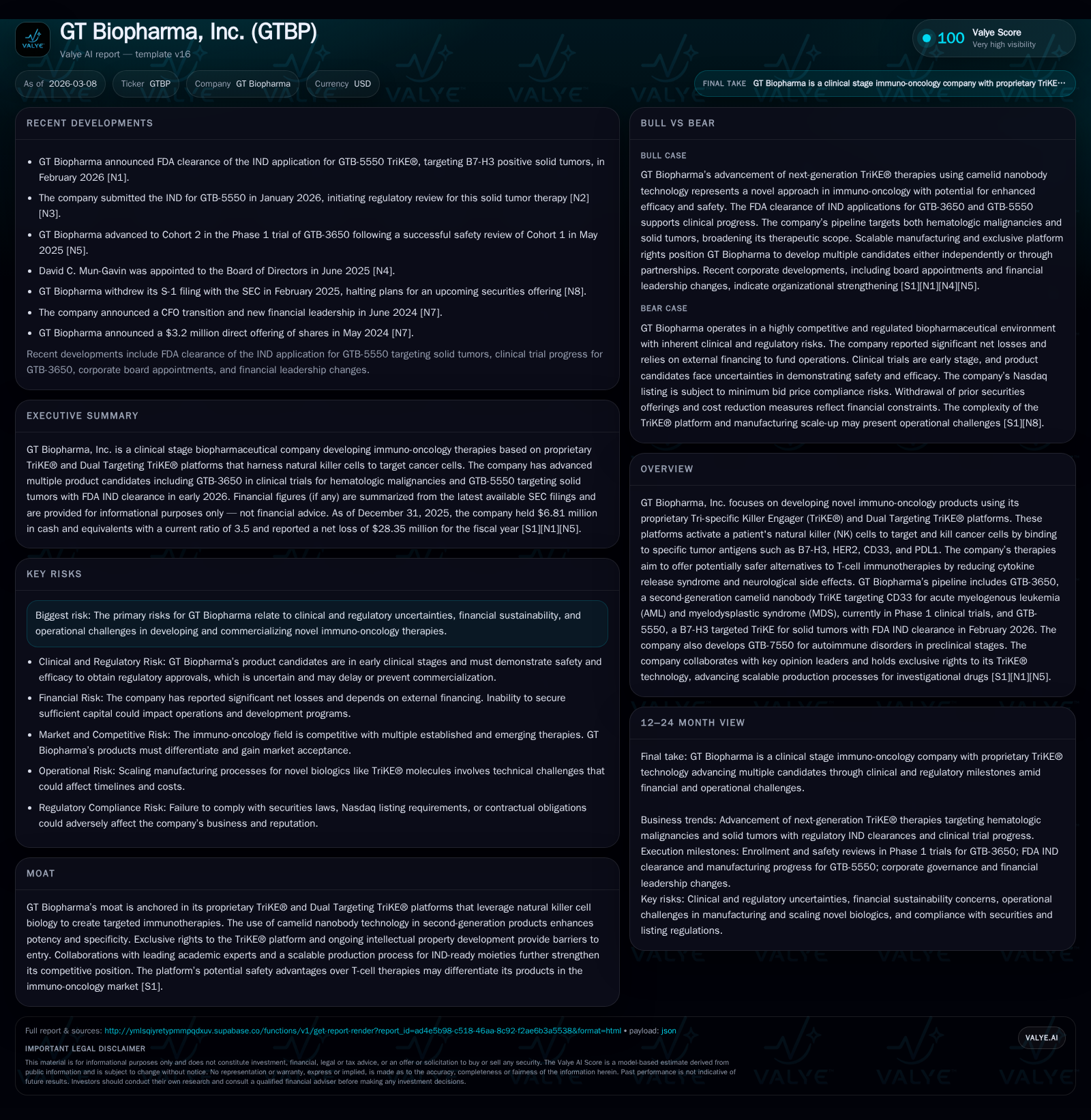
GT Biopharma, Inc. operates as a clinical-stage company developing immuno-oncology therapies based on its proprietary Tri-specific Killer Engager (TriKE®) technology, which activates natural killer (NK) cells to target cancer cells while potentially minimizing T-cell therapy side effects. Recent FDA clearance of its GTB-5550 IND highlights milestone progress amidst an early development pipeline focusing on hematologic malignancies and solid tumors. However, the company continues to report annual net losses now exceeding $28 million for 2025 and operating cash outflows near $13 million, while contending with Nasdaq’s minimum bid price listing requirement warning. Capital structure complexities including liability-classified convertible preferred stock add further financial risk.
Company Overview and Platform
GT Biopharma, Inc. is a clinical-stage developer of novel immuno-oncology therapies based on its proprietary Tri-specific Killer Engager (TriKE®) platform and its evolution into Dual Targeting TriKE® (Tetra-specific Killer Engager) constructs. These biologics leverage recombinant fusion proteins designed to harness patients’ natural killer (NK) cells to seek out and destroy malignant cells by simultaneously binding activating receptors on NK cells (notably CD16), incorporating interleukin-15 (IL-15) for NK cell proliferation, and targeting tumor-associated antigens like B7-H3, HER2, CD33, or PDL1 [S1]. The approach aims to provide targeted anti-cancer activity potentially safer than T-cell engagers by reducing cytokine release syndrome (CRS) and neurological adverse events commonly linked to T-cell immunotherapy.
The company's TriKE® platform does not require patient-specific customization, enabling scalable manufacturing which supports efficient progression into IND-enabling studies [S1]. Collaboration with Dr. Jeffrey Miller—an acknowledged leader in NK cell biology at the University of Minnesota’s Masonic Cancer Center—reinforces scientific rigor in both platform technology and clinical translation.
Historical Performance and Financials
GT Biopharma has yet to generate revenue as it remains in clinical development phases for its pipeline candidates. The company has consistently reported operating losses reflecting expenses invested in R&D, clinical trials, regulatory filings, and corporate overhead.
Historical performance (annual)
| FY | Net ($mm) | CFO ($mm) | OpInc ($mm) | Net YoY |
|---|---|---|---|---|
| 2025 | -28 | -13 | -12 | -115.4% |
| 2024 | -13 | -13 | -14 | -73.3% |
| 2023 | -8 | -9 | -14 | +63.6% |
| 2022 | -21 | -15 | -21 |
Source: SEC companyfacts cache [F1].
Capital returns and efficiency (annual)
| FY | ROE% |
|---|---|
| 2025 | -490.0 |
| 2024 | 788.1 |
| 2023 | -101.6 |
| 2022 | -178.0 |
Source: SEC companyfacts cache [F1].
In FY2025 the operating loss narrowed slightly compared to FY2024 improving by approximately 13.5%, indicating some operational efficiencies; however net loss almost doubled year-over-year (-115%) mainly due to non-operational charges including fair value adjustments related to Greenshoe Rights liability reclassification [F1].
Operating cash flow remained negative at about $13 million in FY2025 essentially flat relative to the prior year suggesting stable but significant cash burn consistent with clinical-stage biopharma profiles [F1]. The absence of material capital expenditures reflects the company's focus on early-stage R&D rather than plant expansion or equipment investment.
Total equity rebounded to a positive balance near $5.8 million at year-end 2025 after being negative the prior year largely due to balance sheet adjustments surrounding complex financing instruments [F1]. Current assets exceeded current liabilities by a wide margin (ratio approx. 3.5), providing some liquidity buffer though continued funding will be necessary given ongoing losses.
Pipeline Advances and Growth Prospects
GT Biopharma’s lead pipeline candidates focus on hematologic malignancies and solid tumors leveraging next-generation TriKE® constructs:
GTB-3650: A second-generation camelid nanobody-based TriKE targeting CD33 for acute myelogenous leukemia (AML) and myelodysplastic syndrome (MDS), currently in Phase 1 clinical trials enhancing potential specificity and potency compared with first-generation molecules [S1].
GTB-5550: Recently received FDA clearance for the Investigational New Drug application in February 2026 targeting B7-H3-expressing solid tumors. This milestone facilitates planned initiation of clinical evaluation marking an important step toward potential commercialization pathways [N1][S1].
A preclinical candidate (GTB-7550) is also being developed for autoimmune indications expanding future therapeutic applications beyond oncology [S1].
The TriKE® platform’s modularity allows design flexibility for diverse tumor targets without individual patient customization—an advantage for quicker clinical development cycles relative to personalized therapies such as CAR-T cells or bispecific T-cell engagers.
Milestones and Forward-Looking Expectations
Recent FDA IND clearance for GTB-5550 represents a tangible forward catalyst allowing GT Biopharma to commence human studies in solid tumors expressing B7-H3 [N1]. Outcomes of these early phase trials will be critical for validating safety signals noted preclinically—principally reduced cytokine release—and determining efficacy markers needed for eventual regulatory approvals.
GTB-3650’s ongoing Phase 1 trial readouts will also provide essential data on dosing regimen optimization and safety profile distinctiveness versus competitive cell engager approaches.
Absent explicit updated near-term financial guidance or timelines beyond disclosed trial progress in SEC filings [S1][S2], operators should watch:
- Initial Ph1 data publication timing for GTB-3650,
- Enrollment status updates and preliminary safety outcomes for GTB-5550,
- Regulatory interactions following these studies,
- Cash runway projections given burn rates linked to clinical activities.
Capital Structure and Returns Analysis
GT Biopharma utilizes a complex capital structure featuring common stock alongside Series L Convertible Preferred Stock carrying a stated dividend rate of 10%. Notably during mid-to-late 2025 the company recognized certain stock rights as liabilities under ASC accounting rules due to redemption provisions affecting classification — these Greenshoe Rights liability markings significantly impacted reported earnings resulting in large non-cash losses totaling ~$28.7 million which were reversed upon waivers subsequently converting such rights back into equity classifications by September quarter end [S8][S17].
Due to these accounting complexities coupled with persistent operating losses and negative free cash flow (~$13 million negative FCF FY2025), estimated shareholder returns remain negative with an approximate ROE around minus 490% calculated from trailing net loss over equity base [F1].
No dividends or stock repurchase programs are evident given developmental stage priorities with capital allocation focused squarely on advancing clinical programs.
Risks Highlighted in Regulatory Filings
Key risks facing GT Biopharma include:
- Clinical Development Uncertainty: As an emerging biotech without approved products GTBP depends heavily on encouraging trial results for multiple novel agents with unknown ultimate efficacy or safety outcomes [S4].
- Regulatory Challenges: Success hinges on navigating complex FDA requirements particularly demonstrating differentiation from established immunotherapies regarding side effect profiles [S4].
- Financial Sustainability: Consistent cash burn exceeding $12 million annually requires access to capital markets or partnership/licensing deals; failure could disrupt progress [S4][S6].
- Market Listing Compliance: Nasdaq has placed the firm on notice for non-compliance with minimum $1 trading price rule effective November 2025; company has until mid-May 2026 to regain compliance or face potential delisting actions which could restrict investor access or further complicate financing [S19][S21].
- Litigation Exposure: Pending arbitration involving former CFO might entail management distraction or financial costs if unresolved unfavorably [S1].
Industry Context Analysis (Uncited)
NK cell-based therapies represent an evolving niche within immuno-oncology aiming for superior safety profiles compared to T-cell-based constructs that often suffer from higher rates of CRS or neurotoxicity. Camelid nanobody incorporation is gaining traction across the sector due to their smaller size enhancing tumor penetration and target engagement stability. However commercial success depends heavily on robust clinical proof points amid intense competition from CAR-T products by established pharma giants plus bispecific antibodies rapidly entering markets.
Manufacturing scalability also remains a pivotal factor since protein fusion biologics require strict quality controls – companies like GT Biopharma investing early in scalable IND-ready production may gain faster paths through regulatory vetting.
Conclusion: Balancing Innovation Against Execution Risks
GT Biopharma manifests compelling scientific innovation through its TriKE® platforms harnessing NK cell immunology coupled with advanced protein engineering innovations like camelid nanobodies. Recent regulatory progress such as FDA IND clearance signals tangible developmental momentum across hematologic cancer and solid tumor indications.
Yet the company navigates steep operational hurdles—ongoing net losses deepening in magnitude driven partly by noncash financing accounting treatments underscore fragile financial footing requiring continued capital raising. Moreover Nasdaq’s trading price deficiency notice brings urgency around investor confidence sustaining market access.
Monitoring upcoming Phase 1 data outputs alongside cash reserves will be essential indicators reflecting whether GTBP can convert its promising technology into meaningful therapeutic breakthroughs while stabilizing its capital structure.
This analysis is based solely on publicly available information as of March 8, 2026. It is not intended as investment advice or recommendation but aims to provide a grounded understanding of GT Biopharma’s business developments alongside associated financial realities within the current biotechnology landscape.
Disclaimer: This is research-only, informational analysis and not investment advice. It may include AI-generated interpretation and general industry context. Always verify important details using primary sources.

Comments