
ALX Oncology's Clinical Advancement Challenges and Capital Strain Impede Near-Term Growth
Early-stage immuno-oncology developer ALX Oncology faces financial pressures and regulatory uncertainties amid advancing clinical trials of its lead assets.
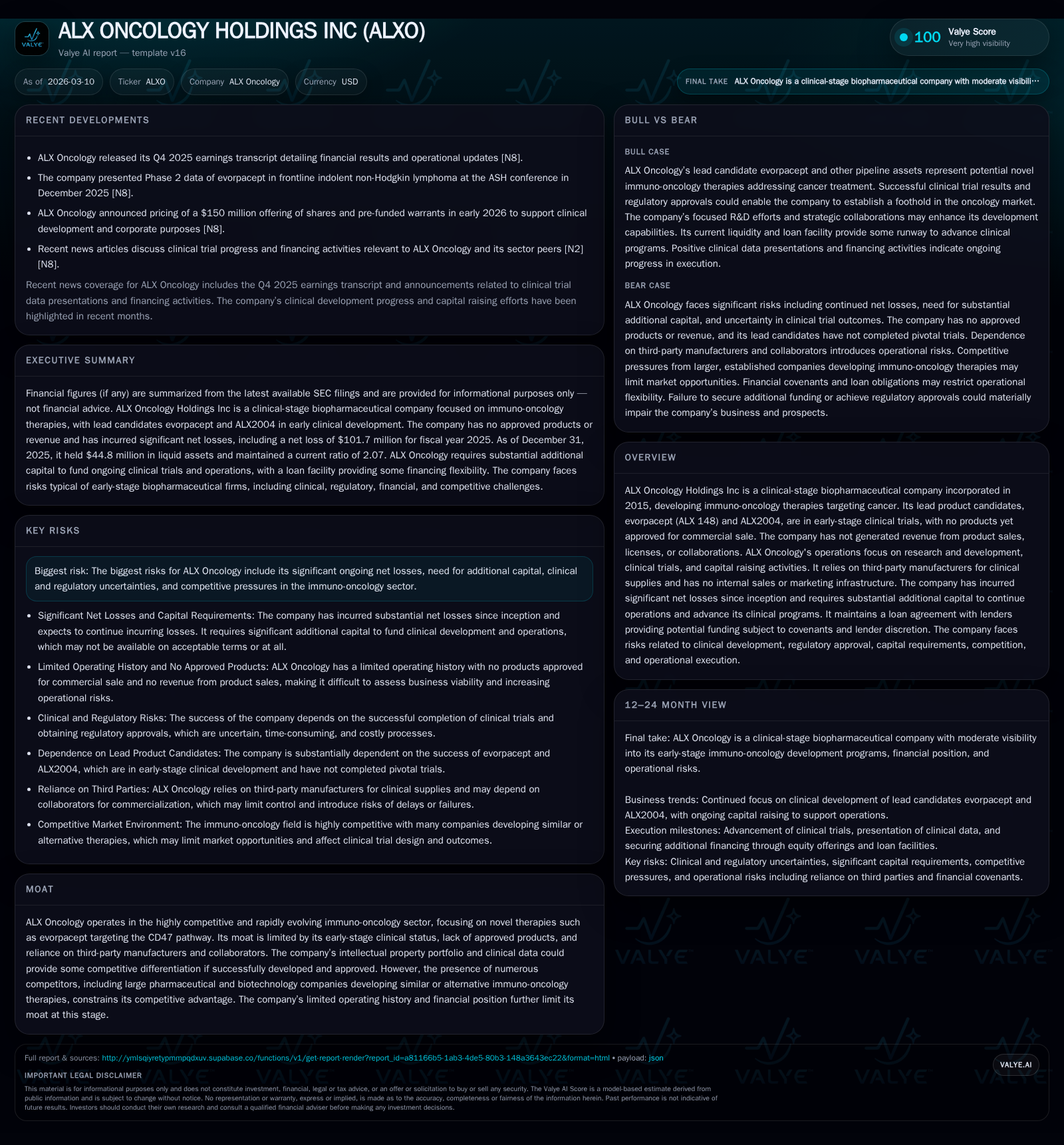
ALX Oncology Holdings Inc is a clinical-stage biopharmaceutical company focused on novel immuno-oncology therapies with no approved products or revenue to date. Its lead candidates, evorpacept (ALX 148) and ALX2004, remain in early clinical phases, requiring significant ongoing investment amid a competitive landscape. The company has incurred substantial net losses each year, with operating income losses exceeding $100 million in 2025 and cash reserves supporting operations into early 2027 only. Dependency on future capital raises, regulatory approval outcomes, and competitive innovations constrain growth prospects. Watch for clinical trial readouts, milestone-driven funding opportunities, and capital management as key near-term corporate milestones.
Company Overview and Historical Financial Performance
Founded in 2015, ALX Oncology Holdings Inc is an emerging clinical-stage biopharmaceutical company specializing in the development of immuno-oncology therapies focused notably on the CD47 immune checkpoint pathway—a mechanism tumors use to evade immune destruction. The company's principal candidates are evorpacept (also known as ALX 148) and ALX2004, which remain in early clinical development stages. To date, ALXO has produced no revenue from product sales, licenses, or collaborations, reflecting a pre-commercialization state solely reliant on capital raises and partnerships.
Financially, the company has exhibited sizeable recurring losses typical for a firm aggressively investing in R&D without commercial products. As detailed in its latest filings [F1], operating income losses have decreased from approximately -$170 million in fiscal year (FY) 2023 to -$104 million by FY 2025. Similarly, net losses narrowed from around -$161 million to -$102 million over this same period—a roughly 25% improvement signaling cost control but persistent negative earnings.
Operating cash flow continues significantly negative at about -$84 million for FY 2025 after a steady improvement from previous higher outflows (-$130 million in FY23). Capital expenditures are nominal relative to operations (just over $200k in FY25), indicating limited investments beyond ongoing research activities. The balance sheet shows $16.4 million in cash and equivalents as of December 31, 2025, supported by current assets of roughly $50.7 million versus current liabilities near $24.6 million—implying a current ratio of just above 2x but still modest absolute liquidity for a company with high burn rates.
Historical performance (annual)
| FY | Net ($mm) | CFO ($mm) | OpInc ($mm) | Capex ($) | Net YoY |
|---|---|---|---|---|---|
| 2025 | -102 | -84 | -104 | 212000 | +24.6% |
| 2024 | -135 | -122 | -142 | 447000 | +16.1% |
| 2023 | -161 | -130 | -170 | 1274000 | -30.2% |
| 2022 | -123 | -89 | -127 | 1427000 |
Source: SEC companyfacts cache [F1].
Capital returns and efficiency (annual)
| FY | FCF ($mm) | ROE% |
|---|---|---|
| 2025 | -84 | -391.4 |
| 2024 | -122 | -118.7 |
| 2023 | -132 | -84.8 |
| 2022 | -91 | -46.9 |
Source: SEC companyfacts cache [F1].
Note: Data are sourced from the company's annual SEC filings [F1].
R&D Focus and Competitive Positioning
ALX Oncology’s strategic emphasis lies on novel immunotherapeutic agents designed to harness or enhance the body's own immune response against cancer cells by targeting mechanisms like CD47-SIRPα checkpoint inhibition (evorpacept). This pathway is gaining traction within oncology due to its role as a 'don't eat me' signal that tumors use to evade macrophage-mediated destruction.
Despite the promising scientific rationale, ALXO remains firmly pre-commercial with its lead candidates still undergoing early-phase trials without pivotal data yet available [N1]. The absence of an approved product means the firm must continue substantial investments over several years before reaching any potential commercialization.
The company’s moat is relatively limited: it operates amid fierce competition including large pharma companies and well-financed biotech peers also advancing immuno-oncology candidates via similar or alternative pathways. Furthermore, reliance on outsourced manufacturing partners increases operational complexity and may slow scalability when transitioning toward commercialization.
Future Growth Prospects
Growth will principally depend on successful completion of ongoing clinical trials with evorpacept and ALX2004 followed by obtaining regulatory approvals to transition into commercial stages—none of which are guaranteed due to inherent clinical and regulatory risks documented extensively [S2][S12]. Positive pivotal data could unlock licensing agreements or partnership opportunities that may accelerate development funding and eventual market entry.
Conversely, failure to meet clinical endpoints or unforeseen safety issues could stall programs indefinitely or raise financing challenges given the absence of revenues currently.
Capital availability remains a critical constraint affecting growth trajectories since clinical development programs require sustained funding over many years before generating return [S13][N11]. The company's latest equity raise priced at $150 million worth of shares and warrants reflects this constant need for infusion but is subject to dilution impacts on existing shareholders.
Market dynamics such as evolving U.S drug pricing policies including Medicare negotiations and inflation-linked rebates introduce additional uncertainty about eventual pricing power for any approved therapies—a common challenge across the biotechnology sector impacting anticipated profitability [S18–S20].
Near-Term Forecasts and Milestones to Watch
While explicit forward guidance is limited beyond standard statements regarding anticipated progression of clinical trials for evorpacept and ALX2004 reported in Q4 earnings [N1], key milestones likely to influence upcoming valuation inflections include:
- Clinical trial interim/final results announcements particularly Phase 2 data sets showing efficacy/safety profiles.
- Progression into late-stage pivotal studies contingent upon regulatory feedback.
- Potential collaborative deals or licensing arrangements enabled by favorable data.
- Capital raising activity adequacy especially around debt repayments commencing December 2025 under their loan agreement [S5].
Market observers should track quarterly updates closely for shifts in developmental progress or balance sheet adjustments that might affect liquidity horizons.
Capital Allocation and Financial Returns
Given the lack of product revenue historically or presently, ALX Oncology’s financial returns metrics such as ROE are currently negative—calculated ROE approximates a severe -391% based on net losses relative to shareholder equity at year-end 2025 [F1]. This reflects typical startup biotech dynamics heavily weighted toward investment rather than returns presently.
Free cash flow remains deeply negative after subtracting minimal capex from operating cash flow (-$84m CFO vs ~$0.2m capex), underscoring continuous dependency on external capital markets for survival beyond early-to-mid next year [F1][S13].
Management prioritizes directing resources predominantly into advancing clinical programs rather than distributing dividends or executing share repurchases given ongoing operational losses and growth phase objectives.
Risk Factors Summary
The company faces multiple compounding risks including:
- Persistent significant net losses threatening solvency without adequate fundraising;
- Uncertainty surrounding outcomes of expensive clinical trials;
- Challenging competitive landscape with numerous peers advancing similar immunotherapy approaches;
- Regulatory hurdles exacerbated by recent changes such as Supreme Court rulings impacting FDA authority;
- Dependence on third-party manufacturing that introduces supply chain vulnerabilities;
- Potential healthcare compliance issues given complex evolving laws governing marketing, pricing, privacy, and fraud prevention;
- Reliance on key personnel capable of navigating drug development complexity;
- No internal sales/marketing capabilities delaying commercial readiness if approvals occur unexpectedly soon;
- External macroeconomic volatility impacting capital markets access.
Extensive details are available within recent SEC risk factor sections [S2],[S12],[S14–S29].
Conclusion: Strategic Outlook Without Investment Opinion
ALX Oncology epitomizes many early-stage biotech firms balancing promising scientific innovation against steep financial challenges inherent to sustained clinical development cycles without imminent revenue streams. Its progress hinges largely upon demonstrating differentiated efficacy/safety signals from evorpacept and ALX2004 while managing finite liquidity constrained by a history of heavy losses balanced against modest improvements in operating efficiency.
Continued monitoring should focus on pipeline development milestones that validate clinical hypotheses alongside capital management strategies that ensure operational continuity through forthcoming trial phases pending positive inflection points enabling potential partnerships or licensing deals ultimately necessary for longer term sustainability.
Disclaimer: This report is prepared for informational purposes only without any recommendation regarding securities transactions or any advice related thereto.
Disclaimer: This is research-only, informational analysis and not investment advice. It may include AI-generated interpretation and general industry context. Always verify important details using primary sources.

Comments