
Eagle Bancorp Faces Credit and Interest Rate Headwinds Amid Elevated Provisions and Losses
Eagle Bancorp’s recent financial results reveal significant credit challenges and cautious interest rate risk management impacting its earnings and capital.
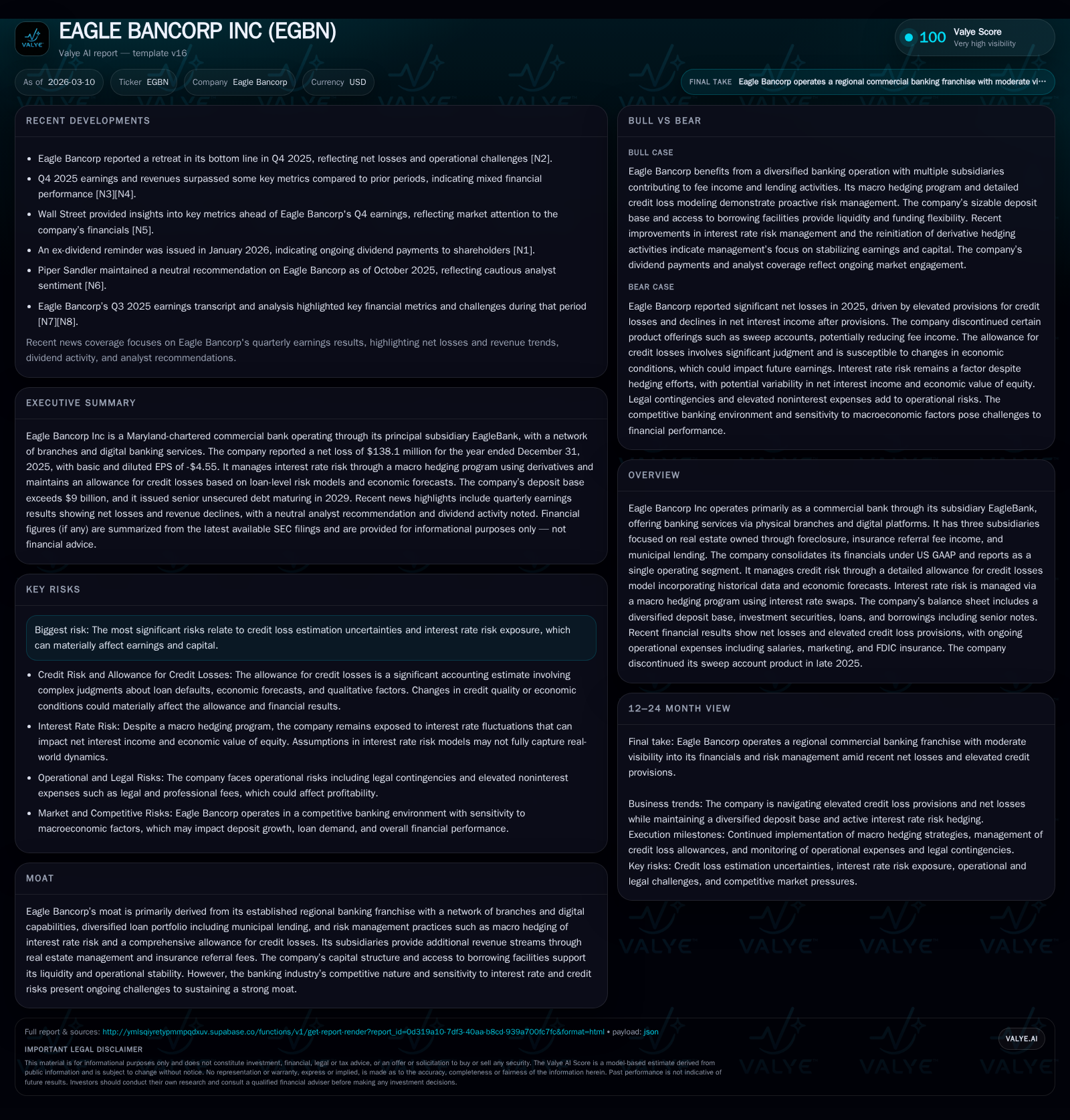
Eagle Bancorp Inc, operating through EagleBank and its subsidiaries, encountered steep net losses in 2025 driven by heightened credit loss provisions and a complex interest rate environment. Its historical growth, fueled by diversified commercial banking and municipal lending, is constrained by rising market risks and regulatory scrutiny. The company’s capital structure remains sound but upcoming performance hinges on credit quality stabilization and effective hedging. Cash flow generation remains positive, though sharply reduced from prior years, while capital returns have been paused amidst operational uncertainties.
Business Overview
Eagle Bancorp Inc operates primarily as a regional commercial bank through its principal subsidiary EagleBank. Serving both physical branch customers and digital platform users, the company delivers a suite of banking services centered on commercial loans, municipal lending, and deposit products [S6]. Complementing these are three subsidiaries focused on special lines of business: Bethesda Leasing manages real estate owned via foreclosure; Eagle Insurance Services generates referral fee income; and Landroval Municipal Finance targets municipal debt investments [S6]. Financial reporting consolidates all these via US GAAP under a single operating segment that integrates income streams chiefly from interest on loans and investments [S7][S28].
Historical Performance
Financial performance over recent years exhibits volatility born from fluctuating credit costs and economic cycles. Net income experienced substantial swings: an encouraging profit of $100.5 million in FY2023 gave way to losses of $47 million in FY2024, deepening sharply to a loss of $138 million in FY2025 [F1]. The step-up in credit loss provisions was the principal driver behind this deterioration, reaching triple the prior year’s level due to increased loan impairments during challenging market conditions [F1][S11][S12].
Operating cash flows demonstrated resilience but contracted markedly from $195.6 million in 2023 down to $28.5 million in 2025—a reflection of tightening liquidity management and lower core earnings generation [F1]. Meanwhile, capital expenditures rose materially from nominal levels seen pre-2025 to $7.7 million last year, signaling strategic reinvestment into infrastructure likely supporting digital banking enhancements and branch modernization efforts [F1].
Historical performance (annual)
| FY | Net ($mm) | CFO ($mm) | Capex ($mm) | Net YoY |
|---|---|---|---|---|
| 2025 | -138 | 28 | 8 | -193.5% |
| 2024 | -47 | 124 | 0 | -146.8% |
| 2023 | 101 | 196 | 0 | -28.7% |
| 2022 | 141 | 195 | 2 |
Source: SEC companyfacts cache [F1].
Capital returns and efficiency (annual)
| FY | Div ($mm) | Buybacks ($mm) | FCF ($mm) |
|---|---|---|---|
| 2025 | 15 | 0 | 21 |
| 2024 | 46 | 0 | 123 |
| 2023 | 55 | 48 | 196 |
| 2022 | 56 | 33 | 193 |
Source: SEC companyfacts cache [F1].
Note: Revenue and operating income figures are not explicitly disclosed; net income is presented in millions USD.
Credit Quality & Risk Management
A central challenge confronting Eagle Bancorp has been deteriorating credit quality, particularly within commercial real estate segments impacted by macroeconomic pressures such as rising interest rates affecting borrowing costs and property valuations [S11][S12]. The company applies a nuanced allowance for credit losses model incorporating historic data blended with forward-looking economic forecasts encompassing unemployment rates, GDP growth, CRE price indices among others [S11][S22]. This model includes qualitative overlays for specific categories like CRE office loans where occupancy risks and refinancing strains persist.
Moreover, certain loans have transitioned into nonaccrual status—specifically those reclassified from held-for-investment to held-for-sale—as management prudently adjusts classifications reflecting heightened default risk profiles [S15]. These factors underlie the marked increase in provision expenses observed recently.
In terms of interest rate risk, Eagle Bancorp employs a macro hedging program by utilizing interest rate swaps to mitigate margin fluctuations stemming from variable-rate loans and deposits repricing dynamics [S1]. Simulation analyses indicate modest net interest income expansion under rising rate scenarios but also highlight sensitivity given deposit cost correlations below full pass-through levels due to competitive market behavior nuances [S1]. These hedging efforts align with industry trends where mid-sized banks seek active risk mitigation amidst volatile monetary policies.
Legal and regulatory risks have also surfaced notably through an ongoing DOJ inquiry into the company's anti-money laundering controls linked with a former customer fraud case originating several years prior. Management accrued a $10 million provision subsequent to additional investigative insights made available after initial earnings releases indicating potential contingent liabilities [S5][S28]. Such developments underscore compliance-related exposures prevalent across financial institutions.
Balance Sheet & Liquidity Position
As of year-end December 31, 2025, total assets stood at approximately $1.21 billion—a reduction relative to $1.30 billion at the end of 2024 mainly attributed to loan runoff effects amid cautious origination policies under prevailing economic pressures [S6][S24]. The loan portfolio net of allowances contracted accordingly while investment securities portfolios saw fair value declines consistent with broader fixed income market adjustments.
On the liability side, the deposit base comprises a balance of noninterest-bearing accounts alongside interest-bearing deposits including time deposits totaling several billion dollars collectively within the subsidiary bank’s scope—reflecting solid core funding sources [S14]. Borrowings include secured advances available from Federal Home Loan Bank arrangements plus a notable issuance of senior notes bearing a relatively high fixed coupon (10%) extending through September 2029 providing long-dated financing stability despite elevated costs [S4][S13].
A substantial liquidity buffer persists from unpledged securities collateral positions amounting to over $300 million coupled with unused borrowing capacity anchored by pledged assets exceeding $2.7 billion which enable flexibility against unforeseen demands or opportunities [S9][S13][S16]. Moreover, bank-owned life insurance policies enhance secondary liquidity resources alongside annuity investments earmarked for supplemental executive benefits committed under unfunded pension-like arrangements [S17][S25].
Capital Adequacy & Returns
Regulatory capital ratios remain comfortably above mandated well-capitalized thresholds with Common Equity Tier 1 ratios around 13%, reflecting prudent capital management despite challenging earnings outcomes (minimum required at ~7%) [S29]. Total shareholders’ equity declined marginally following reported net losses but remained robust at about $1.13 billion reflecting retained reserves built over past profitable years as well as adjustments including comprehensive losses recognized in accumulated other comprehensive income components related primarily to unrealized investment security movements [F1][S24].
Return on equity turned negative (-12%) aligned with significant net losses registered during FY2025 which continued trends seen in prior year's profit contraction signaling pressure on capital efficiency metrics going forward absent recovery in core profitability drivers or write-backs on credit reserves [F1].
From a capital distribution standpoint, dividends were maintained though at sharply reduced levels ($15 million paid versus over $45 million previously) signaling conservatism amid earnings deficits while no share repurchases occurred since FY2023 suspensions—reflective of management prioritizing balance sheet preservation over capital return initiatives during this phase of instability [F1].
Growth Prospects & Outlook Considerations
Looking ahead, Eagle Bancorp's ability to restore positive earnings momentum will depend heavily on stabilization or improvement in credit quality metrics across commercial real estate exposure segments alongside maintenance or enhancement of net interest margins through active asset-liability management strategies including calibrated hedging programs adapting to shifting rate environments [N3][S1][S11]. Digital banking platform investments and expansion of its subsidiary business lines may offer incremental fee income potential although likely insufficient alone to offset cyclical headwinds without accompanying lending volume recovery or deposit margin expansion.
Regulatory resolution outcomes tied to ongoing investigations could impose additional financial or reputational costs affecting stakeholder confidence absent swift closure or remediation measures implemented satisfactorily by management teams [N3][S5][S28]. Market conditions characterized by uncertain macroeconomic variables such as inflation trajectories, employment trends, commercial property cycle shifts will continue shaping portfolio risk assessments substantially.
Milestones worth monitoring include quarterly provisioning trends for loan losses; updates on litigation/regulatory resolution status; shifts in asset mix particularly within higher-risk CRE loan warehousing versus more stable municipal lending; net interest margin trajectory given policy rate changes; liquidity utilization levels against available draws under FHLB lines; and strategic deployment effectiveness tied to digital channel growth supported by operating expense management results.
Summary Table: Annual Financial Highlights (USD millions)
| Metric | FY2025 | FY2024 | FY2023 |
|---|---|---|---|
| Net Income | -138 | -47 | 100 |
| Operating Cash Flow | 29 | 124 | 196 |
| Capex | 7.7 | 0.3 | 0.07 |
| Dividends Paid | 15 | 46 | 55 |
| Buybacks | 0 | 0 | 48 |
| Shareholders’ Equity | 1131 | 1226 | 1274 |
All figures rounded for presentation.
Conclusion
Eagle Bancorp enters this stage balancing substantial challenges arising from elevated credit costs amplified by concentrated exposure within commercial real estate verticals, stabilized yet cautiously managed interest rate risks via derivative hedging frameworks, along with regulatory overlays stemming from legal inquiries affecting provisions and disclosures. While its historically strong regional franchise supported by diversified revenue streams offers some moat protection, near-term performance remains vulnerable as the bank navigates tightening market conditions.
Management’s emphasis on maintaining liquidity buffers, disciplined capital adequacy compliance, measured operational reinvestment—particularly technology—and prudent cost oversight form pillars for potential recovery pathways conditional on external macroeconomic easing or successful mitigation of loan impairment trajectories.
This analysis is informational only and does not constitute investment advice.
Disclaimer: This is research-only, informational analysis and not investment advice. It may include AI-generated interpretation and general industry context. Always verify important details using primary sources.

Comments