
DTI’s Financial Turnaround and Expansion Amid Industry Headwinds
Drilling Tools International Corp balances acquisition-driven growth with margin pressures and operational adjustments in a volatile oilfield services market.
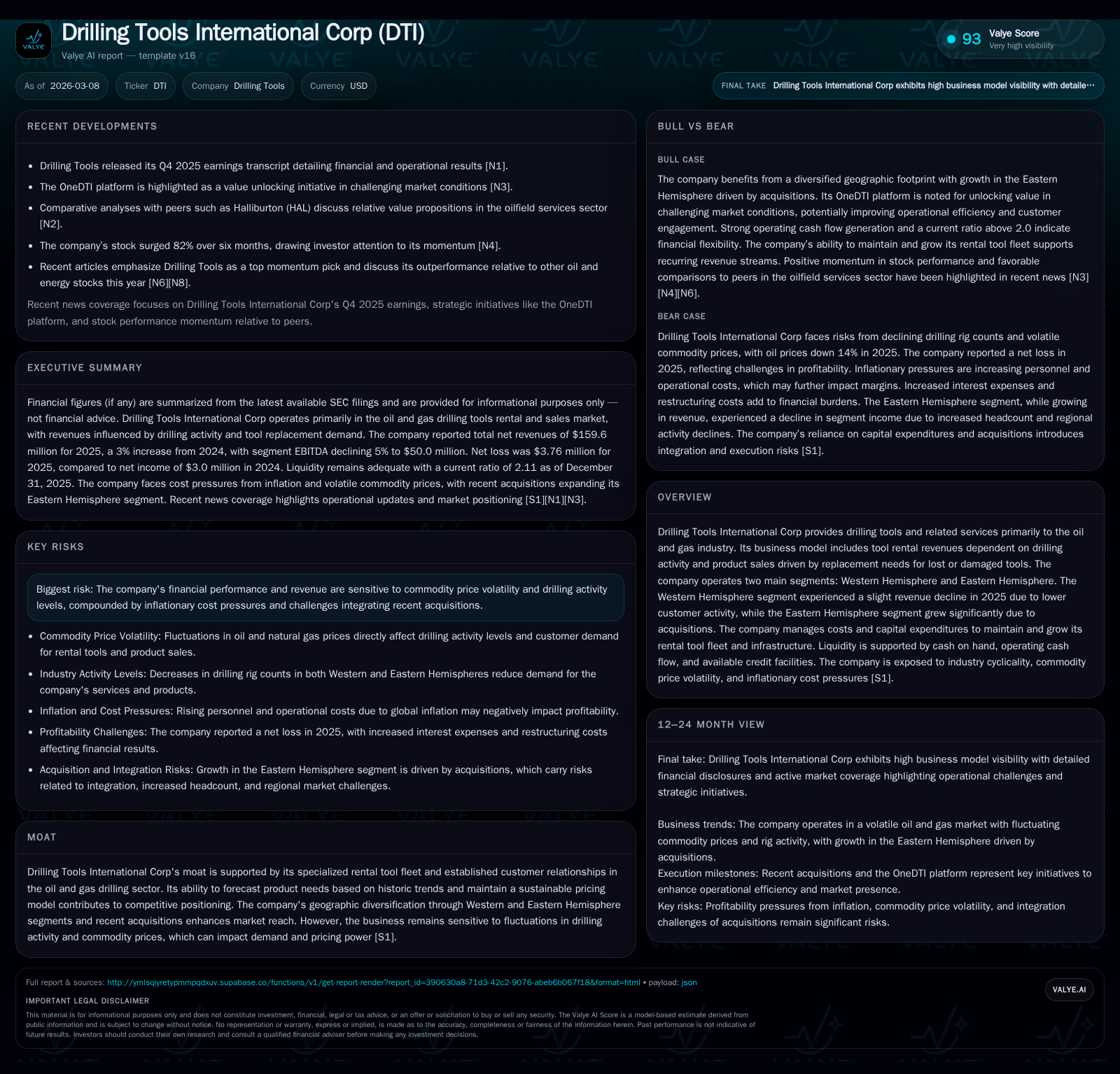
DTI experienced strong operating cash flow growth of 229% in 2025 despite a net loss driven by margin compression and integration costs. Its revenue base remains heavily weighted toward tool rentals, which accounted for over 80% of sales. Geographic segmentation reveals Western Hemisphere revenues slightly declined due to reduced drilling activity, while Eastern Hemisphere revenues grew substantially through recent acquisitions. The company maintains liquidity with drawn credit facilities and prudent capital allocation amid ongoing macro risks including commodity price volatility and inflation.
Historical Growth Patterns and Revenue Drivers Reflecting Geographic Dynamics
Drilling Tools International Corp's revenues have exhibited a nuanced trajectory shaped by both geographic dynamics and business model segmentation. For FY2025, total revenues stood broadly flat relative to prior years but reflected compositional changes tied to tool rental versus product sales mix as well as regional disparities [F1][S1][S4]. Notably, tool rentals generated approximately 81% of revenue in FY2025, underscoring DTI’s rent-centric business model reliant on the cyclical nature of drilling activity [S1]. Product sales composed the remainder and are primarily driven by replacement demand arising from lost or damaged tools during drilling operations.
Segmentally, Western Hemisphere revenues experienced a slight decline compared with previous periods due largely to an approximate 8% reduction in active drilling rigs – a key market driver – reflective of broader North American activity softness [S1][S4]. Conversely, the Eastern Hemisphere segment grew significantly, fueled in part by strategic acquisitions expanding both geographic breadth and product offerings [S1][S7]. This contrast highlights the company's operational pivot toward global diversification as offset against domestic sluggishness.
Historical performance (annual)
| FY | Net ($mm) | CFO ($mm) | OpInc ($mm) | Capex ($mm) | Net YoY |
|---|---|---|---|---|---|
| 2025 | -4 | 20 | 20 | -224.8% | |
| 2024 | 3 | 6 | 13 | 23 | -79.6% |
| 2023 | 15 | 23 | 28 | 44 | +1352.0% |
| 2022 | 1 | -2 | -1 |
Source: SEC companyfacts cache [F1].
Capital returns and efficiency (annual)
| FY | FCF ($mm) | ROE% |
|---|---|---|
| 2025 | 0 | -3.1 |
| 2024 | -17 | 2.5 |
| 2023 | -20 | 16.6 |
| 2022 | -51.6 |
Source: SEC companyfacts cache [F1].
Note: The table merges available financial data from fiscal years per [F1] with supplementary contextual information from [S1], illustrating trends without extrapolation where data is missing.
Dissecting Profitability: Operating Income Declines Despite Revenue Stability
Despite stable top-line trends into fiscal year-end 2025, DTI confronted marked pressure on profitability metrics. Operating income plunged about half compared to 2024’s base levels [F1], reflecting escalating costs linked to inflationary input prices and expenses associated with acquisition integration efforts highlighted by management [N1][S1]. This contraction coincided with diminished operating leverage typical when a rental fleet's utilization does not fully absorb fixed overheads.
The net income margin swung negative amid these headwinds producing an estimated -3.1% ROE based on FY2025 net losses against closing equity balance [F1]. Contributing factors included higher depreciation following asset additions from acquisitions and rising interest expense related to incremental debt drawing under the credit facility [S15][N1]. Such expense pressure reflects tension between growth investments and near-term earnings volatility common in oilfield services during cyclical downturns.
Management commentary underscored difficulty maintaining pricing power despite repair of some demand slip as operators remained cost cautious given oil price softness [N1]. Overall cost escalation manifested notably within corporate overheads and transaction expenses tied to newly acquired entities.
Acquisition Impact on Segment Performance and Market Reach
DTI’s strategic acquisitions have materially influenced segmental revenue composition with notable impact on the Eastern Hemisphere’s expansion trajectory [S1][S7][S24]. These transactions provided entry into new geographies and technology niches such as polycrystalline diamond compact drill bits production after acquiring Superior Drilling Products Inc., enriching the service catalogue for drilling optimization [S24].
However, such cross-border expansion introduced operational complexities including foreign currency translation risk amid increasing non-U.S. dollar denominated revenues and liabilities [S7][S8]. Notably, DTI holds a Euro-denominated unsecured promissory note linked to one acquisition bearing FX sensitivity impacting reported earnings due to exchange rate fluctuations [S15].
Employee headcount increases post-acquisitions elevated fixed cost bases principally within emerging markets like the Middle East where end-market activity waned slightly impacting segment income margins despite revenue gains [N1][S26]. Client concentration risk remains material with two customers accounting for over a quarter of consolidated revenues unchanged post-acquisition but geographic risk profile evolving.
Capital Allocation Discipline: Balancing Capex with Increasing Cash Flow
The juxtaposition of rising operating cash flow (+229%) contrasted against a moderate reduction in capital expenditure (-12%) evidences DTI’s pragmatic approach to capital deployment amidst volatile conditions [F1][S20]. Focused primarily on maintaining and strategically growing its rental tool fleet — the backbone of recurring revenue streams — the capex program emphasizes tool refurbishment cycles and selective expansion rather than aggressive fleet scaling.
This aligns with sector practice prioritizing "rental tool fleet utilization" optimization including "tool recovery" efforts where timely retrieval or replacement mitigates asset write-offs typical in bottom hole assemblies campaigns [S20]. Computer hardware/software investments supporting operational efficiencies also feature modestly but distinctly from core tooling expenditure lines.
Such capital efficiency is critical given prevailing inflation dynamics and constrained borrowing capacity even against ample liquidity headroom provided by revolving credit facilities. The calibrated capex posture supports sustaining operational cadence without excess leverage build-up.
Liquidity and Debt Structure: Navigating Credit Facilities and Financial Flexibility
DTI maintains robust liquidity buffers facilitated by cash reserves (~$3.65 million), substantial working capital evidenced by a current ratio approximating 2.11x at FY-end [F1][S25], complemented by an $80 million revolving credit facility expiring in March 2029 and a term loan balance totaling $16.7 million drawn at year-end [S6][S15]. Total drawn debt including outstanding promissory notes stood close to $41.7 million.
Annual principal prepayments up to $5 million based on excess cash flow initiated FY2024 align debt service schedules prudently with operating cash generation capacity securing covenant compliance while preserving investment flexibility [S6]. Interest expense uptick mainly owes to SOFR-linked margins on these instruments.
The credit facility is fully collateralized by company assets reducing lender risk though contingent interest derivative bifurcation accounting illustrates embedded covenant complexity reflecting varying default rates sensitive to operating disruptions [S15]. Overall funding architecture appears sound balancing growth capital needs against financial discipline.
External Risks: Commodity Prices, Drilling Activity, and Inflationary Pressures
Macro-environmental factors represent fundamental constraints on Drilling Tools International’s operational outlook. West Texas Intermediate crude prices retreated approximately 14% year-over-year in calendar year 2025 while natural gas prices conversely rose around 61%, injecting volatility into customer drilling budgets affecting tool rental usage patterns most directly tied to rig deployment levels [S1].
Industry data reflect ~7-8% declines in active rigs across core operating hemispheres amplifying cyclicality risks inherent in rental tool demand swings tied directly to bottom hole assembly usage intensity prescribed per drilling campaign specifics [S1]. Rising inflation compounds margin squeeze pressures via increased consumables costs and labor rates challenging pricing resilience particularly as operators exert procurement caution.
The absence of hedging strategies against forex risk further exposes earnings variability given expanding international presence raising exposure beyond USD/CAD dominated transactions noted historically [S8]. Customer concentration also remains material; reliance on two customers for over a quarter of revenue could imperil stability should spending priorities shift abruptly.
Looking Forward: Market Metrics to Track for DTI’s Performance Outlook
Absent explicit forward guidance from management as per recent disclosures [N1], assessing DTI’s prospects necessitates vigilant monitoring of several key indicators rooted firmly in oilfield services market fundamentals:
- Rig counts across Western and Eastern Hemispheres as leading proxies for equipment utilization demand,
- Sustained stabilization or recovery in WTI prices affecting exploration/appraisal capital allocation,
- Successful integration track record of recent acquisitions demonstrating synergy realization without disproportionate cost drag,
- Rental pricing trends signaling capacity for passing inflation through without volume erosion,
- Free cash flow trajectory moving toward positive territory after near-breakeven performance last reported,
- Technology adoption rates for niche products enhancing competitive positioning especially internationally.
Close observation of these data points combined with continual scrutiny of macroeconomic variables will frame clarity around whether the recent rebound in operating cash flows translates into durable margin improvement sustaining shareholder value creation potential going forward.
This analysis is based solely on publicly available data compiled from company filings ([F1], [S#]) and recent news transcripts ([N#]). It does not constitute investment advice or recommendations but aims to provide detailed insight into Drilling Tools International Corp's financial performance and industry context as of early FY2026.
Disclaimer: This is research-only, informational analysis and not investment advice. It may include AI-generated interpretation and general industry context. Always verify important details using primary sources.

Comments