
GT Biopharma Advances NK Cell Engagers While Facing Financial Strain and Regulatory Hurdles
The clinical-stage biotech leverages its proprietary TriKE® platform for immuno-oncology but contends with mounting losses and Nasdaq compliance risks.
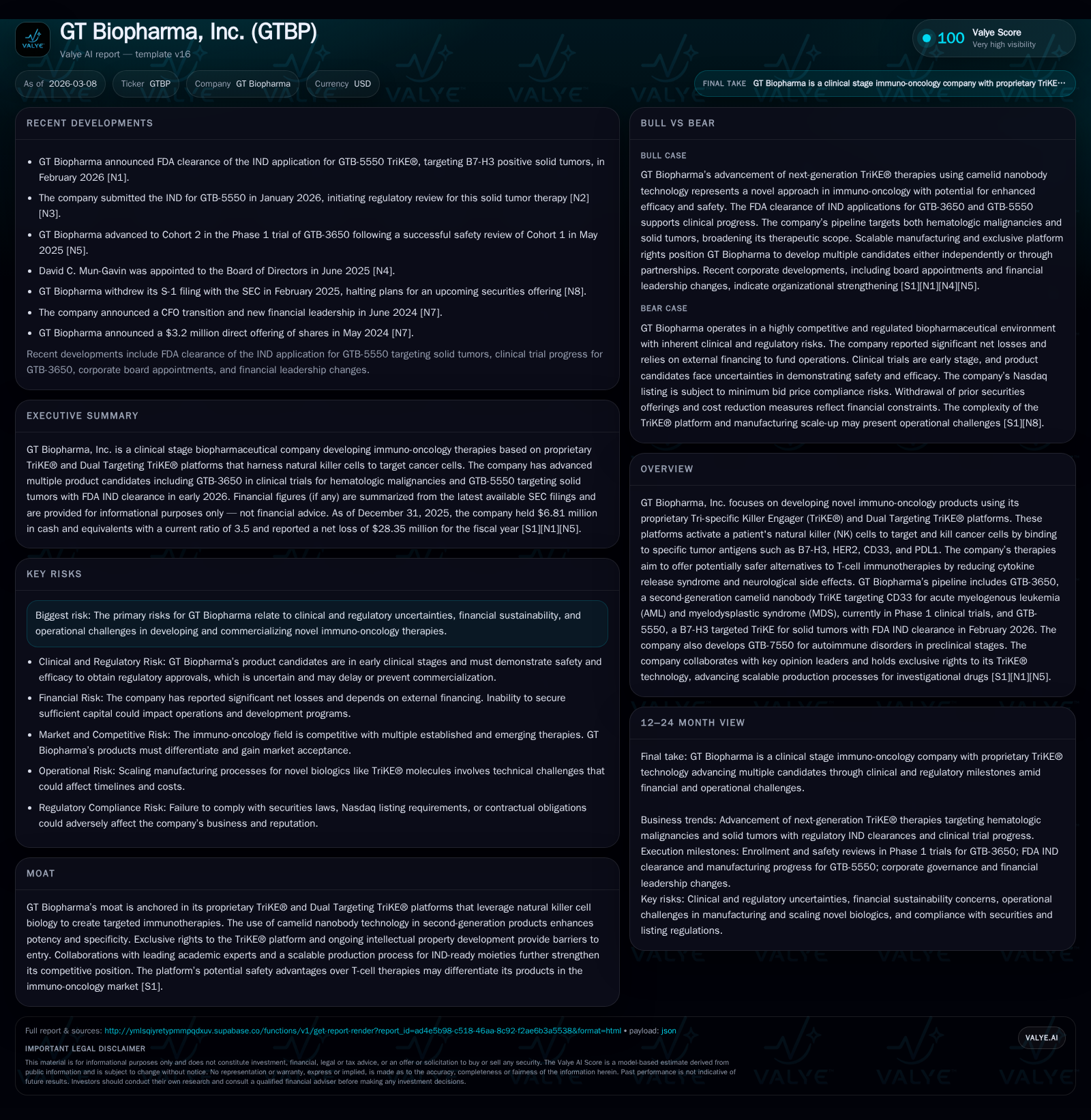
GT Biopharma, Inc. focuses on developing novel natural killer cell engager therapies using its TriKE® platform, aiming to address hematologic malignancies and solid tumors with potentially safer immunotherapy profiles. Despite promising pipeline progress including FDA clearance of GTB-5550 in early 2026, the company remains pre-revenue, reporting growing net losses and operating cash flow deficits, with a recent restatement related to financial liabilities. Nasdaq has issued a compliance notice due to GTBP's sub-$1 share price, highlighting capital market challenges ahead. Key upcoming milestones revolve around clinical trial progress and regulatory submissions which will be critical to watch for future valuation inflection.
Company Overview
GT Biopharma, Inc. (NASDAQ: GTBP), a clinical-stage biopharmaceutical company, is pioneering immuno-oncology therapeutics centered on its proprietary Tri-specific Killer Engager (TriKE®) and Dual Targeting TriKE® platforms [S1]. These platforms harness natural killer (NK) cells' innate ability to target malignant cells by bridging NK cells via high-affinity camelid nanobody moieties to tumor antigens such as B7-H3, HER2, CD33, and PDL1 while incorporating IL-15 stimulation to enhance NK cell proliferation and activation.
Uniquely, GT Biopharma designs these fusion proteins to be off-the-shelf therapies that bypass the need for patient-specific modification typical of cell therapies like CAR-T. This approach theoretically mitigates major adverse events common in T-cell therapies (e.g., cytokine release syndrome and neurological side effects) by preferentially activating NK cells over endogenous T cells [S1]. Such safety advantages could differentiate GTBP’s product candidates if approved.
Historical Performance and Financials
To date, GT Biopharma remains pre-revenue as it focuses on advancing its pipeline through early clinical development stages [F1]. The company’s financial results reflect sustained R&D expenditure leading to consistent operating losses:
Historical performance (annual)
| FY | Net ($mm) | CFO ($mm) | OpInc ($mm) | Net YoY |
|---|---|---|---|---|
| 2025 | -28 | -13 | -12 | -115.4% |
| 2024 | -13 | -13 | -14 | -73.3% |
| 2023 | -8 | -9 | -14 | +63.6% |
| 2022 | -21 | -15 | -21 |
Source: SEC companyfacts cache [F1].
Capital returns and efficiency (annual)
| FY | ROE% |
|---|---|
| 2025 | -490.0 |
| 2024 | 788.1 |
| 2023 | -101.6 |
| 2022 | -178.0 |
Source: SEC companyfacts cache [F1].
Operating income improved by approximately 13.5% from 2024 to 2025 due to tighter cost control despite no revenue generation [F1]. However, net loss expanded sharply—more than doubling—largely driven by accounting adjustments related to the classification and fair value changes of convertible preferred stock rights known as Greenshoe Rights [S12][S14][S15]. These non-cash charges significantly impact GAAP net income but do not affect ongoing operations or cash flows directly.
Operating cash flow remains persistently negative near $13 million annually as expected at this stage of clinical advancement. Capital expenditures are minimal historically since the focus is on outsourced R&D [F1]. Equity declined into negative territory in fiscal year 2024 but rebounded modestly by year's end in 2025 following financings or valuation adjustments.
The ratio of net loss relative to a small equity base results in an approximate negative return on equity near -490% in FY2025 based on reported net loss over equity [F1]. This underscores the financing challenges faced during costly drug development prior to commercialization.
Pipeline and Development Progress
GT Biopharma’s product pipeline centers on its TriKE® technology:
- GTB-3650: A second-generation camelid nanobody-based TriKE targeting CD33 antigen for acute myelogenous leukemia (AML) and myelodysplastic syndrome (MDS), currently in Phase 1 clinical trials [S1].
- GTB-5550: B7-H3 targeted TriKE designed for solid tumors with FDA Investigational New Drug (IND) application clearance obtained in February 2026 [N1][S1].
- GTB-7550: Candidate aimed at autoimmune disorders currently in preclinical stage [S1].
The FDA clearance of GTB-5550 IND marks an important regulatory milestone indicating readiness for clinical enrollment in solid tumor indications [N1]. The modular design of the TriKE platform enables rapid generation of candidates targeting various tumor antigens without patient-specific customization—a key scalability advantage.
Preclinical data indicate selective NK cell activation mediated through CD16 engagement paired with IL-15 stimulation without significant T-cell activation—a potential safety advantage over CAR-T or bispecific T-cell engagers which often face dose-limiting toxicities such as cytokine release syndrome [S1].
Nonetheless substantial uncertainty remains around efficacy or tolerability outcomes from ongoing Phase 1/2 trials that will guide further development decisions.
Regulatory Milestones & Clinical Expectations
The formal FDA IND clearance for GTB-5550 provides a near-term catalyst signaling advancement toward patient dosing in solid tumors [N1]. Ongoing Phase 1 studies with GTB-3650 also merit close attention for safety and preliminary efficacy signals.
While no formal timeline guidance beyond IND clearance has been disclosed publicly [S1], the company intends to pursue monotherapy and combination therapy trials alongside standard oncology treatments. Such development programs typically span multiple years given regulatory review processes.
Investors should monitor upcoming data readouts closely as pivotal inflection points validating the platform’s therapeutic promise or necessitating strategic pivots.
Capital Structure and Liquidity Position
As of December 31, 2025 the company reported approximately $6.8 million in cash and equivalents against current liabilities of about $2.3 million resulting in a current ratio near 3.5x indicative of short-term liquidity sufficiency [F1]. However recurring annual operating cash burn exceeding $12 million absent revenue inflows highlights ongoing capital needs.
Key financial statement volatility stems from convertible preferred stock instruments featuring Greenshoe Rights which required initial liability classification under ASC Topic 480 due to redemption features triggered by certain events outside management control [S14][S17]. Subsequent waivers led to reclassification back into equity beginning late Q3 2025 with related restatements impacting reported earnings but not underlying cash flows.
Nasdaq notified GT Biopharma of non-compliance with minimum bid price rules after shares closed below $1 for over thirty consecutive trading days as of November 20th, 2025 [S19][S21]. The company faces a compliance deadline of May 19th, 2026 before potential delisting or corrective actions such as reverse stock splits become necessary—events that may adversely affect liquidity or investor perception.
Legal Challenges and Risks
The company disclosed arbitration proceedings against former CFO Manu Ohri alleging breaches of fiduciary duty alongside counterclaims delaying final resolution beyond scheduled mediation attempts in mid-2026 [S1]. Such legal matters can divert management focus despite current accruals for potential losses.
Additional litigation concerns involve claims regarding convertible note conversions tied to delayed share issuances invoking liquidated damages though motions to dismiss suggest some defensive progress [S1]. These disputes represent additional operational risks amid typical biotech execution uncertainties.
From a regulatory standpoint no material changes were noted aside from ongoing securities law compliance burdens and governance complexities highlighted in filings [S2][S4].
Sector Context Analysis
Natural killer cell engagers like those advanced by GT Biopharma occupy a distinct niche within immuno-oncology separate from CAR-T therapies or monoclonal antibodies. NK cell biology offers therapeutic appeal due to innate immune functions coupled with reduced severe adverse events commonly seen in T-cell focused modalities. However no TriKE products have yet gained approval making clinical proof-of-concept crucial.
Platform scalability without patient-specific manufacturing addresses cost hurdles associated with personalized cell therapies competing particularly in hematologic malignancies such as AML where treatment options remain limited especially among elderly patients. The use of camelid nanobodies aligns with biotech trends favoring compact binding domains enhancing tissue penetration .
Still translating durable single-agent efficacy clinically across heterogeneous tumor microenvironments remains challenging with multiple immuno-oncology failures underscoring need for rigorous controlled trials .
What To Watch Next (Analysis)
Key near-term catalysts include:
- Safety/tolerability data from ongoing Phase 1 cohorts dosing GTB-3650.
- Enrollment progress updates for GTB-5550 following IND clearance.
- Potential licensing or collaboration deals leveraging platform versatility.
- Outcome of Nasdaq compliance efforts including possible corporate actions like reverse stock splits or capital raises.
- Resolution developments regarding legal disputes impacting governance or financial outlook.
Given absence of revenue guidance or commercialization timelines publicly disclosed yet [N#]/[S#], performance remains binary contingent on emerging clinical data validating novel mechanism utility while sustaining financing runway sufficiently long enough for transition into later-stage development.
Conclusion
GT Biopharma exemplifies an ambitious clinical-stage biotech seeking competitive differentiation through unique NK cell engager technology supporting next-generation immuno-oncology treatments that may offer safer alternatives versus existing T-cell focused approaches. Recent FDA clearance for a solid tumor candidate signals technological progress though significant financial losses highlight developmental investment demands amid complex capital structure considerations.
Capital sufficiency constraints driven by continued operating cash outflows absent revenues; Nasdaq listing risk triggered by sub-$1 share price; plus ongoing legal uncertainties require vigilant management oversight. Monitoring upcoming trial data will prove vital given early-stage pipeline status where success or setbacks materially influence viability narratives.
This overview reflects classic pre-commercial biotech dynamics balancing cutting-edge science against operational realities characteristic of translational medicine sectors.
Disclaimer: This analysis is based solely on public regulatory filings and news reports up to March 8th, 2026. It does not constitute investment advice or recommendations regarding any securities mentioned herein.
Disclaimer: This is research-only, informational analysis and not investment advice. It may include AI-generated interpretation and general industry context. Always verify important details using primary sources.

Comments