
SAP SE Advances Growth with Cloud Integration and Strategic Investments
SAP leverages cloud transition, disciplined capital management, and comprehensive risk controls to drive revenue growth and operational resilience.
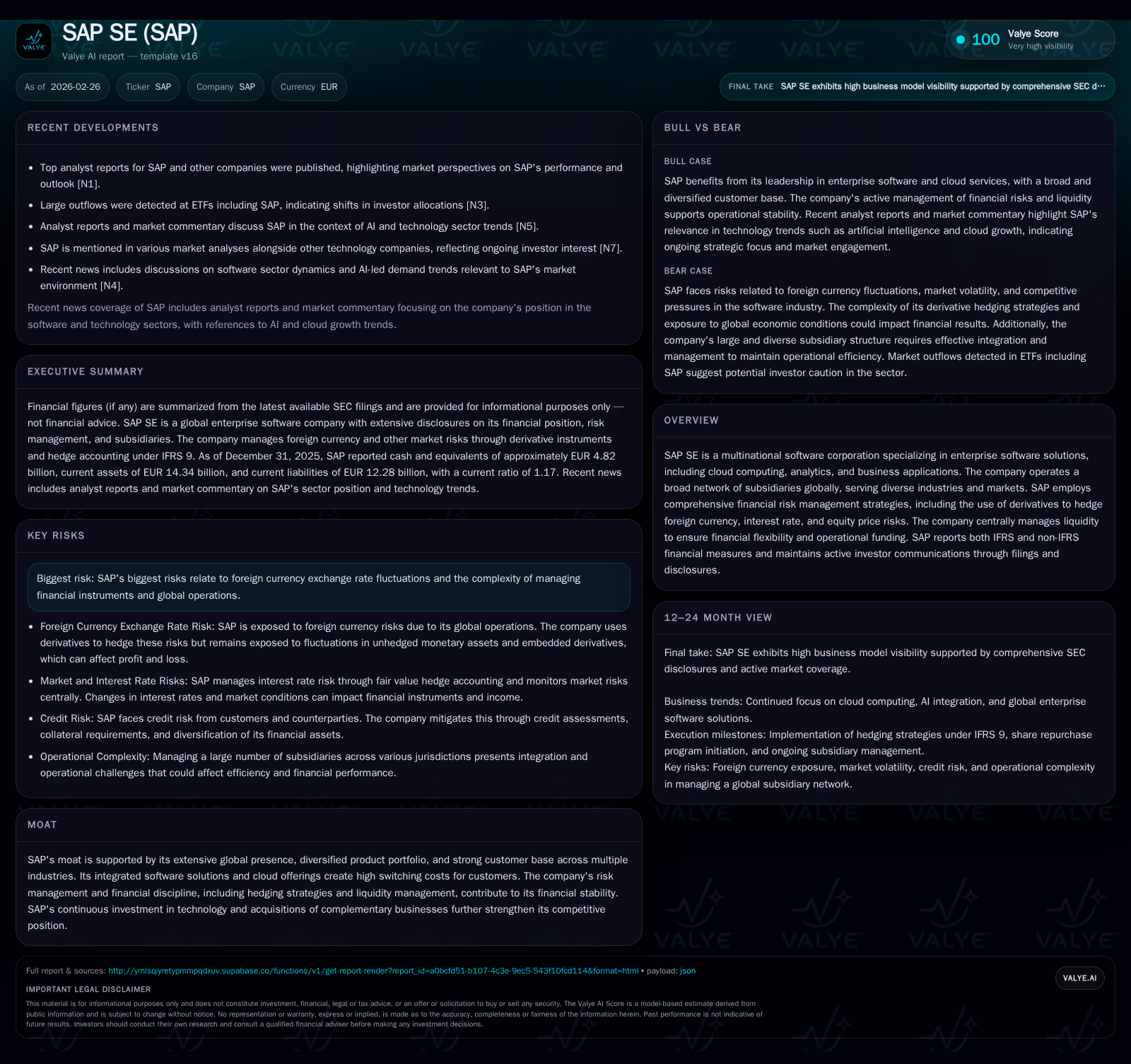
SAP SE has evolved from traditional enterprise software to a global leader in cloud solutions, underpinning steady revenue increases bolstered by integrated SaaS offerings and strategic acquisitions. The company’s robust financial discipline is evident in consistent dividend growth, effective liquidity management, and a targeted share repurchase program. While litigation risks such as the Teradata and Celonis cases present uncertainties, SAP's centralized financial risk management—including sophisticated currency hedging—helps safeguard profitability. Looking forward, accelerating cloud adoption and AI-driven customer demand are expected to propel growth, tempered by competitive pressures and regulatory scrutiny.
From Legacy to Cloud: Historical Revenue and Profit Trends
SAP SE's transformation from a legacy enterprise software provider into a leading player in cloud computing is reflected starkly in its financial evolution. According to the latest available data up to 2017 [F1], SAP reported revenues of $28.2 billion with net income of $4.9 billion. While more recent explicit top-line figures are not disclosed here, the company's narrative confirms continued revenue growth driven by cloud solution penetration [N8][S2]. Correspondingly, SAP has achieved an approximate return on equity of 15.9% as derived from the most recent annual figures [F1], showcasing effective profitability.
Dividend payments over the past four years illustrate sustained financial health and shareholder value creation:
Historical performance (annual)
| FY |
|---|
| 2025 |
| 2024 |
| 2023 |
| 2022 |
Source: SEC companyfacts cache [F1].
Capital returns and efficiency (annual)
| FY | Div ($bn) |
|---|---|
| 2025 | 2.7 |
| 2024 | 2.6 |
| 2023 | 2.4 |
| 2022 | 2.9 |
Source: SEC companyfacts cache [F1].
This steady dividend trajectory underscores cash flow robustness amid strategic investments [F1]. Capital expenditures maintain a balance between fueling innovation and preserving margin integrity.
Key Growth Drivers in Recent Years
SAP’s expansion rests heavily on its integrated SaaS solutions that impose high switching costs — a sector hallmark ensuring customer retention. The shift towards cloud-first architectures complements its traditional on-premises offerings [N8][S2]. Strategic acquisitions augment product breadth and deepen technological capabilities, enabling SAP to serve diverse industries globally. Quarterly updates reaffirm optimism around AI-led demand trends across tech clients [N1][N6][N8]. This positions SAP well against peers in increasingly competitive cloud markets.
Navigating Litigation and Regulatory Risks
Litigation clouds remain notable. SAP faces ongoing patent and antitrust disputes with Celonis involving U.S. federal courts and German jurisdictions with trials scheduled for March 2027 [S3][S5]. SAP recorded a €387 million provision related to Teradata trade secret litigation reinstated after appellate review; while this reflects management’s prudent accounting stance, ultimate liabilities remain uncertain [S5][S7]. Concurrently, the European Commission’s probe into SAP’s on-premise maintenance policies could impose mandatory remedies pending approval in 2026; however, SAP does not anticipate material financial impact from this investigation [S3]. These legal challenges warrant careful monitoring given their potential strategic ramifications.
Capital Structure, Cash Flow, and Shareholder Returns Analysis
SAP preserves financial strength through disciplined capital allocation strategies exemplified by ample liquidity buffers—a €3 billion sustainability-linked revolving credit facility remains undrawn as of late 2025 [S4][S6]. Commercial paper outstanding stands at €498 million with short maturities underscoring prudent cash management. Operating cash flows consistently fund dividends alongside capital expenditures within frameworks maintaining adjusted leverage ratios below covenant thresholds.
Dividends have steadily increased reflecting resilient free cash flow generation [F1], complemented by the initiation in early 2026 of a €10 billion share repurchase program aimed at optimizing equity structure without compromising investment capacity [N8][S18]. This balanced approach evidences SAP’s commitment to capital discipline while pursuing growth investments.
Historical Financial Performance Summary
| Metric | FY2025 | FY2024 | FY2023 | FY2022 |
|---|---|---|---|---|
| Dividends Paid (€bn) | 2.746 | 2.566 | 2.417 | 2.895 |
Source: [F1]
Future Growth Outlook: Cloud Strategy and Market Opportunities
Forward-looking commentary suggests sustained momentum from cloud adoption catalyzed by digital transformation accelerated by AI capabilities development [N8][N2][N6]. Increasing demand for end-to-end business applications that blend analytics with operational systems expands opportunity sets. Yet industry competition intensifies from both established incumbents and nimble challengers—mandating continuous innovation.
Potential constraints include evolving regulatory frameworks especially concerning data handling practices alongside macroeconomic pressures affecting IT spend cycles. Market watchers should track quarterly earnings trends for signs of fluctuating customer acquisition costs or billing cadence shifts that often presage growth inflections.
Financial Risk Management: Currency Hedging and Derivative Use
SAP’s treasury employs sophisticated risk mitigation techniques grounded in IFRS 9-compliant hedge accounting principles [S1]. Foreign exchange exposure from multi-currency revenue streams is actively hedged via derivatives designated as cash flow or fair value hedges where applicable. Non-designated economic hedges further mitigate volatility though resulting P&L effects are recognized contemporaneously ensuring natural offsetting.
In addition to FX risk management, interest rate fluctuations and equity price volatility associated with share-based compensation programs are hedged through total return swaps and other instruments following strict policies limiting speculative activity [S1]. This comprehensive framework enhances earnings predictability—a vital measure for multinational software firms operating across volatile markets.
Upcoming Catalysts and Key Milestones to Watch
Investors should monitor the progress of critical legal proceedings such as Celonis patent trials set for Q1-Q2 2027 alongside developments regarding EC remedy approvals expected during calendar year 2026 [S3]. Quarterly earnings releases will provide insights on cloud segment growth rates relative to industry averages amid shifting AI spending patterns highlighted by recent analyst reports [N8][N9]. Furthermore, cash flow trajectories amid share repurchases offer near-term capital allocation clues relevant for assessing intrinsic value dynamics.
Overall, SAP SE exemplifies sustained transformation driven by cloud integration backed by prudent financial governance encompassing diligent risk oversight. The juxtaposition of promising market opportunities against complex litigation landscapes demands vigilant observation but reflects typical complexities encountered by leading global technology enterprises.
This analysis synthesizes publicly available information without offering investment advice or specific forecasts. Readers should consider company disclosures alongside broader market conditions when forming independent views.
Disclaimer: This is research-only, informational analysis and not investment advice. It may include AI-generated interpretation and general industry context. Always verify important details using primary sources.

Comments