
Kilroy Realty Advances Its Development Pipeline as Capitalized Interest Declines
Q1 2026 results reveal subdued capitalized interest and evolving asset composition, highlighting development pacing and financing strategy shifts at Kilroy Realty.
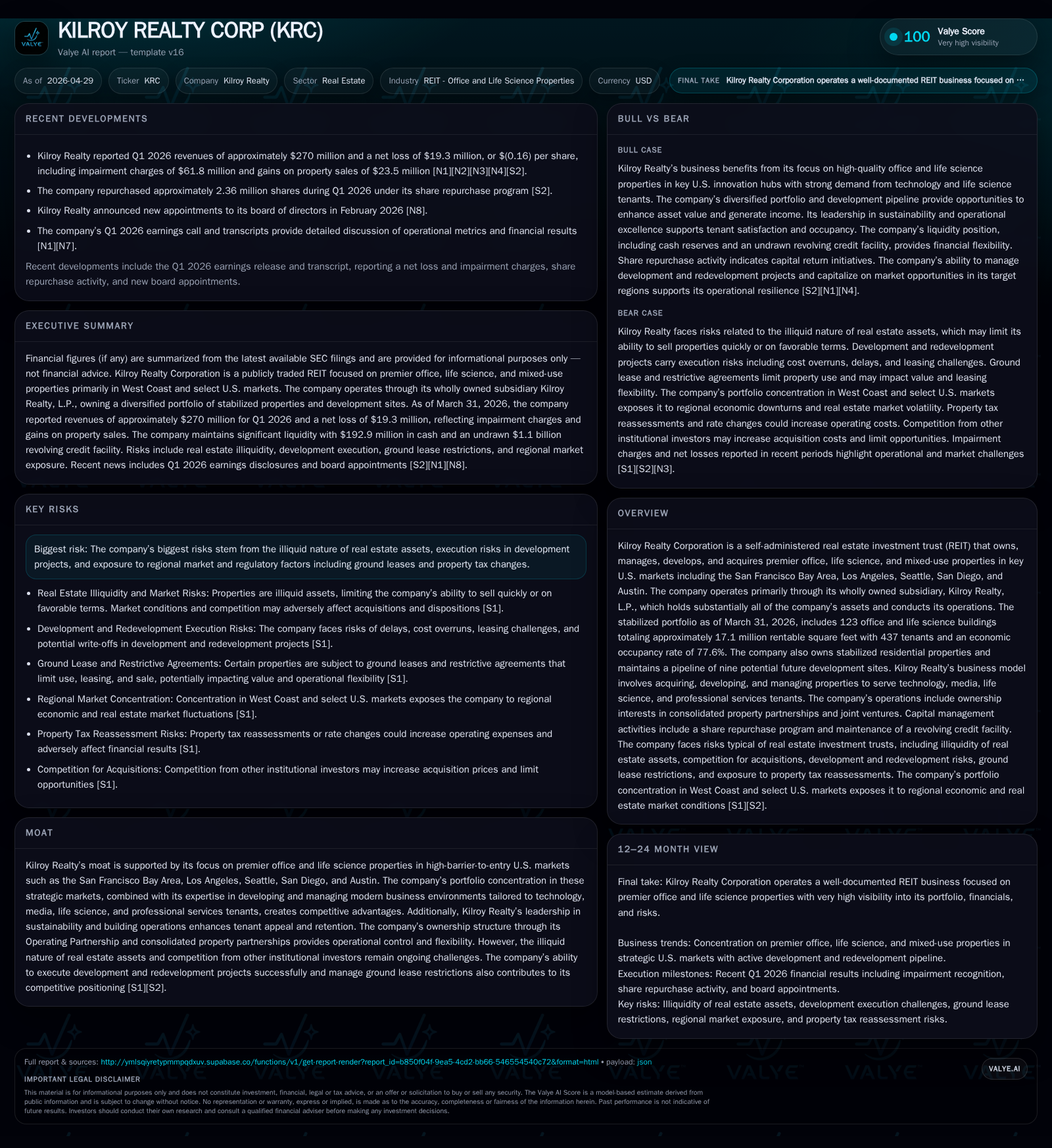
Kilroy Realty’s latest quarterly filing for Q1 2026 signals a notable decline in capitalized interest from prior year levels, suggesting a moderation or improved efficiency in its ongoing development projects. Concurrently, the company’s prepaid expenses and deferred financing costs contracted modestly, reflecting timing adjustments in project spend and steady amortization of financing fees. Kilroy’s business model is anchored in premier office and life science assets across high-barrier U.S. innovation hubs, with growth driven by a robust nine-site development pipeline and sustainability excellence that enhances tenant retention. The concentrated portfolio benefits from regional supply barriers but remains vulnerable to execution risk and regulatory exposures specific to California, Seattle, and Austin markets. Looking ahead, refinancing the $200 million term loan maturing in October 2026 will be a key liquidity milestone alongside leasing velocity and pipeline execution metrics.
Latest Quarterly Developments: Capitalized Interest and Asset Movements
Kilroy Realty’s Q1 2026 Form 10-Q reveals that gross interest expense remained stable at around $52.5 million compared to the prior year period ($51.7 million), but capitalized interest—a critical measure of how much borrowing cost is allocated to active development projects—declined materially from $20.5 million in Q1 2025 to approximately $14.0 million this quarter [S2]. This reduction suggests either a slowdown or improved capital discipline in the pace of development/redevelopment expenditures capitalized onto land and construction-in-progress.
Simultaneously, total prepaid expenses and other assets net declined modestly to $52.3 million from $54.6 million at year-end 2025 [S2]. Notably, furniture, fixtures and other long-lived assets decreased by about 9%, prepaid expenses contracted nearly 25%, while deferred financing costs saw steady amortization from $9.15 million to $8.26 million over the quarter.
These asset shifts collectively reflect evolving project timelines—fewer new upfront expenditures—and ongoing finance cost amortization consistent with debt management through steady repayment or refinancing cycles [S2]. The company’s ability to capitalize less interest while maintaining development momentum could indicate improved project cost controls or adjustments in construction sequencing aligned with market absorption.
Kilroy Realty's Business Model and Product Differentiation
Kilroy Realty Corporation operates as a self-administered REIT specializing predominantly in premier office, life science, and mixed-use properties strategically located within innovation-centric U.S. metros: San Francisco Bay Area, Los Angeles, Seattle, San Diego, and increasingly Austin [S1]. The firm’s wholly owned subsidiary Kilroy Realty L.P. holds nearly all operating assets totaling about 17.1 million rentable square feet spread across 123 stabilized buildings housing an economic occupancy rate near 77.6% with more than four hundred tenants.
The company’s business model generates revenue primarily through leasing high-quality commercial real estate spaces tailored to technology media telecommunications (TMT), life sciences R&D facilities, professional services firms, and mixed-use tenants requiring built-to-suit environments optimized for innovation-driven workflows [S1]. This focus lends itself to higher rent premiums supported by strong tenant credit profiles relative to generic office landlords.
Operational control exercised via their self-administration approach enables tighter oversight of leasing strategies, property management efficiencies, and sustainability initiatives—a growing tenant retention lever given rising environmental regulation expectations. The integration of premier amenities with environmentally conscious building systems bolsters the company’s differentiation amid rising demand for ESG-aligned workspaces.
Competitive Positioning within Core High-Barrier Innovation Markets
Kilroy Realty resides within a competitive landscape populated by institutional REITs specialized in coastal gateway markets known for steep barriers-to-entry such as limited developable land coupled with robust local economies anchored by tech hubs [S1]. Their geographic footprint centers on California’s highly regulated submarkets (Los Angeles metro area including San Diego county plus the Silicon Valley corridor) alongside Seattle’s burgeoning tech clusters and rapidly expanding Austin market.
These regions benefit from constrained new supply due to zoning rules, environmental approval processes, seismic risk considerations (notably earthquake zones), and community resistance to large-scale commercial projects—all limiting oversupply risk but amplifying acquisition premiums [S1]. Consequently, Kilroy enjoys enhanced pricing power reflective of scarcity dynamics while also grappling with elevated operating costs tied to local taxes and compliance.
Tenant switching costs augment their structural advantage because technology firms place increasing value on office spaces that integrate sustainable design features combined with proximity to labor pools specialized in engineering/science disciplines—features Kilroy emphasizes through consistent reinvestment into building upgrades. This supports moderately sticky occupancy even if cyclical slowdowns challenge broader office demand.
Growth Drivers: Development Pipeline and Sustainability Leadership
Kilroy's near-term growth story leans heavily on advancing its portfolio via a pipeline comprising nine identified future development sites primed for office/life science expansions [S2]. Successfully executing these projects will incrementally raise rentable square footage beyond the current stabilized footprint while seeking sustained occupancy improvements above the current sub-80% economic occupancy.
The decline in capitalized interest expense reported suggests more measured capital deployment or potentially completion phases shifting from heavy construction spend toward lease-up stages—each influencing near-term margin trends positively compared with earlier heavy investment periods [S2]. Efficiency gains during development reduce carrying costs captured through capitalized interest line items.
Moreover, rigorous sustainability programs—encompassing energy efficient systems integration along with green certification pursuits—differentiate Kilroy’s assets by mitigating vacancy risk within tenant cohorts placing premium value on ESG credentials. Such credentials align well with the company's target industries where corporate mandates increasingly require carbon footprint reductions and facility resiliency strategies.
Risks and Constraints: Execution, Market Concentration, and Regulatory Exposures
Despite strategic advantages, Kilroy faces multi-layered risks characteristic of a specialized REIT operating in volatile innovation hubs. First is real estate illiquidity—the timeframes needed to sell or reposition large commercial assets can stretch multiple quarters or years depending on macroeconomic demand shifts or valuation changes triggered by rising capitalization rates linked tightly to current interest rate trajectories [S1].
Execution risks dominate as well given heightened construction inflation pressures described in the annual filing—rising materials/labor costs could compress expected yields or shrink profit margins on under-construction projects if not carefully managed [S1]. In addition, delays influenced by permitting or supply chain disruptions would exacerbate carrying costs including non-capitalizable expenses.
Kilroy’s concentration solely within California (notably Los Angeles/San Diego/Silicon Valley), Seattle metro area, and Austin introduces regulatory vulnerability tied to each locale’s tax policies (i.e., ground leases/property tax increases) as well as localized natural disaster exposure such as earthquakes or drought-driven water restrictions [S1]. While earthquake insurance coverage exists at commercially reasonable levels per management commentary, catastrophic events could yield losses exceeding coverage limits impacting operational expense volatility.
Lastly repeated mentions across filings underscore near-term refinancing risk surrounding their $200 million Term Loan Facility maturing October 2026 with an adjustable interest rate just under 5% currently plus an accordion feature allowing additional borrowing capacity subject to lender approval [S2]. Successfully executing this refinancing will be critical for maintaining financial flexibility amid tight credit markets.
Key Upcoming Milestones and Guidance Signals
Investors should monitor several pivotal points shaping Kilroy's trajectory over the next two quarters:
- The maturity timeline for the October 2026 term loan facility mandates proactive refinancing efforts; available "accordion" provisions permit incremental borrowings up to $130 million but require external commitments reflecting lender confidence [S2].
- Leasing velocity progress reported during earnings calls informs occupancy trends which currently linger below optimal levels (~77%)—accelerated renewal activity or new tenant additions would signal stronger market acceptance [N1].
- Execution updates on the nine future development sites including permitting status completions will impact when additional rentable square footage boosts top-line growth potential [S2][N1].
- Any directional guidance revisions disclosed during earnings reportage should be weighted carefully against broader regional demand conditions given concentrated market exposure [N2][N5].
Summary Financial Profile Reflecting Liquidity and Leverage
As of March 31, 2026, Kilroy held cash and equivalents of approximately $193 million, providing liquidity to address near-term obligations including the $200 million term loan due in October 2026 [F1][S2]. The term loan carries an interest rate just under 5% and includes an accordion feature allowing for additional borrowings subject to lender approval [S2]. Interest expense net of capitalized amounts rose year-over-year, reflecting changes in borrowing costs and capital deployment [S2]. Deferred financing costs amortized steadily during the quarter, consistent with ongoing balance sheet management [S2].
This analysis is based entirely on publicly available SEC filings as of April 28th/29th, 2026 including recent quarterly Form 10-Q disclosures supplemented by earnings call transcripts without extending into investment recommendations.
Disclaimer: This is research-only, informational analysis and not investment advice. It may include AI-generated interpretation and general industry context. Always verify important details using primary sources.

Comments