
Sensata Technologies Advances Profitability with Strategic Divestitures and Organic Growth in Aerospace Segment
Q1 2026 results reveal margin expansion driven by operational efficiencies and targeted portfolio realignment.
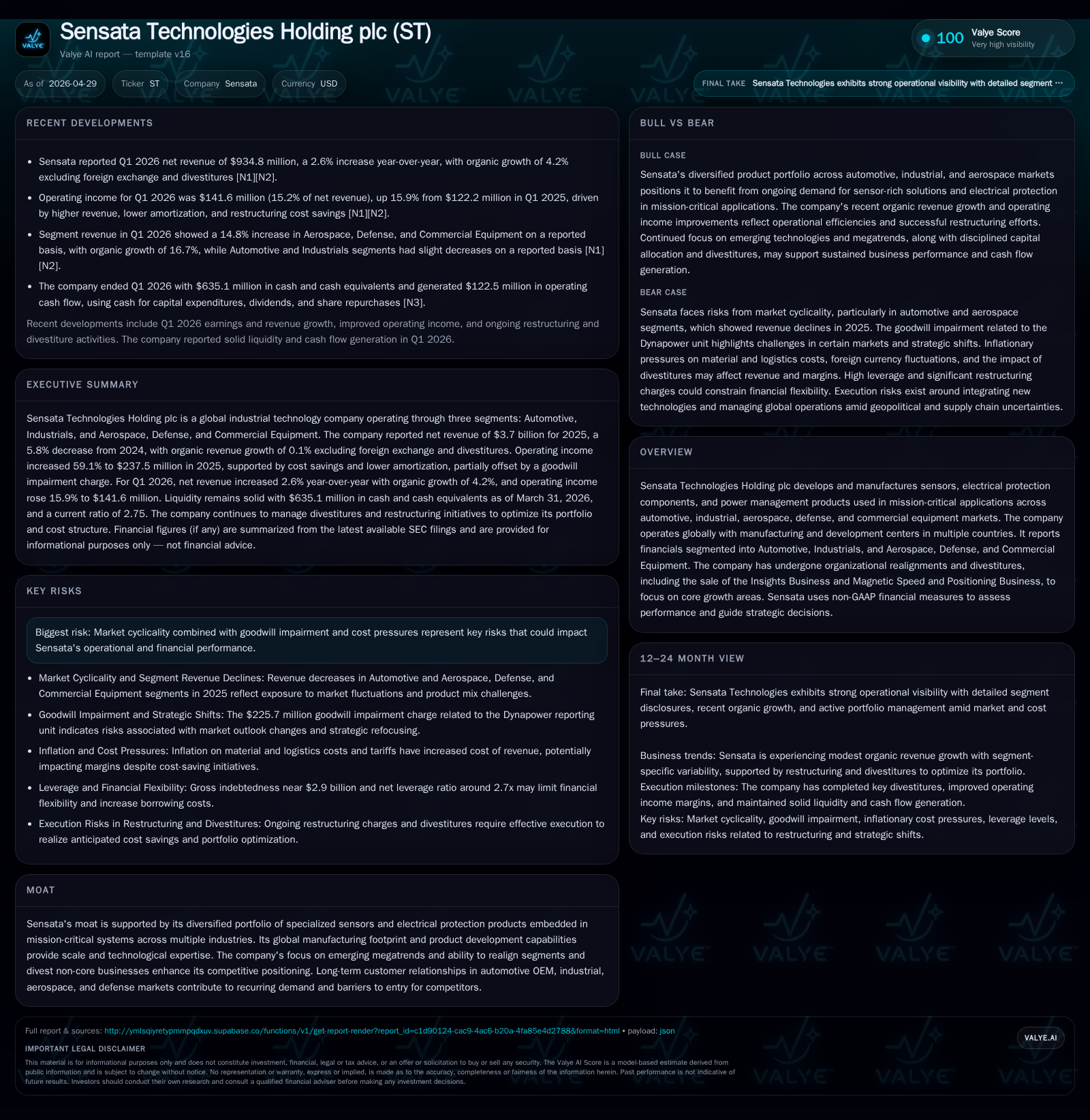
Sensata Technologies Holding plc reported a resilient start to 2026 with a 2.6% revenue increase driven by strong aerospace segment performance offsetting marginal declines in automotive and industrial end markets. Adjusted operating income grew 15.9% year-over-year, reflecting disciplined cost management and the benefits of recent divestitures including the Magnetic Speed and Positioning business. With a streamlined focus on core markets such as automotive, industrials, and aerospace/defense, Sensata is positioning for sustained growth supported by technological expertise and global manufacturing scale amid ongoing industry cyclicality. Key risks include demand softness in certain markets and goodwill impairment pressures. Cash flow generation remains robust, underpinning capital returns and investment capabilities.
Recent Operating Update
Sensata Technologies Holding plc's latest quarterly filing for Q1 ended March 31, 2026 ([S2]) presents a clear picture of operational progress highlighted by both top-line growth and margin improvement compared to the prior-year period. Reported net revenue increased by 2.6% year-over-year to approximately $934.8 million, driven predominantly by organic growth of 4.2% when adjusting for currency exchange rates (+2.2%) and the negative impact of divesting the Magnetic Speed & Positioning business (-3.8%).
Operating income rose meaningfully by 15.9% to $141.6 million, lifting the operating margin from 13.4% in Q1 2025 to 15.2%. This gain reflects management’s focus on cost efficiency as well as the strategic shedding of lower-margin or non-core units such as Insights Business in prior periods ([S1]). Net income also expanded from $69.9 million to $87.1 million at a margin of 9.3% versus 7.7% previously.
Segment-wise breakdown reveals diverging trends: Automotive revenues contracted marginally (-0.8%), though organic uplift was a modest +0.7%, reflecting product mix shifts within OEM partnerships supported by foreign exchange tailwinds (+2.5%). The Industrials segment experienced similar dynamics with a flat reported revenue but roughly +0.7% organic growth aligned with content expansion in its served markets.
In contrast, Aerospace, Defense, and Commercial Equipment segment posted robust momentum with a reported +14.8% revenue rise boosted by an organic increase of +16.7%. Continued strength in commercial equipment alongside aerospace verticals evidences successful portfolio realignments focused on mission-critical sensing technologies ([S2]).
Capital deployment included $17.5 million dividends paid and $25.1 million spent repurchasing shares under an active buyback plan, supported by strong operating cash flow generation exceeding $122 million during the quarter.
Business Model Overview
Sensata Technologies predominantly generates revenue through the design, manufacturing, and sale of sensors, electrical protection devices, and power management systems that are embedded in critical applications across automotive OEMs, industrial machinery producers, aerospace platforms, defense contractors, and commercial equipment manufacturers ([S1], [S2]).
Revenue streams are largely volume- and mix-driven; automotive sensor integration depends heavily on new vehicle production cycles and evolving requirements around electrification and autonomous vehicle safety features, while industrial end-markets revolve around content growth via automation upgrades and regulatory-driven controls enhancements. Aerospace customers require high-reliability performance components often certified to stringent standards which create significant switching costs.
The company’s approach includes active portfolio management: divesting businesses outside its strategic core (e.g., Insights Business sold in Q3 2024; Magnetic Speed & Positioning business divested in Q1 2025) reduces complexity while reallocating resources towards higher-growth offerings that align with electrification trends and industrial automation demand ([S1], [S2]).
Margins benefit from Sensata’s ability to leverage scale manufacturing footprint across multiple geographies (including development centers) coupled with proprietary sensor technology platforms that underpin differentiation in competitive landscapes dominated by a few specialized suppliers.
Industry Structure and Competitive Position
Sensata operates within a fragmented yet technologically sophisticated market centered on sensing solutions tailored for harsh or mission-critical environments requiring precision and durability: automotive (powertrain controls, safety systems), industrial automation (process controls), aerospace/defense (navigation, power subsystems), among others.
Competitive dynamics favor incumbents with deep integration expertise, broad product portfolios covering multiple sensor modalities (pressure, temperature, speed), global supply chain networks ensuring just-in-time delivery aligned with OEM production schedules.
Sensata’s moat derives from:
- Long-standing relationships with top-tier OEMs enabling recurring demand tied to vehicle/platform lifecycles.
- Intellectual property protecting key technologies integrated into complex assembly lines.
- Scale economies facilitating cost control amid rising material prices.
- Customer-specific qualification processes that impose barriers to entry for new competitors.
Recent organizational realignments have sharpened Sensata’s sector focus allowing nimble responses to shifting customer needs particularly those spurred by megatrends such as EV adoption (electrification mandates), industry 4.0 automation imperatives, aerospace modernization programs targeting fuel efficiency gains ([S1], Valye report).
Growth Drivers
Sensata’s pathway to growth rests on several structural drivers:
- Electrification in automotive: Increasing penetration of electric vehicles boosts demand for specialized sensors managing battery systems, thermal regulation, power conversion efficiency.
- Industrial automation: Rising global investment in smart factories requires sensors embedded into robotic arms, predictive maintenance systems accelerating content per machine.
- Aerospace modernization: Growing air traffic combined with regulatory pressure for emissions reduction creates demand for lightweight sensor systems used in advanced components.
- Defense spending: Stable government budgets directed toward upgrading military avionics sustain long-term order backlog.
- Portfolio optimization: Proceeds from divestitures fund R&D enhancing sensor performance while expanding addressable markets via new product introductions ([S1], [S2], Valye report).
These drivers correlate directly with KPIs such as bookings growth in key segments (notably aerospace showing double-digit organic revenue gains), backlog stability post-divestitures indicating retained customer confidence, increasing content per unit shipped fostering better revenue mix.
Risks and Watchpoints
Key vulnerabilities include:
- Market cyclicality: Automotive production downturns or industrial capex slowdowns could compress volumes leading to underutilized manufacturing capacity.
- Goodwill impairments: Past write-downs (notably Dynapower reporting unit) expose risk if acquired assets underperform or market valuations decline further impacting profit metrics ([S1]).
- Input cost inflation: Raw materials scarcity alongside freight/logistics challenges may pressure gross margins despite price pass-through efforts.
- Foreign exchange volatility: Revenue exposure through multinational operations creates earnings translation risk despite partial hedging strategies.
- Competitive threats: New sensor technologies developed by rivals or disruptive entrants could erode share if innovation pace stalls.
Active monitoring of backlog health across major segments will be crucial along with execution on mitigating restructuring charges or efficiencies promised via organizational streamlining initiatives documented since late 2024 ([S1], [S2]).
What to Watch Next
Upcoming milestones include:
- Management’s commentary on Q2 guidance during earnings calls post-April announcements ([S3], [N1], [N2]) focusing on how sustained macroeconomic headwinds or easing supply chain constraints may shape volumes.
- Progress against R&D investment plans targeting next-generation sensor platforms aligning with autonomous vehicle requirements or industrial IoT compatibility.
- Further impact assessment from FX movements given currencies fluctuations noted between quarters affecting reported results.
- Updates on any future portfolio adjustments responsive to shifting end-market priorities or tech roadmaps announced externally.
- Cash flow trends supporting continued capital returns or potential opportunistic bolt-on acquisitions enhancing competitive reach.
Financial Profile Summary
Latest financial snapshot
| Metric | Value | Period |
|---|---|---|
| Cash & equivalents | $635mm | |
| 2026-03-31 | ||
| Current assets | $2.1bn | |
| 2026-03-31 | ||
| Current liabilities | $759mm | |
| 2026-03-31 | ||
| Current ratio | 2.75x | |
| 2026-03-31 |
Source: SEC companyfacts cache [F1].
Reflecting data from Q1 2026 filings ([S2], [F1]): Operating cash flow reached $122.5 million during Q1 supporting capital expenditures ($17.9 million), dividends ($17.5 million), and share repurchases ($25.1 million). Interest expense moderated slightly compared to prior year ($34 million vs $38 million). The liquidity position appears solid for near-term obligations despite outstanding debt levels unsupported by more recent detailed disclosures but consistent with historical leverage targets ([S2], [F1]).
Conclusion
Sensata Technologies demonstrated an operational pivot toward profitability enhancement backed by strategic portfolio pruning that reinforced its technological edge within critical sensing markets spanning automotive electrification to aerospace modernization themes. While cyclical risks remain inherent given exposure across capital-intensive industries sensitive to macro fluctuations, the company’s focused execution on innovation-led growth combined with stable cash flow generation provides a foundation for navigating these headwinds efficiently over the medium term.
This analysis is based exclusively on publicly available regulatory filings up to April 28, 2026 ([S1],[S2],[S3]), corroborated by recent market commentary ([N1],[N2]). It is intended solely as an informational industry evaluation without any form of investment advice.
Disclaimer: This is research-only, informational analysis and not investment advice. It may include AI-generated interpretation and general industry context. Always verify important details using primary sources.

Comments