
Booking Holdings Surpasses Estimates with Robust Q1 Growth and Expands Travel Marketplace
Booking Holdings reported stronger-than-expected Q1 2026 results, underpinned by diverse travel offerings and prudent financial management.
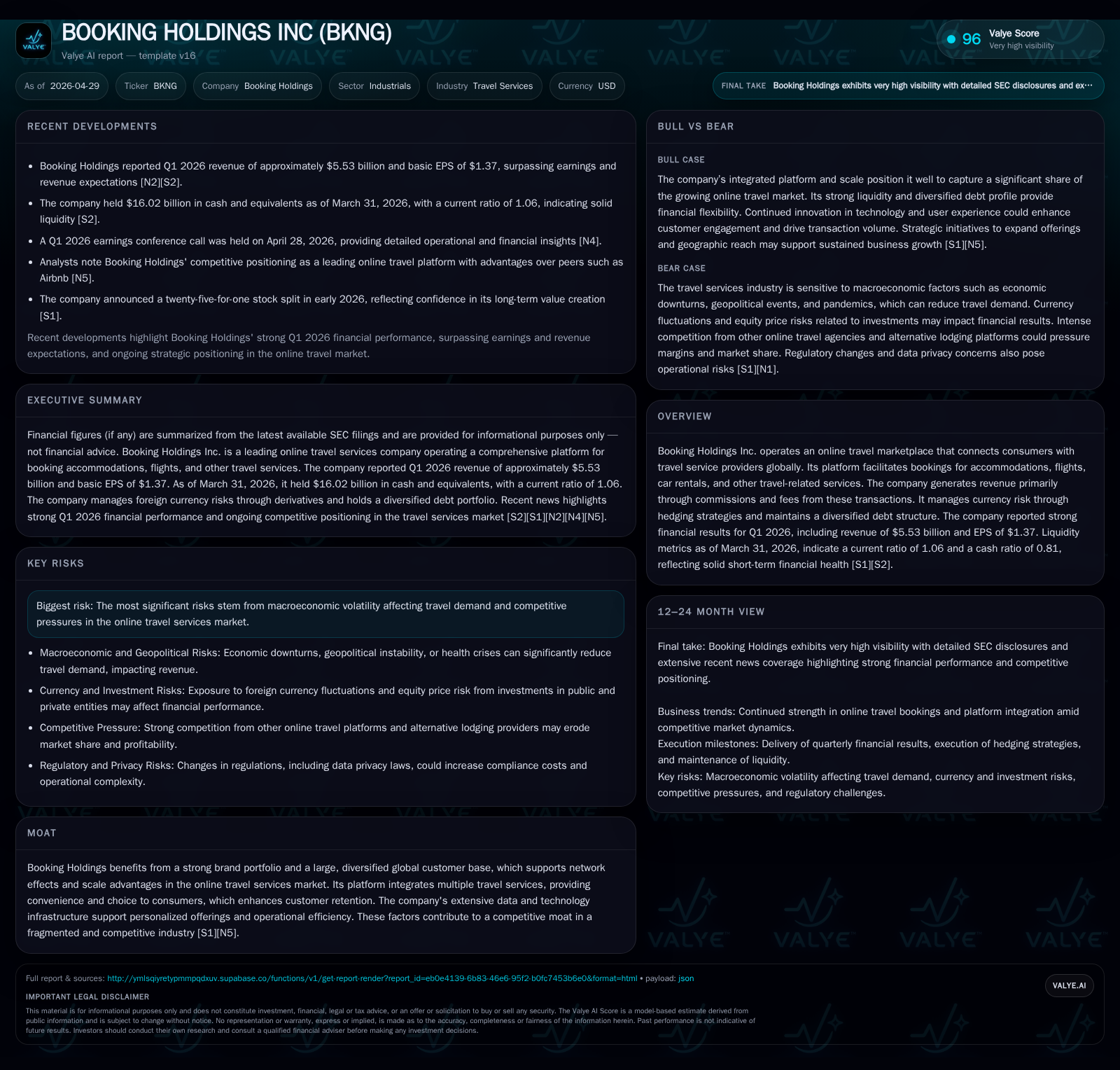
In its latest quarterly filing dated April 28, 2026, Booking Holdings delivered solid financial performance with revenue reaching $5.53 billion and EPS of $1.37, exceeding market expectations. The company’s multi-service online travel marketplace continues to benefit from network effects, scale, and a strong brand portfolio. Despite facing macroeconomic and competitive challenges, Booking Holdings is leveraging platform enhancements and geographic expansion to drive growth. The balance sheet remains robust with ample liquidity and manageable leverage supporting strategic investments.
Q1 2026 Performance: Revenue and Earnings Beat Expectations
In its most recent quarterly filing on April 28, 2026 [S2], Booking Holdings announced first quarter revenue of $5.53 billion alongside earnings per share (EPS) of $1.37. These figures surpassed consensus estimates reported by market analysts [N1][N2], illustrating robust demand recovery in global travel markets after pandemic disruptions. This momentum underscores the resiliency of Booking’s platform model in a dynamic environment where consumer confidence and discretionary spending are rebounding.
Importantly, strong cash generation evidenced by these results reinforces operational efficiency while supporting continued investment into technology and product innovation [S2]. The accompanying event filing [S3] corroborates stable capital market access amid diversified debt maturities stretching well into the future.
How Booking Holdings’ Business Model Drives Revenue and Customer Retention
Booking Holdings operates an online travel marketplace that efficiently connects consumers worldwide with an extensive array of travel products: accommodations, flights, car rentals, restaurant reservations, and other services [S1]. Its primary revenue streams derive from commissions on bookings processed through the platform.
This commission-based model benefits from a broad mix of offerings which reduces reliance on any single travel segment or geography. With comprehensive hedging strategies addressing foreign currency exposures on international transactions and Euro-denominated debt [S1], the company mitigates forex volatility effects that could otherwise impact margins.
Furthermore, integrating multiple travel services within one platform enhances customer convenience — a critical factor driving retention as users prefer seamless booking experiences over fragmented alternatives. This integration also supports attractive unit economics by spreading acquisition costs across diverse transactional volumes.
Competitive Moat: Brand Portfolio, Technology, and Scale Advantages
Booking Holdings thrives on a defensible moat anchored by its prominent brand portfolio including flagship sites like Booking.com [S1]. These well-established brands benefit from recognition that attracts millions of travelers globally, fueling powerful network effects.
Its dedicated technology stack enables sophisticated data analytics which personalize user experiences by optimizing search results and tailoring recommendations based on customer preferences and past behavior [N5]. Such capabilities improve customer satisfaction and repeat engagement while streamlining operational costs.
Scale advantages manifest not only in marketing reach but also in supplier relationships — vast inventory access empowers Booking to offer competitive pricing despite the fragmented nature of hotel and rental markets [S1][N5]. This differentiation helps defend against competitors ranging from traditional OTAs (online travel agencies) to emergent platforms like Airbnb.
Industry Environment: Navigating Market Dynamics and Competitive Pressures
The global online travel industry is characterized by highly fragmented supply side elements including hotels, airlines, rental car companies, some regulated heavily depending on jurisdiction [S4]. Consumer price sensitivity constrains pricing power across the value chain; thus Booking’s ability to negotiate volume discounts with suppliers forms a key competitive asset.
Regulatory scrutiny around listings — particularly for short-term rentals — adds complexity requiring ongoing compliance investments. Booking’s scale assists in meeting such regulatory demands efficiently compared to smaller platforms.
External risks include economic downturns or geopolitical tensions which can sharply affect travel volumes, introducing cyclicality into demand profiles [S4]. Nevertheless, the company’s diversified global footprint partially offsets localized shocks.
Growth Catalysts: Expansion of Service Offerings and Geographic Reach
Booking continues broadening its product suite by deepening multi-modal transport options (integrated flight-and-rental packages) alongside innovation in ancillary services like restaurant reservations [S2][N8]. Enhanced mobile platform engagement initiatives seek to boost conversion rates as travelers increasingly transact via smartphones.
Geographically, targeted expansion into emerging markets offers opportunity to capitalize on rising middle-class travel propensity combined with relatively lower OTA penetration levels compared to mature Western economies [N9].
Technological advances also create scope for embedding AI-driven customer support tools reducing friction points during booking processes while personalizing promotions to increase overall transaction values.
Potential Headwinds: Macroeconomic Volatility and Intensifying Competition
The primary vulnerabilities relate to macroeconomic uncertainty influencing discretionary leisure spending patterns globally — recessions or inflation spikes inevitably curb outbound tourism demand impacting Booking’s core revenue streams [S4].
Competitive pressures remain acute from niche innovators such as Airbnb targeting alternative accommodation segments as well as large diversified rivals including Expedia Group competing across similar verticals with comparable scale [S4]. Shifts in consumer preferences perhaps favoring direct booking or local platforms pose execution challenges requiring continuous investment in differentiation.
Key Metrics and Upcoming Catalysts to Monitor
Investors should track gross bookings growth which serves as a proximal measure of demand trends through the platform alongside evolving take rate dynamics reflecting pricing mix changes or promotional intensity [S2][N5]. Active customer counts coupled with repeat purchase frequency provide insights into retention effectiveness.
Upcoming milestones likely include new market launches especially in Asia-Pacific or Latin America where growth potential is significant. Further technology rollouts planned by the company have potential to enhance user experience metrics further influencing conversion rates positively.
Financial Position: Liquidity, Leverage, and Capital Allocation Overview
Booking Holdings’ balance sheet exhibits solid liquidity with cash & equivalents totaling approximately $16.0 billion at quarter-end March 31, 2026 versus total debt near $18.6 billion yielding net debt around $2.6 billion—a manageable leverage profile given operating cash flows capacity [F1][S2].
Current asset coverage relative to short-term liabilities produces a current ratio of roughly 1.06 indicating sufficient short-term financial stability supporting ongoing operational needs without undue refinancing risk exposure [F1].
This conservative capital structure underpins flexibility for strategic investments in technology development, acquisitions if suitable opportunities arise, along with shareholder return programs as warranted.
Disclaimer: This analysis is based solely on publicly available information as of April 29, 2026. It does not constitute investment advice or recommendations regarding any securities.
Disclaimer: This is research-only, informational analysis and not investment advice. It may include AI-generated interpretation and general industry context. Always verify important details using primary sources.

Comments