
Newegg Commerce Strengthens Tech E-Commerce Position with Expanding SKU Base and Positive Adjusted EBITDA in 2025
Newegg reported improved operating results for fiscal 2025 anchored by growth in gross merchandise value and adjusted profitability alongside continued investment in its tech-focused e-commerce ecosystem.
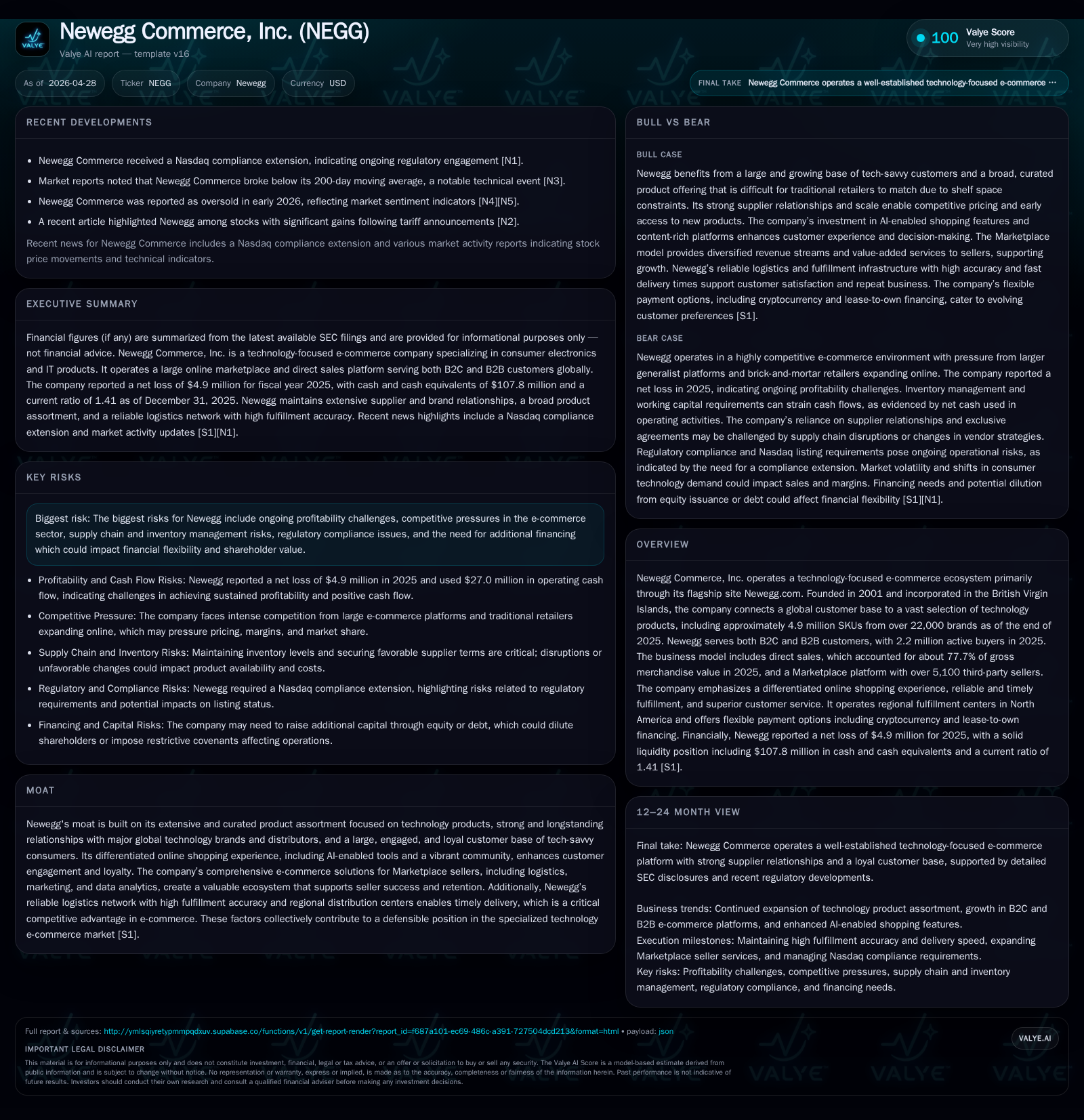
In its latest 2025 annual results filing, Newegg Commerce, Inc. demonstrated a notable recovery from prior losses, reporting an Adjusted EBITDA of $24.8 million and a significantly reduced net loss of $4.9 million. The company’s core strength remains its expansive technology product catalog and marketplace model serving over 2.2 million active buyers with nearly 5 million SKUs available. Although still facing cash flow pressures from inventory build-up, Newegg maintains a healthy liquidity profile with strong cash reserves and low debt. Going forward, growth is expected to be driven by its marketplace expansion, proprietary private-label brands, and enhanced logistics capabilities, balanced against the risks of competitive online retailing and capital requirements.
Recent Operating Update
Newegg Commerce's latest filing for the fiscal year ended December 31, 2025, delivers a cautiously optimistic picture after several years of losses. The company disclosed net sales of approximately $1.44 billion with gross merchandise value (GMV) climbing to about $1.77 billion for the year [S1][S22]. This represents both growth compared to 2024 GMV ($1.53 billion) and a rebound from the sharper declines experienced around 2023.
Critically, Newegg recorded a positive Adjusted EBITDA of $24.8 million in fiscal 2025 compared to negative results in the preceding two years ($-9.5M in 2024 and $-21.3M in 2023). Nonetheless, the company reported a consolidated net loss of $4.9 million for the period; materially improved from prior years but indicating ongoing profitability headwinds typical for specialized e-commerce players investing in growth levers [S1][S16].
Operating cash flow suffered a significant outflow of $27 million during the same period primarily due to aggressive inventory build-up totaling $70.9 million intended to support expected robust holiday season demand—a common but working-capital-intensive pattern in consumer electronics retailing [S13][S14].
Business Model and Strategic Position
Newegg operates as a technology-focused e-commerce ecosystem with a clear specialization in IT components, gaming peripherals, consumer electronics, and related categories supported by approximately 4.9 million SKUs representing over 22,000 brands as of year-end 2025 [S1][S24]. This extensive catalogue enables Newegg to serve both B2C consumers—2.2 million active buyers in the year—and B2B clients.
Revenue generation follows a dual approach: Direct sales account for nearly 78% of gross merchandise value where Newegg manages inventory and transactions directly with customers; meanwhile, its Marketplace platform hosts over 5,100 third-party sellers enabling broader assortment leveraging network effects [S1]. This mix balances margin potential with scale.
The business model complements product breadth with value-added services targeting brand partners: marketing campaigns leveraging data insights harvested from customer behavior on Newegg.com; distribution logistics supported by regional fulfillment centers; and seller tools enhancing operational efficiency—all aimed at creating sticky vendor relationships within this vertical niche [S24].
Of particular note are Newegg’s private label brands Rosewill (targeting computer components/accessories at cost-effective price points) and ABS (selling premium gaming PCs). These brands utilize data-driven insights drawn from platform activity allowing focused investment where higher-than-average margins are achievable while maintaining quality standards—a strategic move toward capturing brand equity along the value chain [S24].
Industry Structure and Competitive Landscape
Newegg competes in the highly contested yet lucrative technology e-commerce segment dominated by larger generalist platforms such as Amazon alongside specialized retailers like Micro Center or Fry’s (geographically more limited). Its moat chiefly arises from curated assortments targeted at tech-savvy customers combined with superior fulfillment reliability underscored by regional warehousing infrastructure enabling timely delivery—a critical differentiation given consumer sensitivity to product availability timing among tech enthusiasts.
Moreover, its marketplace ecosystem nurtures seller success through integrated logistic support including third-party logistics (3PL), staffing solutions (Staffing By Newegg), and media advertising services providing sellers multiple levers for growth on the platform beyond simple listing exposure [S24]. These capabilities create switching costs for sellers reluctant to abandon well-tuned channels that reduce operational friction.
However, market dynamics remain challenging: expansion requires continuous technology investment—especially AI-enabled personalization tools—and balancing inventory risk amid component obsolescence cycles common in electronics retailing.
Growth Drivers & Constraints
Growth catalysts for Newegg revolve around:
- Marketplace expansion: increasing third-party sellers enriches assortment diversity which attracts more buyers.
- Private label scaling: leveraging identified high-margin niches to build own-brand recognition supports margin enhancement.
- Logistics network optimization: enhancing fulfillment capacity reduces shipping times—vital for customer experience improvements.
- Ecosystem services: cross-selling marketing solutions and analytics deepens seller engagement enhancing platform revenue streams.
Conversely constraints include:
- Inventory management risks inherent to fast-evolving tech products lead to potential write-downs or obsolete stock provisioning.
- Intense competition pressure necessitates continual innovation around pricing strategies and differentiation.
- Need for external funding if operational cash flow deficits persist constraining capital availability for growth-driving investments.
- Regulatory compliance complexity given global sourcing environments especially impacting supply chains amidst geopolitical uncertainties.
What to Watch Next
Key upcoming milestones involve:
- Monitoring GMV trends into Q1-Q2 2026 will indicate whether inventory build-up translates into sustainable revenue gains or excess stock liability.
- Progression in private label revenues particularly Rosewill and ABS categories which can shift overall profitability structures.
- Execution on marketplace seller acquisition and retention metrics alongside expansion of support services offerings driving incremental revenue.
- Liquidity position updates reflecting working capital cycle improvements or capital raise activities as necessary.
- Any changes or extensions regarding credit agreements or covenants given evolving financing conditions outlined up through late 2025.
Financial Profile Summary
As of December 31, 2025, Newegg maintains a liquidity position evidenced by approximately $107.8 million cash and equivalents against total current liabilities of about $256.5 million resulting in a current ratio near 1.41—a generally healthy sign though working capital pressures persist from inventory funding needs [F1]. Total debt is relatively low at near $1.4 million reported as of December 31, 2022, emphasizing limited leverage risk [F1].
Capital expenditures have moderated from levels seen during major property acquisition years (e.g., purchase of office building in California) stabilizing around $2.7 million reflecting ongoing investment primarily into infrastructure [S6][S14].
Net losses narrowed considerably driven by improved operating results but still reflect investments in stock-based compensation ($21.7M) as well as depreciation/amortization charges associated with prior capex spendings which collectively point toward reinvestment phases rather than mature steady-state profitability models [S11][S13].
Disclaimer
This analysis is provided solely for informational purposes based on publicly available documents filed by Newegg Commerce Inc., without provision of any investment advice or recommendations.
Disclaimer: This is research-only, informational analysis and not investment advice. It may include AI-generated interpretation and general industry context. Always verify important details using primary sources.

Comments