
Ekso Bionics Charts Strategic Pivot with Applied Digital Cloud Merger Proposal and Q1 2026 Challenges
Ekso Bionics reveals key merger milestones in its April 2026 10-Q, spotlighting transformational plans amid liquidity constraints and evolving market dynamics.
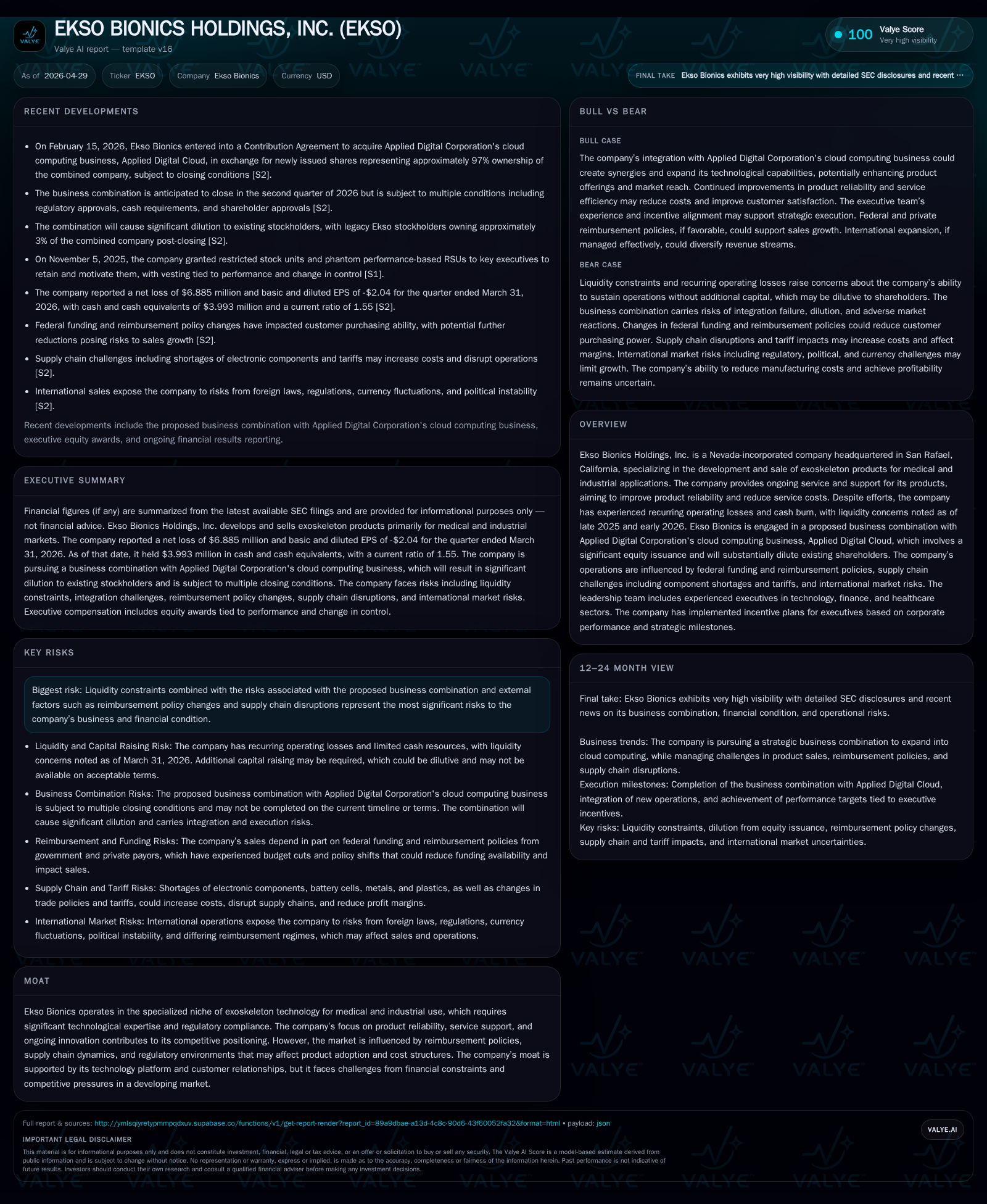
The latest quarterly filing from Ekso Bionics underscores a pivotal moment as the company advances a proposed business combination with Applied Digital Cloud, involving substantial equity issuance that will reshape its capital structure. While the merger aims to pivot Ekso towards integrated cloud-enabled exoskeleton innovation, near-term liquidity pressures and operational losses remain significant challenges. The company's specialized product offerings in medical and industrial exoskeletons face headwinds from reimbursement policies, regulatory complexity, and supply chain disruptions. Execution on merger closing conditions and capital raises will be critical to sustaining ongoing development and market expansion efforts.
Latest Quarterly Update Frames Strategic Transformation
Ekso Bionics’ April 28, 2026 Form 10-Q clearly marks a strategic inflection as it details progress toward a transformative business combination with Applied Digital Corporation’s cloud computing subsidiary, Applied Digital Cloud ("Cloud") [S2]. This agreement contemplates a Contribution and Exchange where Cloud's equity is contributed in exchange for approximately 138.2 million newly issued shares of Ekso common stock. This transaction would grant Cloud roughly 97% ownership of the combined company pre-other transactions, significantly altering Ekso’s capital base and shareholder composition [S2][S3].
Crucial closing conditions outlined include regulatory clearances preventing any legal impediments; obtaining all required approvals; the filing and effectuation of amended articles of incorporation; and critically maintaining a minimum cash balance of $15 million at closing—well above current levels [S2]. Additionally, performance compliance with preclosing covenants by both parties and completion of a concurrent private placement investment (PIPE) led by APLD Intermediate are needed for consummation [S2][S3]. These financing arrangements will dilute existing Ekso shareholders further but provide vital capital inflows necessary for sustainability.
This filing draws attention to heightened operational execution risks hinging on timely approvals from government bodies as well as shareholders plus the successful navigation of capital markets for PIPE closure. The near-term trajectory thus pivots on managing merger-related milestones while addressing ongoing liquidity shortfalls highlighted below.
Business Model Insights: Specialized Exoskeleton Solutions and Service Revenue
Ekso has positioned itself within a narrow yet technically demanding niche that centers around powered exoskeleton systems targeting both medical rehabilitation—particularly for mobility impairment patients—and industrial sectors seeking ergonomic augmentation to reduce workplace injury risks [S1]. Its revenues primarily stem from direct product sales complemented by comprehensive service agreements designed to uphold equipment reliability and curtail warranty or repair costs over product lifecycles [S1][F1].
The company’s core offerings revolve around modular exoskeleton platforms featuring biomechanical sensor arrays coupled with control systems enabling wearer-assistive motion. These products require adherence to stringent medical device regulations when applied clinically, imposing high barriers to entry. Service revenue streams contribute to predictable revenue components but have yet to offset heavy upfront research & development expenditures reflected in persistent operating losses.
Despite its established technology base and customer relationships cultivated through specialized sales channels focusing on hospitals and enterprise clients, Ekso continues investing heavily in next-generation devices intended to improve clinical outcomes and industrial efficiency—a pattern typical among medtech innovators adapting to reimbursement policies that affect purchasing cycles.
Industry Positioning: Niche Tech with Regulatory and Reimbursement Complexities
The exoskeleton industry remains embryonic with significant fragmentation due partly to technological challenges and uncertain reimbursement landscapes. Regulatory oversight across jurisdictions complicates market access; securing FDA clearance or CE marking involves extended timelines impacting commercialization speed [S1][S24]. Moreover, third-party reimbursement authorities present volatile dynamics—U.S. Medicare/Medicaid policies alongside commercial payors frequently evolve coverage criteria constraining widespread adoption [S24].
Supply chains remain under pressure owing to semiconductor shortages and tariff impositions affecting component sourcing costs that can elevate unit economics [S1]. These factors combine to restrict rapid scaling despite ideal structural demand drivers such as aging populations globally requiring rehabilitative solutions.
In this context, Ekso’s moat stems from its integrated technology stack blending hardware robustness with software control sophistication alongside knowledge-driven customer engagement models supporting usage compliance. Still, margins are pressured by external factors beyond internal innovation capabilities.
Growth Drivers: Cloud Integration, Product Development, and Market Expansion
A fundamental catalyst shaping Ekso’s future growth outlook is the anticipated synergies from integrating Applied Digital Cloud’s assets following the business combination. This cloud computing expertise is expected to bolster Ekso's device connectivity features, tele-rehabilitation possibilities, real-time data analytics capabilities, and remote monitoring services—shifting the company toward a more scalable digital health model [S3][S1].
Concurrently, ongoing product pipeline enhancements aim at extending application breadth through novel certification pathways targeting both U.S. FDA approvals for new clinical indications as well as ISO standard accreditations facilitating international sales expansion [S1]. Efforts also target streamlining reimbursement workflows by improving payor communication platforms—the latter crucial given past barriers hampering payor acceptance rates.
Management has set corporate goals centering on establishing predictable recurring revenue streams through service agreements linked with these digitally enhanced products while managing cash spends judiciously amid tight financial constraints [S1]. Positive execution against these milestones may offer clearer visibility into scaling opportunities beyond traditional unit sales alone.
Growth Limiters: Liquidity Constraints, Dilution Risks, and Supply Chain Challenges
While strategic opportunities exist post-merger integration, immediate growth faces several inhibiting factors. The Q1 2026 balance sheet reveals cash & equivalents of approximately $4 million against current liabilities near $9 million delivering a current ratio of around 1.55—marginally adequate liquidity relative to known obligations [F1][S2]. Operating losses continue unabated reflecting high fixed costs but an immature top line still emerging from developmental commercialization stages.
Moreover, shareholders face dilution risks tied directly to the equity issuance planned under the Contribution Agreement including private placement shares offered via PIPE investments needed to meet closing conditions totaling at least $15 million cash reserves [S2][S3]. This mix undermines existing equity value though injects necessary capital for operational continuity.
Supply chain uncertainties persist as component availability remains vulnerable amid geopolitical tensions affecting tariffs or disruption risks. These cost pressures influence pricing flexibility which is limited due to managed healthcare cost containment measures discussed earlier.
Failure to close the business combination timely or secure acceptable financing terms could sharply restrict runway for innovation investment or sales initiatives hurting competitive momentum.
What to Watch: Closing Conditions, Capital Raises, and Execution Milestones
Key developments going forward hinge on several measurable milestones stated explicitly in SEC filings including receipt of requisite stockholder consents implementing amendments like Second Restated Articles of Incorporation enabling merger mechanics; securing government permits or lack of prohibitive regulation injunctions; corroboration of preclosing covenant compliance; Nasdaq listing approvals for new entity stock; completion of agreed private investment placements simultaneousto closing; confirmation that Investor Rights Agreements are executable; binding tail insurance policies coverage; finally transaction consummation itself [S2].
Additional updates will likely emerge regarding governance restructuring plans encompassing board composition shifts reflecting majority owner influence post-merger plus potential divestiture or spin-outs planned per strategic realignment discussions mentioned pre-close disclosures [S3][S4]. Monitoring quarterly operating KPIs will shed light on how integration affects existing Exo products' market absorption especially whether digital platform upgrades stimulate higher user engagement or retention.
Execution risk remains substantial until completion is officially acknowledged thereby representing an event-driven focal point underpinning near-term strategic clarity.
Financial Snapshot: Liquidity, Capital Structure, and Risks
As of March 31, 2026, [F1] reports $3.99 million in cash & equivalents balanced against current liabilities approximating $9.09 million yielding a current ratio of about 1.55—marginally adequate liquidity relative to known obligations [F1][S2].
Operating income remained negative with losses persisting due primarily to ongoing R&D investment intensity required for product innovation combined with limited commercial scale presently achieved totaling modest revenue recognition historically described in previous filings [F1][S1]. No recent debt refinancing events or new leverage facilities were disclosed which underscores dependency on external equity capital via PIPE transactions tied closely with business combination consummation efforts.[F1]
The balance sheet highlights salient financial constraints framing complexity around its strategic transformation ambitions underscoring key risk factors emphasizing cash flow vulnerability absent successful capital raises influencing solvency outlooks faced currently by small-cap specialized medtech firms like Ekso Bionics.
This analysis reflects current publicly available information up through April 28th, 2026 filing dates. It does not constitute investment advice but offers an indication of operational status anchored in recently disclosed merger-related developments contextualized within Ekso Bionics' advanced exoskeleton market position.
Disclaimer:
This report is provided solely for informational purposes without any offer or solicitation for securities transactions nor any investment recommendation or advice. Readers should consult their own professional advisors before making financial decisions related to this company or sector.
Disclaimer: This is research-only, informational analysis and not investment advice. It may include AI-generated interpretation and general industry context. Always verify important details using primary sources.

Comments