
Porch Group Leverages Reciprocal Insurance Platform to Boost Market Reach and Revenue Streams
The company’s Q1 2026 results highlight revenue growth driven by its integrated insurance and software services despite ongoing underwriting challenges.
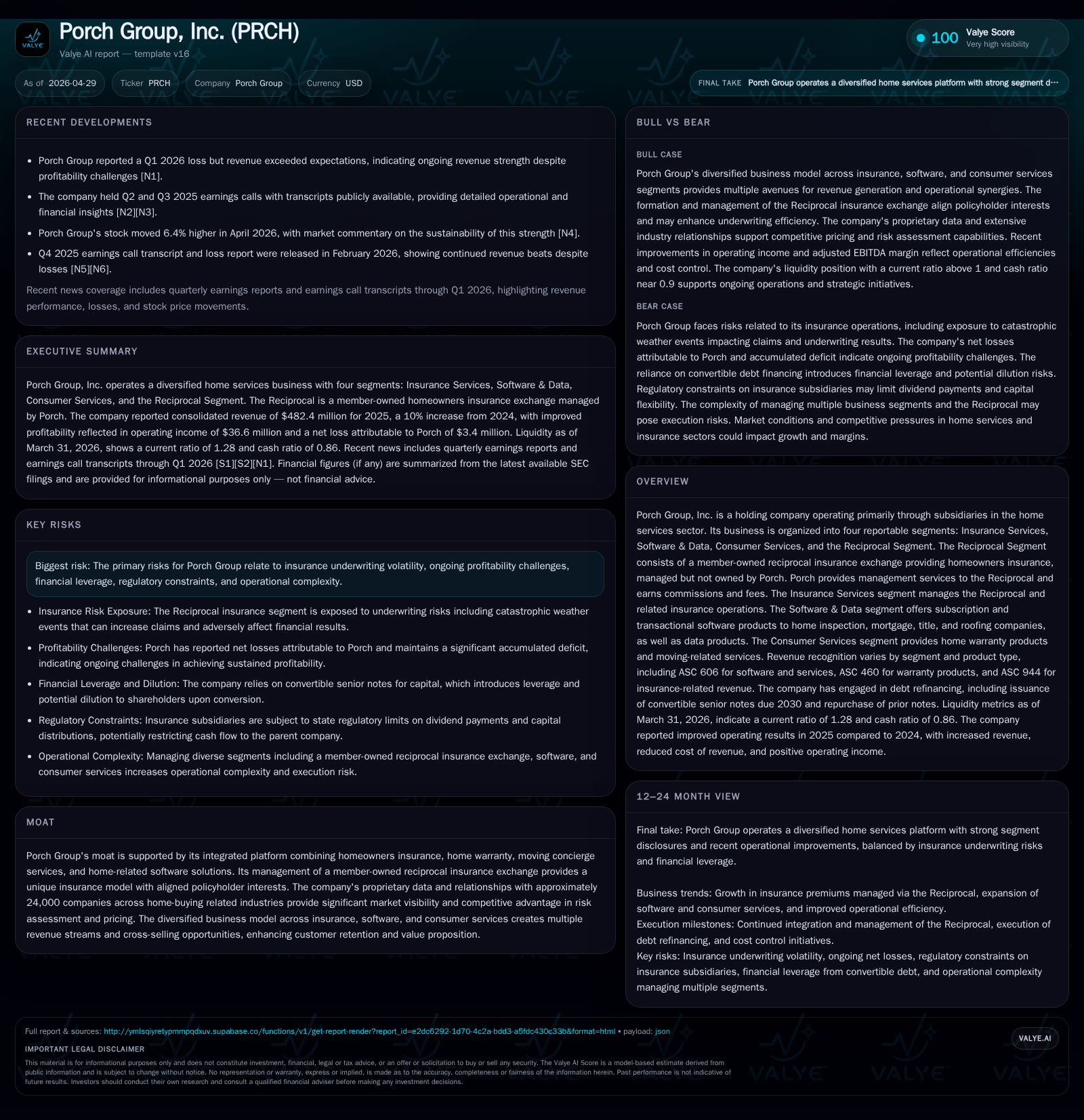
Porch Group reported first quarter 2026 revenue growth led by gains across its Insurance Services and Software & Data segments, driven by management fees from its unique member-owned Reciprocal insurance exchange and expansion of software subscriptions. Operating losses persist due to underwriting volatility and investment in growth initiatives. The company benefits from a platform integrating homeowners insurance, home warranty, and home services software that supports cross-selling and customer retention. Financial leverage remains elevated with net debt exceeding $410 million at quarter-end but liquidity is sufficient for near-term operations. Upcoming milestones include monitoring underwriting profitability trends and further scaling of newly launched insurance products.
First Quarter 2026 Results Highlight Continued Revenue Growth
Porch Group's latest quarterly filing for Q1 2026 reveals sustained top-line momentum across key segments. While the company does not provide full detailed numbers here, it confirms continuing revenue growth driven mainly by increased commissions and fees from managing its Reciprocal homeowner’s insurance exchange alongside rising subscription income within its Software & Data segment [S2][S3]. Despite this topline gain, Porch continues to grapple with operating losses, largely attributable to inherent underwriting volatility within the Reciprocal insurance operations and ongoing investments in platform scale [S2][N1]. There were no material changes to risk factors compared with the previous year’s annual report, underscoring persistent exposure to claims experience swings and regulatory oversight [S2].
These results update the near-term outlook by emphasizing growth in recurring revenue streams but also point toward margin pressure linked to insurance risk fluctuations and expansion costs.
Porch’s Integrated Business Model: Insurance, Software, and Consumer Services
Porch Group operates through four principal reporting segments: Insurance Services, Software & Data, Consumer Services, and the Reciprocal Segment [S1]. The Insurance Services segment oversees management of the Reciprocal—a member-owned reciprocal exchange that issues homeowners insurance policies but is consolidated as a variable interest entity (VIE) since Porch manages but does not own it directly [S1]. Revenue here comes mainly from commissions on premiums—now refined by an updated operational metric termed Revised Written Premium (RWP), which captures both premium payments and surplus contributions reflecting the launch of Porch-branded insurance products [S4].
Software & Data delivers subscription-based products serving home inspection firms, mortgage lenders, title companies, roofers, and other ecosystem stakeholders [S1]. This segment provides transactional software offerings plus proprietary data solutions facilitating risk analysis and market insights.
Consumer Services offers home warranties along with moving-related concierge services designed to increase consumer touchpoints beyond insurance purchase moments [S1]. This broad approach creates multiple cross-selling points across the home-buying lifecycle.
Each segment contributes differentiated revenue characteristics: recurring subscription revenue is highly scalable with improving margins for Software & Data; fee-based income from reciprocal management offers stable cash flows; Consumer Services augments ecosystem stickiness via consumer-facing offerings enhancing total customer lifetime value.
Unique Value Proposition of Porch’s Reciprocal Insurance Structure
Porch’s hallmark is the Reciprocal Segment—a member-owned reciprocal insurance exchange that differs sharply from traditional insurers by shifting underwriting risk ownership while retaining operational control [S1][F1]. Through this model, Porch collects management fees based on premiums written but cedes claims payment obligations to the Reciprocal entity itself. This alignment mitigates direct loss exposure for Porch while maintaining upside through management commissions tied closely to policyholder volume.
The reciprocal is supported by robust reinsurance programs starting at $25 million per event up to $410 million annually for excess catastrophe coverage—a measure protecting capital surplus against extreme events [S1][S8]. Additionally, reinsurance ceding strategies enhance capital efficiency which further strengthens financial resilience.
This structure provides Porch with distinct market visibility into risk assessment powered by proprietary data integrated across its software platform. By leveraging insights from relationships with nearly 24,000 industry partners spanning inspections to mortgages [S1], Porch enhances pricing accuracy and customer engagement.
Competitive Environment in Home Services and Insurance Tech
Porch competes in a fragmented market comprising large incumbent insurers offering traditional homeowners policies along with an influx of insurtech startups providing point solutions such as digital quoting or claims automation [N3][N4][S1]. Moreover, home service aggregator platforms vie for consumer attention on warranty products or moving-related services.
Despite this crowded environment, Porch's integrated approach combining reciprocal-driven insurance management with embedded home services software establishes meaningful switching costs for customers reliant on an end-to-end platform experience. Network effects grow as more agents leverage its data products.
However, capacity constraints within the captive Reciprocal remain a limiting factor for scaling premiums rapidly given reserve requirements tied to regulatory capital standards [S1]. Regulatory risks also impose pricing power limitations especially under tighter state-level insurance oversight.
Key Growth Drivers: Cross-Selling, Software Subscriptions, and Market Expansion
Growth trajectories center on expanding penetration of subscription software offerings across mortgage lenders and title firms as well as augmenting warranty product adoption within Consumer Services [S1][N2][S2]. The definition refinement of RWP incorporating surplus contributions associated with new Porch Insurance product launches reflects strategic moves to deepen policyholder engagement economically.
Cross-selling potential between segments remains an important growth avenue. For example, customers utilizing home warranties may be more likely to adopt complementary moving concierge or reciprocal-based insurance policies [N2]. Similarly, increasing digital adoption throughout real estate transactions facilitates broader embedding of Porch’s software tools driving recurring revenue inflows.
Management tracks policies written (RWP) alongside subscription renewal rates as pivotal KPIs signalling uptake expansion across the ecosystem [S4][S11]. Effective scaling depends on execution discipline combined with marketing investments targeting consumer warranty conversions and professional channel activations.
Margins and Profitability Constraints From Underwriting Volatility
Notwithstanding revenue progress, profit margins are challenged predominantly by the volatile nature of homeowners insurance underwriting results reflected within the Reciprocal segment [S2][S8]. Claims frequency or severity fluctuations lead to reserve adjustments affecting profitability unpredictably quarter-to-quarter. Adjusted EBITDA margins are positive but constrained amid claim loss ratios tending toward higher ranges due to catastrophe exposures inherent in states like Texas representing over half of consolidated revenues [S21].
Additionally, investments in technology platforms intended to improve customer experience or risk modeling impose further near-term expense burdens [S12]. These financial realities necessitate sustained operational improvements alongside prudent reinsurance strategies to stabilize earnings streams sustainably.
Balance Sheet Snapshot: Debt Profile and Liquidity Position
As of Q1 2026 quarter-end March 31st balance sheet shows Porch holding approximately $64 million cash and equivalents against total debt nearing $475 million resulting in a net debt position around $411 million—the figure combining convertible senior secured notes maturing in 2028/2030 plus remaining 2026 notes refinanced in prior quarters [F1]. The current ratio stands at 1.28 indicating adequate short-term asset coverage versus liabilities including accrued expenses totaling about $79 million [F1].
Management disclosed multiple refinancing actions during 2025 lowering near-term maturities including partial repurchases of soon-maturing convertible notes weighted toward extending maturities through 2030 instruments bearing higher coupon rates around 9% versus original low-coupon 2026 notes at 0.75% [S8][S14][S24].
Overall liquidity suffices per management guidance for operating needs over the next year although elevated leverage introduces financial flexibility constraints typical for growth-stage insurtech entities balancing innovation spending while building scale [S5][F1].
Upcoming Catalysts and Operational Milestones to Monitor
Key upcoming aspects for market participants include updates on Q2 guidance particularly underwriting loss trend disclosures clarifying path toward profitability stabilization post initial scaling phases [N2][S3]. Monitoring policy count trajectory will shed light on velocity gains within Reciprocal expansions alongside subscription subscriber growth in software units impactful for recurring revenues.
Further attention should be paid to marketing return effectiveness driving consumer warranty conversions—an element under active investment—and early performance signals related to newly introduced Porch-branded homeowner’s insurance product variants integrating surplus contributions reflected in RWP evolution [N2][N4].
Regulatory environment developments impacting reciprocal structures warrant continuous observation given their influence on management fee dynamics versus direct underwriting economics; novel acquisition or partnership announcements could also alter competitive positioning or enhance distribution reach going forward.
This analysis incorporates information sourced from Porch Group's most recent quarterly (Form 10-Q) filing dated April 28, 2026 [S2], supplemented by recent SEC filings including an April 28, 2026 Form 8-K earnings release [S3], their February 20, 2026 Form 10-K annual report detailing business structure [S1], alongside third-party news transcripts where indicated. Financial data align with verified companyfacts snapshot dated March 31, 2026 [F1]. This article does not constitute investment advice but presents an informed operational perspective grounded in disclosed public documents.
Disclaimer: This is research-only, informational analysis and not investment advice. It may include AI-generated interpretation and general industry context. Always verify important details using primary sources.

Comments