
NeoGenomics Bolsters Oncology Testing Network with Pathline Acquisition and Strategic Growth Initiatives
NeoGenomics’ Q1 2026 filings highlight operational expansion and integration of the Pathline acquisition, reinforcing its position in the competitive oncology diagnostics market.
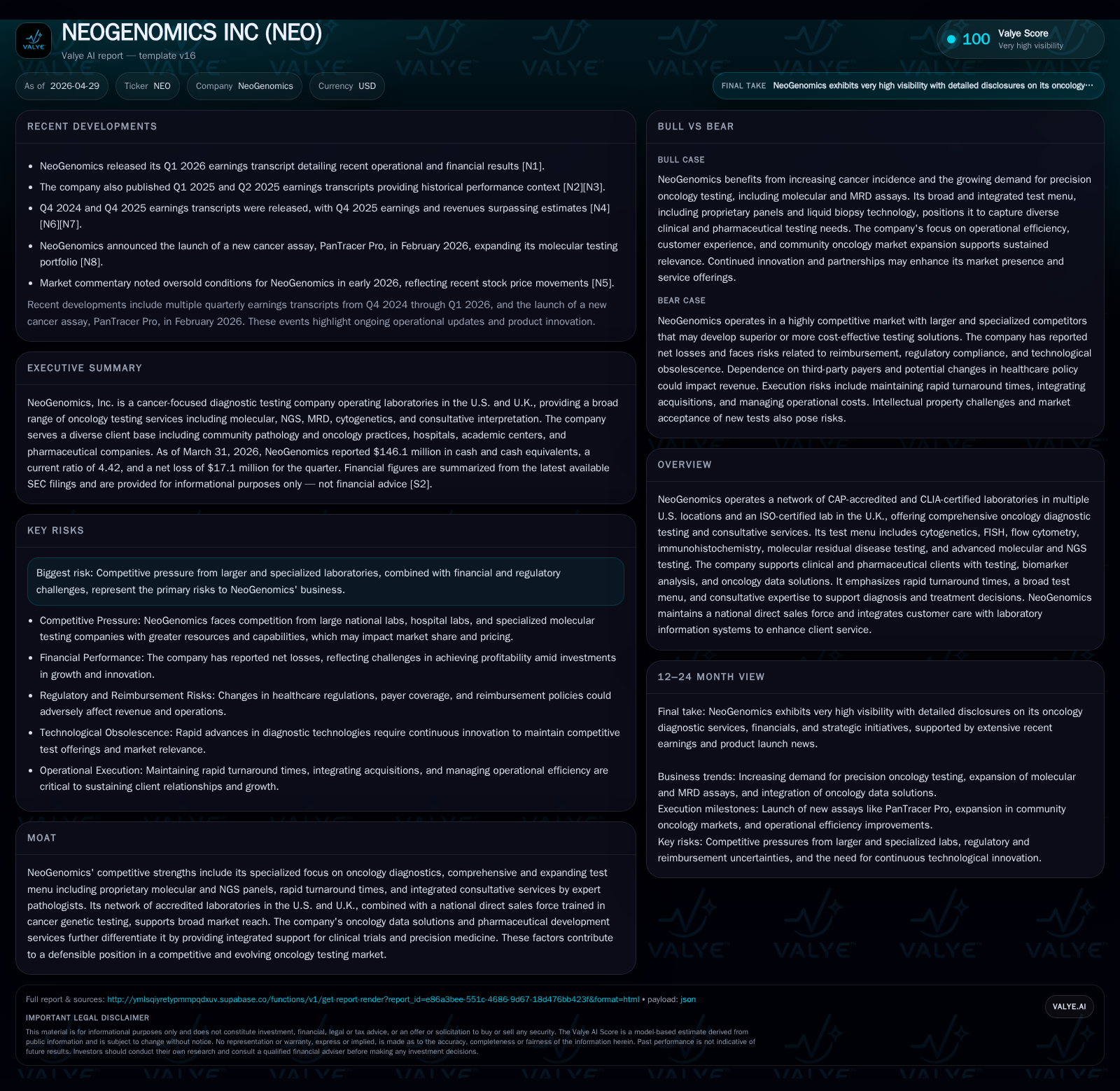
In its latest 10-Q filing for Q1 2026, NeoGenomics disclosed progress on integrating Pathline, an oncology diagnostics lab acquired in 2025, alongside test menu expansions and operational enhancements. The company’s CAP/CLIA/ISO-certified lab network across the U.S. and U.K. supports rapid turnaround molecular and cytogenetic testing focused on oncology. Despite regulatory challenges and competitive pressures, NeoGenomics leverages a consultative sales model and pharmaceutical partnerships to drive growth. Its financial profile shows adequate liquidity and manageable leverage supporting near-term investments.
Q1 2026 Operating Highlights: New Tests, Capacity, and Market Reach
NeoGenomics’ latest quarterly filing dated April 28, 2026 (Form 10-Q) provides the primary lens into its near-term operational landscape [S2]. Among the key developments is the successful attainment of the contingent consideration milestone tied to its April 2025 acquisition of Pathline LLC, a CLIA/CAP/NYS-certified laboratory based in New Jersey [S7]. This event concretizes Pathline’s integration into NeoGenomics' Northeast U.S. footprint — a strategic move enhancing regional coverage in a dense oncology market.
The company also reports growth in test volumes driven by incremental adoption of expanded molecular residual disease and next-generation sequencing (NGS) panels alongside established cytogenetics and FISH assays. Leadership commentary from the accompanying earnings transcript highlights continuous improvements in turnaround time (TAT), a critical service metric in oncology diagnostics where timely results directly impact treatment decisions [N1]. The national direct salesforce remains pivotal in driving utilization via consultative engagement with oncology practices.
Business Model: Integrated Oncology Diagnostics and Consultative Expertise
NeoGenomics’ revenue model rests on providing technically sophisticated laboratory testing coupled with professional interpretation services rendered by oncologic pathologists and genomics experts [S1]. Its testing portfolio spans multiple platforms: cytogenetic karyotyping; FISH targeting structural chromosomal abnormalities; flow cytometry to phenotypically classify hematological malignancies; immunohistochemistry (IHC) for protein expression profiling; plus molecular residual disease assays leveraging sensitive PCR and NGS technologies.
A key feature is NeoGenomics’ emphasis on rapid TAT enabled through networked CAP-accredited labs across five U.S. locations plus an ISO-certified facility in Cambridge, UK, facilitating both domestic clinical demand and pharmaceutical trial support. Consulting services augment technical testing by guiding clinicians on actionable findings in complex cases, creating switching costs via knowledge integration.
Oncologic pharmaceutical clients generate ancillary revenues through biomarker development programs tied to drug pipelines requiring companion diagnostics or genomic stratification markers — embedding NeoGenomics deeper into the precision medicine value chain.
Competitive Positioning: CAP-Accredited Labs Across U.S. and U.K.
NeoGenomics secures competitive moats through robust regulatory accreditations—the College of American Pathologists (CAP) accreditation combined with CLIA certification forms an industry-standard gateway ensuring quality compliance essential for reimbursement eligibility [S1],[F1]. The added ISO certification for its UK lab broadens its geographic reach while meeting stringent international quality norms.
Its multi-lab system architecture affords redundancy and capacity flexibility contrasted with smaller single-site competitors. The direct salesforce trained extensively in cancer genetic testing provides tailored client education—a differentiator fostering higher client penetration relative to commoditized reference laboratories.
These factors collectively buttress durable customer relationships amid pressure from larger conglomerates who compete primarily on scale rather than consultative depth or specialty focus.
Industry Backdrop: Growing Demand for Genetic and Molecular Cancer Testing
Demand for oncology-focused genetic testing is underpinned by structural trends outlined in the company's annual SEC disclosure [S1]:
- Increasing prevalence of cancer diagnoses globally coupled with expanding repertoire of implicated genes drives volume growth.
- Progressive shift toward targeted therapies necessitates biomarker-based patient selection via companion diagnostics.
- Wider acceptance by payers concerning clinical utility fuels reimbursement expansion.
- Technological advancements reduce per-test costs enabling broader routine use across care settings.
Collectively these forces sustain secular growth distinctive from cyclicality affecting other laboratory segments.
Growth Catalysts: Pharmaceutical Partnerships and Expanded Test Menu
Central to NeoGenomics’ medium-term growth strategy is deepening its role within drug development ecosystems by providing comprehensive biomarker assay development services integrated with clinical trial sample testing [S1],[N1]. This function not only generates recurring contracted revenues but embeds NeoGenomics into high-value precision oncology workflows that may extend post-approval diagnostic utilization.
The Pathline acquisition complements this by expanding capabilities especially in molecular assays validated under stringent regulatory frameworks relevant for trials conducted under FDA oversight. Proprietary NGS panels designed for minimal residual disease detection offer potential differentiation versus commoditized generic assays competing predominantly on pricing.
Nonetheless, capacity constraints highlighted as a key risk require careful management as increasing complexity of tests demands more specialized labor and capital-intensive instrumentation upgrades [S1],[S4],[S12].
Risk Factors: Regulatory Compliance and Competitive Headwinds
Persisting regulatory scrutiny represents the foremost operating risk. NeoGenomics maintains an $11.2 million reserve related to ongoing investigations by federal healthcare authorities regarding compliance issues tied to consulting agreements with providers subject to fraud, waste, and abuse laws [S4],[S5],[S10],[S11]. Any adverse developments or expanded enforcement actions could materially impact financial outcomes.
Price competition from larger reference labs further pressures margins given partially commoditized product segments lacking proprietary test exclusivity [S1],[S4].
Moreover, NeoGenomics’ ongoing investment in Laboratory Information Management Systems (LIMS) modernization illustrates dual-edged challenges: anticipated scalability benefits versus execution complexity risks that could disrupt order processing or TAT if inadequately implemented [S12].
What Investors Should Monitor Next
Key performance indicators include quarterly updates on test volume ramp-ups especially for recently integrated Pathline assays along with TAT metrics reflecting operational efficiencies post-LIMS deployment [S2],[N1]. Progress on resolving regulatory inquiries including disclosures around any fresh reserves will be material given possible financial impacts [S4,S5].
Further validation milestones or commercial launches related to proprietary NGS panels provide tangible signals of product pipeline health. Investment community attention should focus also on salesforce productivity trends relative to prevailing demand seasonality patterns noted historically within pharma clinical trial cycles [N1,S1].
Financial Overview: Recent Liquidity and Capital Structure Snapshot
At March 31, 2026, NeoGenomics had cash and cash equivalents of $146.1 million with current assets totaling approximately $373.7 million against current liabilities near $84.6 million—yielding a strong current ratio of about 4.42x supportive of operational liquidity needs over at least the medium term [F1],[S2].
Total debt reported was approximately $345 million as of December 31, 2025 with net debt around $199 million when factoring available cash—representing a manageable leverage profile given ongoing free cash flow potential linked to improving revenue scales post-acquisition integration [F1].
Disclaimer: This is research-only, informational analysis and not investment advice. It may include AI-generated interpretation and general industry context. Always verify important details using primary sources.

Comments