
Trident Digital Tech Reveals Quarterly Advances and Strategic Blockchain Initiatives
Recent filings spotlight Trident Digital Tech's steady operational disclosures alongside strategic blockchain partnerships and XRP treasury plans, amidst liquidity headwinds.
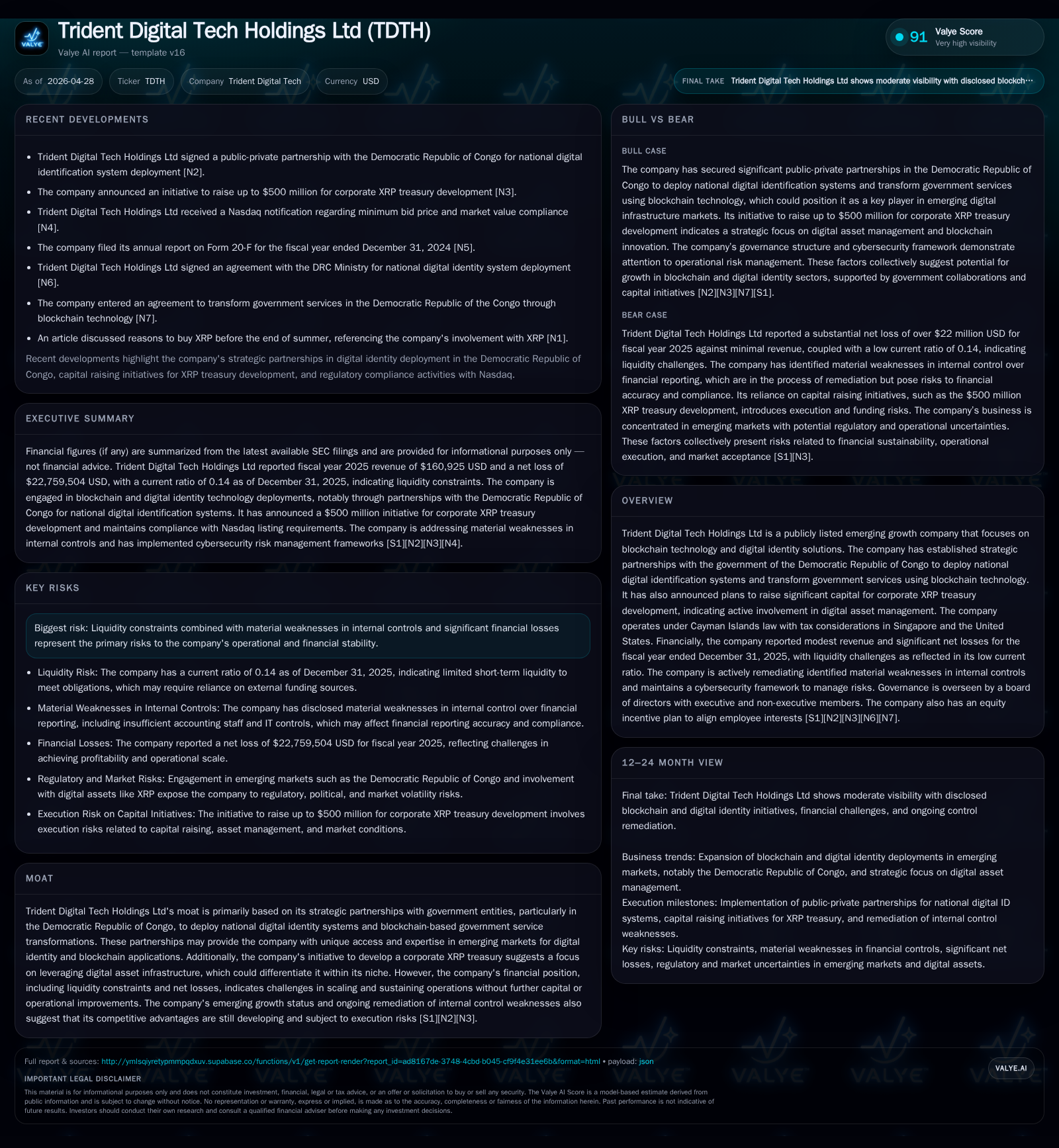
Trident Digital Tech Holdings Ltd’s latest quarterly 6-K filings reaffirm routine regulatory compliance and a planned ADS ratio adjustment, underscoring its commitment to transparency without reporting material new revenue streams. The company’s business model centers on deploying blockchain-based digital identity systems in emerging markets, notably through government collaborations in the Democratic Republic of Congo, supplemented by initiatives to harness digital asset infrastructure via a corporate XRP treasury. Despite strategic positioning within an underpenetrated market niche, TDTH faces structural constraints from significant liquidity challenges and material control weaknesses that temper near-term scaling prospects. Upcoming execution milestones revolve around completing treasury development, advancing government contract deployments, and addressing internal control remediation.
Quarterly Operating Developments: Latest Filings Breakdown
Trident Digital Tech Holdings Ltd’s April 21, 2026 Form 6-K filing serves as the key recent disclosure anchoring this analysis [S2]. This filing primarily confirms procedural matters including the company’s intention to implement an American Depositary Share (ADS) ratio change announced earlier in April [S3], reflecting standard equity structure adjustments aimed at optimizing investor accessibility rather than signaling new commercial developments. Both April filings are signed off by CEO Soon Huat Lim, reinforcing accountability.
Critically, these updates do not indicate material changes in revenue generation or new project awards. Instead, they reflect TDTH’s ongoing commitment to regulatory compliance through diligent reporting under the Securities Exchange Act of 1934. This steadiness suggests the company remains in a phase focused on operational consolidation and stakeholder communication rather than rapid expansion or diversification.
Core Business Model and Blockchain Product Offering
Trident Digital Tech operates within a specialized niche of blockchain technology applications targeting digital identity solutions predominantly deployed in emerging economies. Its flagship initiative involves collaboration with the government of the Democratic Republic of Congo (DRC) to create comprehensive national digital identification systems leveraging blockchain’s immutability and security features [S1]. Such deployments aim to modernize public service delivery and enhance governmental transparency.
Revenue arises from multi-year service contracts involving system implementation, maintenance, and upgrades, augmented by consulting fees tied to blockchain integration strategies. Beyond identity management systems, TDTH is actively developing a corporate XRP treasury—a strategic move integrating digital asset management capabilities to capitalize on growing cryptocurrency infrastructure trends [S1].
Given the complexity and customization involved in government blockchain solutions—entailing data privacy protocols, interoperability with legacy systems, and adherence to local regulations—the company positions itself as a knowledgeable niche player. Its offering is less commoditized software than bespoke infrastructure aligning technological innovation with public sector modernization agendas.
Competitive Positioning within Emerging Market Digital Identity
TDTH occupies a less crowded segment characterized by high barriers to entry stemming from political sensitivities around government data sovereignty and intricate regulatory landscapes. The partnership with DRC acts as a high-moat asset; national ID projects typically exhibit lengthy adoption cycles but yield sticky relationships due to switching costs involved in moving identity platforms once embedded.
Competitive threats primarily come from larger global technology providers with more diversified offerings and deeper capital reserves capable of absorbing longer sales cycles. However, these incumbents may lack TDTH’s regional focus or agile approach suited for frontier market nuances. Alternative startups in blockchain identity face challenges scaling without comparable governmental access or capital backing.
Policy volatility and regulatory uncertainty in emerging markets constitute notable risks but also reinforce TDTH’s value proposition as a partner adept at navigating these complexities [S1].
Strategic Partnerships Driving Market Access and Moat
Government partnerships form the backbone of TDTH’s competitive edge by granting privileged access to national-scale identity initiatives otherwise difficult for new entrants to penetrate [S1][S2]. Such alliances confer legitimacy that can be extended into adjacent public services needing secure digital verification mechanisms.
The announced development of a corporate XRP treasury signals an innovative effort to diversify revenue streams by leveraging blockchain-derived assets beyond traditional software licensing and service fees [S1]. While nascent, this initiative could create synergistic value by integrating treasury management with transactional use cases within target markets. It also aligns TDTH with expanding digital currency ecosystems that may underpin future platform capabilities.
Growth Catalysts Versus Structural Constraints
Growth opportunities hinge on scaling existing deployments in DRC while signing new partnerships in comparable emerging economies receptive to blockchain modernization. Milestones such as successful rollouts completing initial phases or confirmations of additional sovereign engagements represent measurable KPIs driving top-line growth potential.
Conversely, structural impediments are material. The year-end financial snapshot reveals modest revenue around USD 160K contrasted against significant net losses exceeding USD 22 million coupled with minimal liquid assets relative to liabilities (current ratio ~0.14) [F1]. These figures underscore tight liquidity requiring either fresh capital influx or stringent cost management to sustain operations during multi-year contract durations.
Internal control weaknesses identified by management relate to accounting staffing shortages, procedural deficiencies in complex GAAP transactions, and IT security gaps [S10]. Although remediation actions commenced—including upgraded accounting systems and standardized closing processes—full resolution remains pending. These shortcomings add operational risk layers potentially impairing timely financial reporting vital for investor confidence.
Inflationary factors affecting personnel and overhead costs have so far exerted negligible direct impact but remain monitored risks given their potential erosion of margin structures if revenues stagnate [S4]. Foreign exchange exposure exists due to Singapore dollar functional currency entities; however, current exposures are deemed immaterial pending greater international scale [S4].
Upcoming Milestones and Key Execution Metrics to Watch
Future performance hinges on several critical execution points: completion of the ADS ratio adjustment planned post-April filings; advancement of corporate XRP treasury development efforts including capital raising activities; tangible progress reports on expansion of blockchain identity deployments within DRC; potential announcement of new governmental contracts; and evidence of effective remediation of internal control material weaknesses established during fiscal 2025 [S2][S3][S10].
Investor attention should focus on disclosures detailing schedule adherence for government project phases as these correlate directly with revenue recognition timing. Updates on treasury asset accumulation or monetization within the XRP project will shed light on diversification success beyond core services.
Current Financial Profile and Liquidity Assessment
TDTH’s financial profile at the close of 2025 starkly illustrates its start-up phase challenges: total debt stood at approximately USD 568K against current assets below USD 800K juxtaposed with current liabilities nearing USD 5.57 million resulting in a perilously low current ratio near 0.14—a key indicator highlighting acute liquidity strain limiting short-term flexibility [F1].
Revenues remain modest at approximately USD 161K reflecting early-stage contract rollouts while net income showed substantial losses exceeding USD 22 million largely driven by operating expenses necessary for technology R&D and market development [F1].
Such dynamics reveal an urgent imperative for either injection of external capital or acceleration toward operational breakeven through contract scaling. The company’s tax domicile strategy spanning Cayman Islands legal framework combined with Singapore tax considerations provides some structural efficiency but does not mitigate fundamental cash flow constraints at present [S1].
Management's ongoing remediation plan aims at shoring up internal control effectiveness which is essential for sustained credibility among investors and partners as TDTH evolves its governance framework aligned with Nasdaq-listed comparables [S10].
This analysis is based solely on publicly filed SEC documents dated through April 28, 2026, including Forms 6-K and 20-F filings associated with Trident Digital Tech Holdings Ltd (ticker TDTH). All financial metrics cited rely explicitly on reported figures without extrapolation or speculation outside documented disclosures. This report intends solely informational synthesis without providing investment recommendations or price targets.
Disclaimer: This is research-only, informational analysis and not investment advice. It may include AI-generated interpretation and general industry context. Always verify important details using primary sources.

Comments