
XCF Global’s Strategic Shift: Executive Changes Signal New Phase Amid SAF Expansion
Recent executive turnover at XCF Global underlines strategic recalibration as the company pursues scaled Sustainable Aviation Fuel production through a tolling model amid operational and financial pressures.
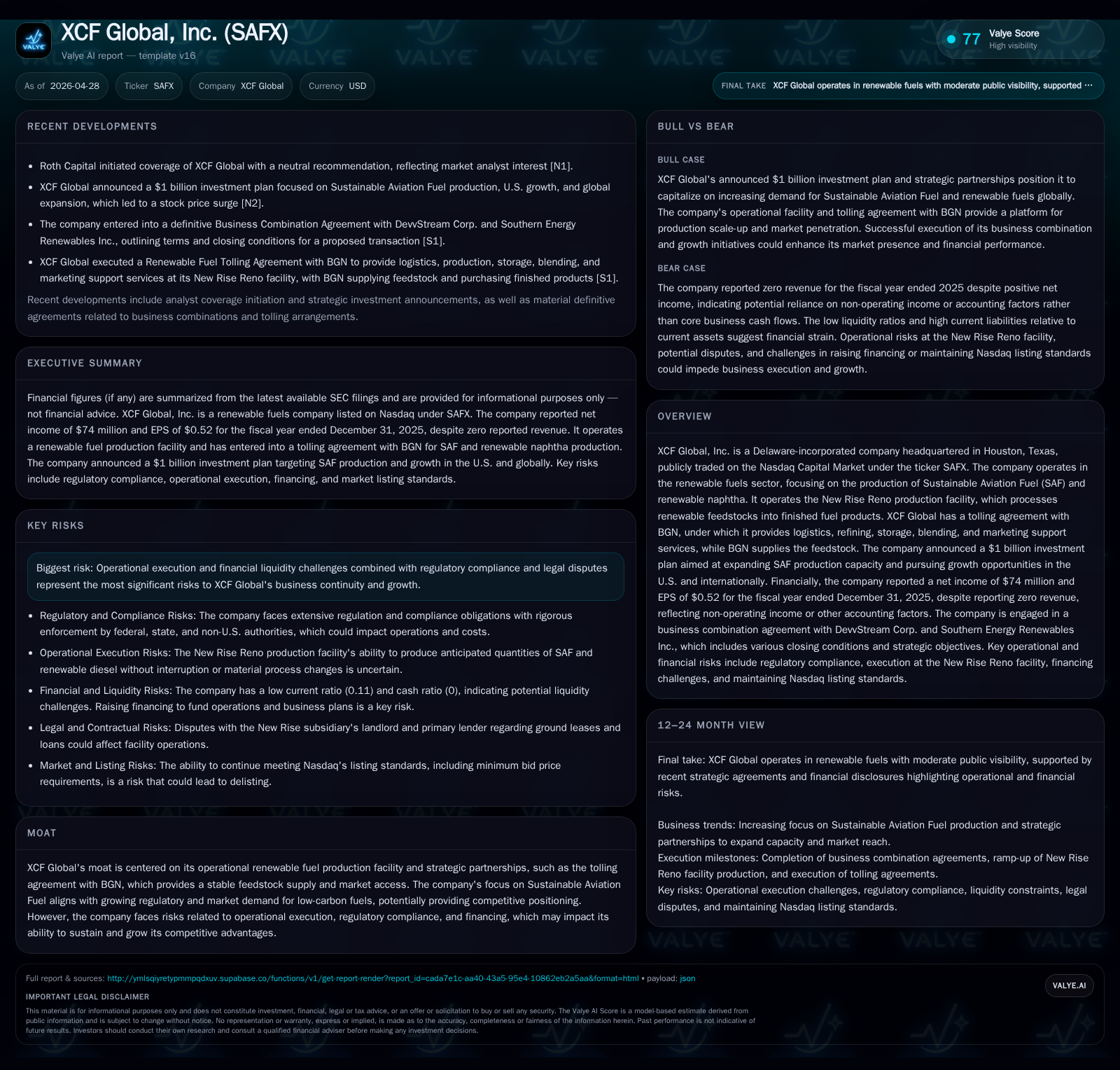
In April 2026, XCF Global, Inc. announced the termination of its Chief Financial Officer, marking a significant leadership change during a critical growth phase. The company operates the New Rise Reno facility producing Sustainable Aviation Fuel (SAF) and renewable naphtha under a tolling agreement with BGN, providing steady feedstock supply and logistics capabilities. With a $1 billion expansion plan underway to boost SAF capacity in alignment with global low-carbon fuel policies, XCF faces challenges including tight liquidity, high leverage, and complex regulatory compliance. Monitoring operational ramp-up progress, leadership transitions, and capital deployment will be key to assessing execution.
Executive Leadership Update and What It Signals
In the company's most recent material event filing dated April 14, 2026, XCF Global disclosed the termination of William Dale as Chief Financial Officer effective April 9, 2026 [S3]. Mr. Dale brought extensive experience overseeing finance functions through periods of growth and integration at prior global firms. His departure comes at a pivotal time when the company is seeking to scale sustainable aviation fuel production rapidly. This leadership change likely signals an intensification of focus on financial oversight during rising operational complexities and cash flow management demands intrinsic to capital-intensive renewable fuels development.
A seasoned executive exit often presages strategic realignments or adjustments in execution priorities—particularly in companies navigating large-capex phase shifts under evolving market and regulatory conditions. XCF's move suggests board and management are recalibrating their approach to managing liquidity risks while advancing expansion programs.
Business Model Overview: Tolling Agreement and Renewable Fuel Production
XCF Global’s core operating model pivots around its New Rise Reno production facility located in Houston, Texas, specializing in renewable fuels—principally Sustainable Aviation Fuel (SAF) and renewable naphtha [S1]. The firm operates primarily under a tolling agreement with BGN, whereby BGN supplies the renewable feedstocks while XCF handles processing activities including refining, storage, blending, logistics coordination, and marketing support.
This partnership-based structure positions XCF somewhat asset-light regarding feedstock procurement risk because it does not own raw material inventories outright but instead relies on feedstock supply contracts managed by BGN. From a scalability standpoint, this reduces exposure to input cost volatility and enables focus on optimizing plant throughput efficiency and downstream value-add services.
However, reliance on a single partner for feedstock also introduces dependency risk that could constrain continuous operations if supply disruptions occur. The firm's revenue generation is thus tied tightly to throughput volumes processed on behalf of BGN alongside the efficacy of its service margin capture across fuel logistics and blending.
Industry Context: Competitive Dynamics and Regulatory Tailwinds in SAF
The sustainable aviation fuel sector is characterized by robust structural demand driven by intensifying global environmental policies aiming to dramatically reduce carbon footprints within commercial aviation—a sector historically difficult to decarbonize. Low Carbon Fuel Standards (LCFS), Renewable Fuel Standard (RFS) credits in the U.S., along with accelerating international mandates compel airlines toward adopting certified SAF blends.
Within this expanding addressable market, incumbent refiners expanding into renewables compete alongside emerging pure-play SAF producers like XCF Global [S1]. The industry exhibits moderate entry barriers due to capital intensity of retrofit or Greenfield facilities capable of converting diverse bio-feedstocks into drop-in sustainable hydrocarbons.
XCF's positioning leverages regulatory tailwinds enabling potential pricing power above fossil jet fuel benchmarks attributable to environmental attributes embedded within credit markets. Yet competitive pressures from larger integrated energy firms investing aggressively in renewables pose ongoing challenges alongside hurdles integrating evolving compliance certification pathways for new products.
Growth Catalysts: Capacity Expansion Plan and Market Opportunities
Central to XCF’s growth strategy is its announced $1 billion investment plan designed to expand SAFE from New Rise Reno’s base capacity substantially both domestically within the U.S. market and internationally targeting jurisdictions with favorable incentive regimes [S1,N1]. This scale-up aims not only to enhance volume throughput but also broaden product portfolio relevance into renewable naphtha potentially serving petrochemical applications.
Achieving these buildouts aligns firmly with policy-driven demand escalations pegged to mid-century carbon neutrality goals set by aviation regulators globally. The timing of this CAPEX matches anticipated tightening supply versus soaring mandate requirements that forecast supply deficits over the next decade.
Utilizing the tolling model may improve fixed cost absorption associated with expanded infrastructure since incremental capacity directly correlates to processing volumes contracted with BGN or similar partners. The model theoretically allows flexible scaling without concomitant upstream capital burden effectively improving return dynamics once stable operational execution matures.
Operational Risks and Financing Constraints
Despite promising expansion plans, XCF confronts near-term execution challenges spanning plant ramp-up dynamics and financing tightness. Its balance sheet as per SEC-filed disclosures indicates very constrained liquidity evidenced by a current ratio around 0.11 (current assets roughly $27.6 million versus current liabilities about $249 million) signaling potential working capital stress [F1].
Furthermore, net debt stands near $3.57 million suggesting elevated leverage given limited cash reserves (~$155k), consistent with an organization heavily invested yet early in commercial scaling phases [F1]. These financial constraints increase vulnerability to unexpected execution delays or regulatory compliance costs related to evolving SAF certification rules.
Management turnover at CFO level echoes these pressures spotlighting urgent needs for rigorous cash flow discipline amidst heavy capital deployment pipelines. Regulatory uncertainty remains another vector of risk where shifting government incentives or rule interpretations could materially impact project economics or eligibility criteria for credit mechanisms supporting pricing power.
Critical Event and Operating Highlights from Latest SEC Filings
Alongside leadership changes documented in April 2026 filings [S3], recent proxy-related disclosures incorporated into the amended annual report reveal new board appointments including executives skilled in global risk management, cybersecurity frameworks, and decarbonization advisory roles [S1]. This governance rejuvenation underscores an intentional pivot toward bolstering oversight capabilities aligned with strategic transformation imperatives.
Operating updates reaffirm active status of New Rise Reno production assets focusing on ramping SAF output though specific volume targets remain undisclosed. The filings emphasize continued reliance on the BGN tolling partnership for feedstock reliability essential to meeting projected capacity timelines [S1,S3].
Financial Profile Snapshot Supporting Operational Narrative
Cash holdings remain limited just shy of $155k against significant current liabilities exceeding $249 million further highlighting liquidity pressures during this build period [F1]. Total debt registered at over $3.7 million reinforces financing commitments already assumed likely tied to capital project funding requirements.
The financial snapshot confirms that while profitability may currently be symbolic or temporarily buoyed by financing gains or other factors, operational scalability remains key before revenue recognition solidifies underlying business sustainability.
Forward-Looking Indicators and What to Monitor Next
Investors monitoring XCF Global will want to carefully track several forward indicators relevant for gauging strategic execution:
- Subsequent executive appointments or any further turnover particularly regarding finance or operations that reflect organizational stability or realignment efforts [S3].
- Milestones relating to deployment progress against the announced $1 billion capital expenditure framework including construction completions at New Rise Reno or potential new facilities [S1,N1].
- Initial revenue recognition events tied to commercial-scale SAF sales validating throughput targets under contractual arrangements.
- Stability of feedstock supply from BGN or diversification efforts mitigating dependency risks underpinning production continuity.
- Regulatory developments on SAF incentives including LCFS credit valuations or governmental support programs influencing pricing dynamics.
- Any shifts in credit rating or financing terms affecting liquidity access amid heightened leverage environment indicated by latest filings.
Together these factors will define whether XCF transitions successfully from early development towards fully commercialized sustainable aviation fuel producer leveraging regulatory momentum effectively.
This analysis synthesizes information solely from publicly filed SEC documents dated April 2026 and corroborated numerical data as of fiscal year-end 2025 without speculative extrapolation beyond documented facts. It aims to provide an informed industry commentary contextualizing recent corporate events within prevailing sector trends relevant for buy-side decision makers evaluating company operational positioning.
Disclaimer: This is research-only, informational analysis and not investment advice. It may include AI-generated interpretation and general industry context. Always verify important details using primary sources.

Comments