
Northfield Bancorp Eyes Strategic Scale Boost Through Columbia Financial Merger
Northfield Bancorp’s ongoing merger with Columbia Financial represents a pivotal move to enhance scale and competitiveness in regional banking.
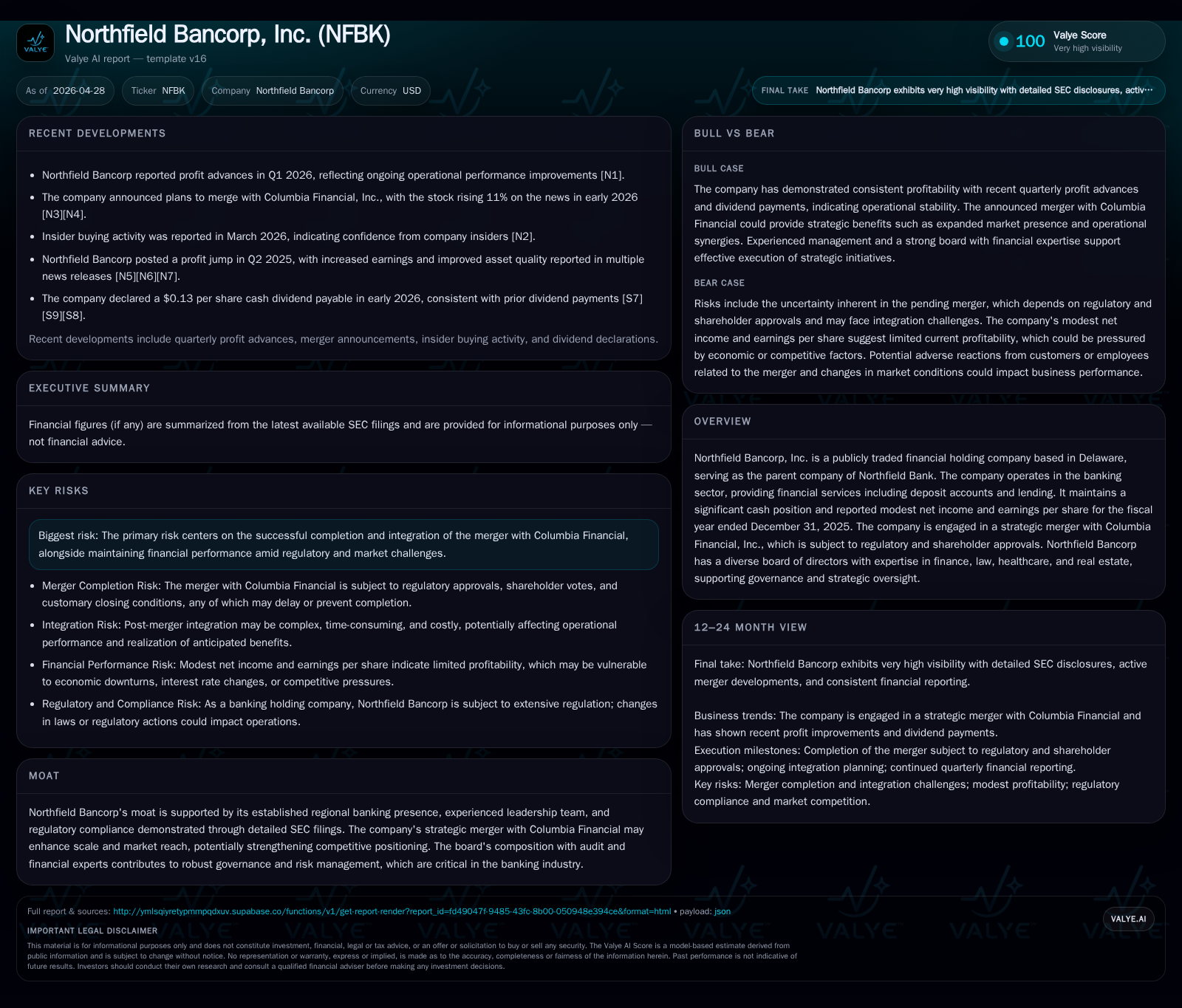
Northfield Bancorp recently reported modest earnings in Q3 2025, underscoring its steady regional banking model as it progresses toward a transformative merger with Columbia Financial. This merger, pending regulatory and shareholder approvals, aims to deliver scale advantages, operational synergies, and expanded market reach that the standalone entity struggles to achieve. The combined governance strength and focused management team position the merged entity to better navigate regulatory challenges and competitive pressures intrinsic to the regional banking sector. Key near-term performance indicators will center on merger execution milestones, earnings trajectory, and dividend continuity.
Recent Quarterly Operating Update: What Changed and Why It Matters
Northfield Bancorp’s latest 10-Q filing dated November 7, 2025 [S2] provides key insights into its near-term operating environment ahead of an imminent strategic transformation. The company reported modest net income reflecting its regional banking portfolio's steady but limited earnings power. This conservative profitability base underscores the inherent challenges mid-sized banks face in scaling margins absent significant operational leverage.
Further reinforcing their strategic direction is the April 2026 8-K update [S3], which communicated first quarter earnings alongside a $0.13 per share dividend declaration payable in May 2026. The dividend continuation despite modest profits signals management's commitment to shareholder returns while navigating transition, balancing growth ambitions with prudence.
Together, these filings anchor Northfield’s current operating picture on stability as it prepares for a transformative merger with Columbia Financial [S5,S6], positioning this transaction as the primary catalyst for future performance trajectory.
Business Model Insights: Foundations of Northfield’s Regional Banking Approach
Northfield Bancorp functions primarily as a financial holding company for Northfield Bank [S1]. Its business model rests on traditional banking activities — accepting deposits from individuals and businesses, alongside lending operations primarily within its regional footprint. The offering is strategically oriented toward retail and commercial customers valuing localized relationships and tailored solutions over commoditized national bank products.
Operationally, this model emphasizes deposit gathering which provides a low-cost funding base to support loan origination. The company maintains a sizable cash position (~$164 million as of end-2025) [F1], reflecting liquid asset buffers that support regulatory capital requirements and enable agile responses to credit or interest rate dynamics.
The annual report highlights governance processes designed to align executive compensation with market norms in community banking while limiting excessive perks [S1]. This prudent alignment demonstrates an organizational culture focused on sustainable performance rather than aggressive growth, consistent with observed modest earnings levels.
Industry Competitive Framework: Regional Banks and M&A as Growth Engines
Within U.S. banking, Northfield occupies the mid-tier regional segment—a space characterized by pricing pressures due to intense competition for loan and deposit customers among numerous similarly sized peers. Regulatory demands around capital adequacy, compliance programs, and risk management also weigh heavily on these institutions [S2].
In such an environment, scale becomes increasingly vital. Larger regional banks benefit from broader geographic reach, diversifying revenue streams while gaining better pricing power through expanded customer bases — factors standalone smaller players struggle to replicate naturally.
The pending merger with Columbia Financial must be understood against this backdrop: it is a strategic response to competitive realities pressing many mid-sized banks toward consolidation [S1,S5]. Governance expertise evident in board composition — including audit committee members skilled in finance and regulatory affairs — further buttresses Northfield’s capability to operate effectively within a complex regulatory regime.
Growth Catalysts: Merger Synergies, Market Reach, and Earnings Potential
The announced agreement with Columbia Financial [S5,S6] represents Northfield's best pathway toward meaningful growth and improved profitability metrics. Post-merger scale should enable fixed cost dilution across a larger asset base, driving operational efficiencies impacting combined return metrics positively.
Merger-related filings specify anticipated accretion effects on tangible book value earn-back periods and EPS enhancements contingent on successful integration [S5]. Expanded branch networks can attract more diversified deposits reducing reliance on any single geography or sector.
Synergies likely encompass shared technology platforms, streamlined back-office functions, and enhanced product offerings benefiting from combined expertise. These elements collectively should strengthen pricing flexibility on both loan rates and deposit costs — critical levers under margin compression environments typical of regional banking.
Headwinds and Risks: Regulatory Approvals, Integration Complexity, and Market Sensitivity
Despite potential benefits, substantial execution risks persist. The transaction remains subject to customary closing conditions including regulatory consent from bodies such as the Federal Reserve Board and the Office of the Comptroller of the Currency, with no materially burdensome conditions imposed [S20,S22]. Delays or restrictive stipulations could diminish expected benefits or defer timeline.
Integration challenges—common in bank mergers—include harmonizing distinct corporate cultures, systems migration without service disruption, retention of key staff and customers, plus aligning risk frameworks appropriately [S2]. Earnings volatility remains a concern given current net income modesty (~$796K reported for FY2025) [F1], constraining buffer capacity if integration costs escalate.
Monitoring regulatory developments closely will be essential given evolving oversight trends post-financial crises have entrenched rigorous examination regimes particularly focused on systemic risk contributors within mid-sized institutions.
Key Milestones to Monitor: Merger Progress, Dividend Sustainability, and Earnings Trajectory
Investors should track multiple event-driven milestones clearly outlined across recent filings:
- Shareholder Approvals: Votes required for both entities underpin merger completion timing [S20].
- Regulatory Clearance: Notifications about receipt or delay of government consents will signal progress or potential hurdles [S22].
- Dividend Payments: Continued declaration of quarterly dividends (latest $0.13 per share for May 2026) affirms commitment toward balanced capital stewardship despite transition risks [S3,S6].
- Quarterly Earnings Releases: Updates post-merger closing will provide clarity on operational performance improvements or challenges realized from integration steps.
Clear communication around these milestones could materially shift market expectations regarding valuation re-rating prospects tied to delivery vs execution slippage.
Financial Position Briefing: Liquidity, Net Debt, and Profitability Snapshot
Northfield’s balance sheet as of December 31, 2025 exhibits a robust cash & equivalents position at approximately $164 million against trailing total debt around $666 million recorded at end-2024 per best available data [F1]. This translates into an estimated net debt figure near $502 million enabling manageable leverage levels within typical community bank norms.
Reported net income was modest at roughly $0.8 million for fiscal 2025 [F1], consistent with conservative earnings performance seen throughout recent quarters [S2]. The declared dividends totaling $0.13 per share evidence disciplined cash flow allocation aiming to maintain investor confidence while balancing investment needs for merger-related growth initiatives [S3,S6].
This capital structure maintains sufficient flexibility for funding ongoing operations plus merger financing requirements without imposing undue strain on liquidity reserves—an important consideration given market sensitivities in banking sector credit cycles.
This analysis synthesizes publicly available SEC filings alongside company facts without speculation beyond evidenced disclosures. It reflects operational realities shaped by strategic consolidation moves typical in mid-sized U.S. regional banking landscapes today while anchoring expectations firmly in documented financial metrics. Readers seeking investment decisions should consult licensed financial advisors considering their personal circumstances.
Disclaimer: This is research-only, informational analysis and not investment advice. It may include AI-generated interpretation and general industry context. Always verify important details using primary sources.

Comments