
Kandi Technologies Expands U.S. Footprint with Rawrr Acquisition Amid Off-Road EV Market Shift
Kandi Technologies’ late 2025 strategic acquisition of Rawrr Inc. marks a pivotal expansion into North America, complementing its established off-road electric vehicle business.
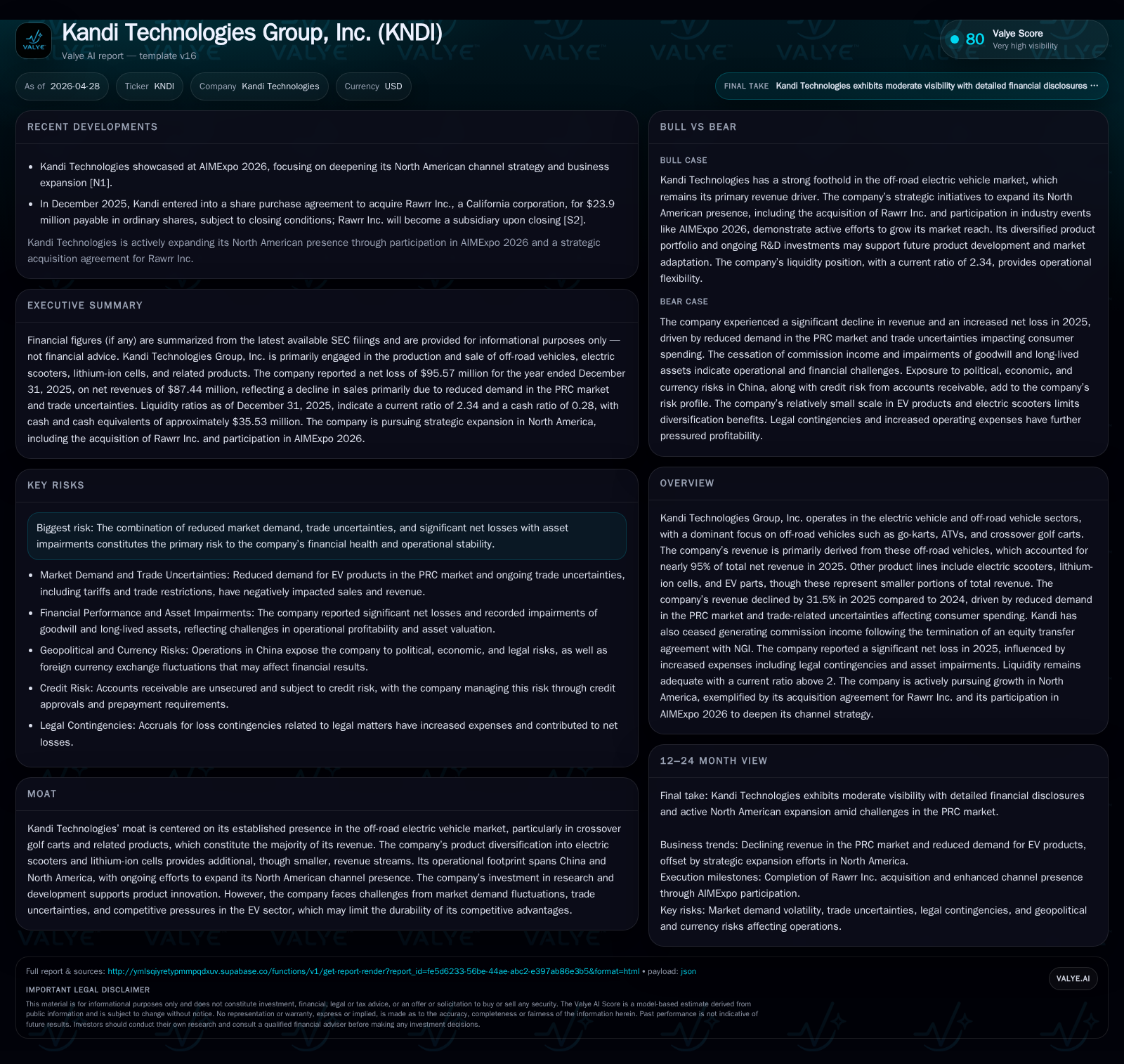
In December 2025, Kandi Technologies Group entered a conditional agreement to acquire Rawrr Inc., a California-based company, for approximately $23.9 million in stock consideration, signaling intensified focus on the North American off-road electric vehicle market. This move aligns with Kandi’s core business concentration on electric off-road vehicles—primarily crossover golf carts, ATVs, and go-karts—which made up nearly 95% of revenues in 2025, despite an overall revenue decline amid challenging market conditions in China. While Kandi grapples with net losses driven by impairments and legal expenses, its expanding U.S. presence and ongoing R&D investment in new off-road vehicle models promise pathways for future growth, provided it navigates risks inherent to demand variability and trade uncertainties.
Recent Quarterly Update: Rawrr Acquisition Signals North America Expansion
In December 2025, Kandi Technologies Group solidified its strategic intent to expand aggressively into the U.S. market by entering a share transfer agreement to acquire Rawrr Inc., a California-based off-road electric vehicle player valued at $23.9 million according to an independent third-party valuation [S2]. The purchase consideration is payable entirely through issuance of approximately 17.7 million ordinary shares at $1.35 each, reflecting recent Nasdaq trading prices before the deal reference date.
Notably, Rawrr’s board leadership includes individuals connected to Kandi’s director base, introducing related-party dynamics that Kandi's audit committee carefully reviewed before approval [S2]. Upon completion of this acquisition—pending customary closing conditions—Rawrr will become a consolidated subsidiary of Kandi, effectively broadening Kandi's operational footprint into key North American markets where off-road EV acceptance is growing.
This transaction underscores a deliberate shift in Kandi’s geographic revenue mix as the Chinese EV market encounters persistent regulatory uncertainties and subdued consumer demand volatility [S16]. By securing a foothold in the U.S., Kandi aims to leverage established distribution networks and capitalize on rising interest in electrified off-road mobility solutions.
Business Model Centered on Off-Road Electric Vehicles with Diversifying Product Mix
Kandi Technologies derives the vast majority—nearly 95%—of its revenue from sales of pure electric off-road vehicles including crossover golf carts, all-terrain vehicles (ATVs), and go-karts [S1]. These products cater predominantly to recreational and utility use cases and benefit from relatively favorable unit economics compared with passenger EV segments due to simpler design architectures and niche market positioning.
The company has strategically de-emphasized the lower-margin EV parts segment post-2023, concentrating investments towards these off-road segments where proprietary designs allow for better margin capture [S1]. Ancillary product lines such as electric scooters and lithium-ion battery cells contribute marginal revenue but also represent potential long-term growth levers given rising urban micro-mobility demand patterns.
Revenue recognition aligns strictly with fulfillment obligations upon delivery under ASC 606 standards, providing clarity into contract performance dynamics across product lines [S1]. The gross margin uplift to 42.6% in 2025 compared with prior years signals improved profitability driven by favorable product mix shifts compounded by liquidation of impaired inventory reserves that temporarily boosted margins earlier in the year [S15].
Competitive Dynamics and Industry Structure in EV and Off-Road Markets
Kandi operates within a specialized niche that straddles electric mobility’s broader trend but avoids direct head-to-head competition with large passenger EV manufacturers dominating China or global markets. This distinct vertical focus on off-road vehicles builds moat aspects anchored on brand recognition within recreational users as well as emerging commercial applications.
Research & Development investments have ramped up notably (over +50% increase) supporting continuous innovation including upcoming launch plans for electric UTVs alongside enhanced crossover golf carts slated for sequential release phases [S3], [S16]. Such R&D inputs also attempt to counterbalance challenges in supply chain costs and evolving regulatory landscapes both inside China (e.g., fluctuating safety standards) and abroad.
The expansion into North America via Rawrr acquisition attempts to alleviate historical channel penetration bottlenecks faced by Asian manufacturers trying to scale foreign sales amidst logistical complexities and consumer preference localization requirements [S2]. Meanwhile, competitive pressures persist from local players deploying differentiated technology stacks or focusing on adjacent personal transportation segments.
Growth Drivers: New Product Launches and Channel Expansion Strategies
Kandi is betting on its pipeline of pure electric off-road vehicles—including the imminent release of crossover golf carts upgraded for broader utility use—and new electric UTV offerings as principal sources for sustainable volume growth beyond its home China market where demand softness has become structural rather than cyclical [S16].
The acquisition of Rawrr plays a complementary role here by providing immediate access to North American distribution infrastructure plus product-market fit insights essential for tailoring models towards western customer expectations. This inorganic growth initiative fits a classic "growth-by-acquisition" playbook while enabling cross-brand synergies that could improve supply chain leverage and reduce per-unit manufacturing costs over time.
Secondary contributions stem from ongoing lithium-ion battery cell production capabilities which although currently small-scale deliver incremental revenue streams while supporting vertical integration efforts that could eventually improve margin profiles if scaled efficiently [S8].
Key Challenges: Market Demand Volatility and Trade-Uncertainty Risks
Despite technology progressions and geographic diversification plans, Kandi faces substantial headwinds characterized by a sharp revenue decline (-31.5%) from $127.6 million in 2024 to $87.4 million in 2025 primarily due to weakened consumer spending in the PRC amidst trade tensions and regulatory uncertainty impacting market confidence [S1], [F1].
Furthermore, the company ceased commission income following the termination of an equity transfer arrangement with NGI, removing a non-operational revenue buffer line present earlier [S1].
On cost pressures, significant impairment charges related to goodwill ($9.7 million) and long-lived assets ($6 million) reported in 2025 signal cautious accounting recognition around asset recoverability given uncertain future cash flows linked partly to soft retail adoption rates and inventory obsolescence risk inherent in fast-evolving EV tech cycles [S15].
Legal contingencies and elevated general & administrative expenses — which alone comprise over half of operating costs — compound near-term profitability challenges.
Such hurdles highlight risk exposures not only tied to macroeconomic cyclicality but structural shifts requiring prudent capital allocation going forward.
Next Milestones to Monitor: Integration Progress and Revenue Recovery Signals
Investors should closely watch completion status of the Rawrr acquisition including any post-closing adjustments or integration synergies disclosed by management through upcoming Q1/Q2 filings given how pivotal this event is for expanding commercial reach outside Asia [S2], [S1].
Product rollout timelines for new electric crossover golf carts and UTV models will serve as proxies for innovation execution quality alongside customer acceptance metrics revealed through shipment volumes or backlog disclosures.
Monitoring quarterly top-line trends especially within North American channels post-acquisition could provide early signs whether geographic diversification efforts translate into tangible revenue growth mitigating PRC market softness risks.
Additionally, changes or trends in operating expense structures — particularly around impairments or R&D spend momentum — will be informative about management’s financial discipline amid scaling initiatives.
Financial Snapshot: Cash Position, Debt Levels, and Operating Loss Analysis
At year-end December 31, 2025, Kandi held approximately $35.5 million in cash & equivalents against total debt near $6.1 million resulting in a net cash position indicative of moderate balance sheet strength supporting ongoing operations and planned acquisitions [F1].
However, operating performance remains under pressure highlighted by an operating loss exceeding $57 million for fiscal 2025 reflective primarily of impairments amounts combined with elevated selling/administrative overheads amid shrinking top-line base [F1], [S15]. Net loss widened sharply close to $94 million marking sustained earnings headwinds despite cash flow improvements evidenced elsewhere by positive operating cash inflows reported recently after previous periods’ negative cash flow swings [S3].
This mixed financial picture suggests that while liquidity buffers grant runway for near-term strategic moves such as Rawrr acquisition or R&D push; profitability restoration hinges critically on successful execution across product innovation adoption curves coupled with effective cost controls.
This analysis is based solely on information available from Kandi Technologies Group's publicly filed SEC documents as of April 28th, 2026 ([S1], [S2], etc.) along with financial snapshots ([F1]). It does not constitute investment advice or recommendations.
Disclaimer: This is research-only, informational analysis and not investment advice. It may include AI-generated interpretation and general industry context. Always verify important details using primary sources.

Comments