
Waterdrop Inc. Advances with Q4 2025 Profitability and Technological Integration
Waterdrop's Q4 2025 results mark its first net profit and dividend declaration, underscoring a maturing integrated platform amidst competitive and regulatory challenges in China.
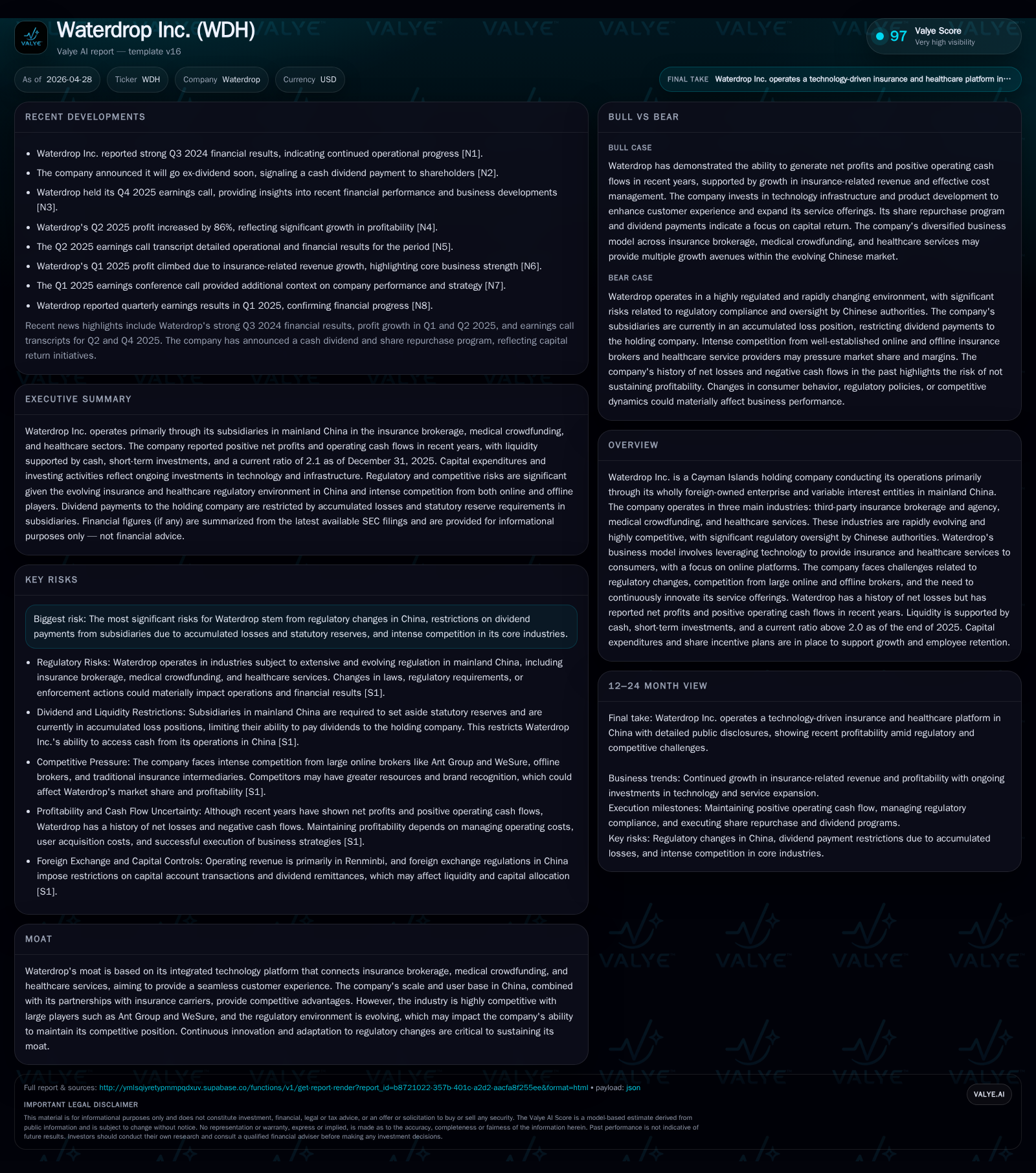
Waterdrop Inc. reported its first net profit for Q4 2025, coupled with a declared cash dividend, signaling operational maturity in its complex business model that spans insurance brokerage, medical crowdfunding, and healthcare services. The company leverages technology to integrate these sectors through an online platform targeting the expanding Chinese insurance and healthcare market. Waterdrop navigates intense competition from both digital giants like Ant Group and traditional brokers amid evolving regulatory landscapes. Key growth drivers include technology investments and expanding user adoption, while constraints arise from capital flow restrictions and statutory reserves under Chinese law. Liquidity remains solid with a healthy current ratio and net cash position supporting strategic initiatives.
Latest Quarterly Results: A Turning Point in Profitability
Waterdrop Inc.'s Q4 2025 unaudited financial results represent a milestone event for the company, reporting its first net profit at RMB 565.1 million (approximately $80.8 million) accompanied by a declared cash dividend payment. This represents a material shift from prior years characterized by net losses and underscores improving operational execution within a complex multi-industry business model [S2]. The declaration of a dividend signals enhanced cash flow generation confidence despite prior limitations on outbound capital flows due to Chinese regulatory requirements.
This profitability stems from robust growth in insurance-related income facilitated through Waterdrop’s integrated platform which links third-party insurance brokerage with medical crowdfunding and healthcare services. The positive operating cash flow of RMB 243.9 million ($34.9 million) alongside profit signifies sustainable revenue conversion capacity despite increases in working capital accounts such as contract assets and accounts receivable driven by escalating first-year premiums (FYP) sourced via the platform [S13].
Business Model Architecture: Integrating Insurance Brokerage, Crowdfunding, and Healthcare Services
Waterdrop operates primarily through its wholly foreign-owned enterprise (WFOE) and variable interest entities (VIEs) in mainland China, functioning as an integrated digital ecosystem spanning three interconnected industries: third-party insurance brokerage/agency, medical crowdfunding, and healthcare services [S1].
Revenue is primarily generated through commissions and fees earned from online insurance brokerage activities that serve as a distribution channel connecting insurers to consumers who increasingly prefer digital-first purchasing experiences. Complementary to this, medical crowdfunding provides consumer-accessible financing solutions for health-related expenses, enhancing stickiness while tapping into unmet social needs within China’s healthcare system. Additionally, the company has expanded into adjacent healthcare services that support clinical research and pharmaceutical development leveraging digital tools.
The proprietary technological infrastructure is fundamental to Waterdrop's value proposition — enabling seamless end-user interactions across insurance policy shopping, claims facilitation, crowdfunding contributions, and care services without fragmentation common in traditional setups. This integration fosters user engagement cross-levers for upselling opportunities and data-driven product personalization aligned with evolving consumer preferences [S1], [S6].
Competitive Dynamics: Navigating China's Rapidly Evolving Insurance and Healthcare Tech Sectors
Waterdrop competes in intensely fragmented markets dominated by tech behemoths such as Ant Group's WeSure brand alongside established offline brokers like Mingya and Datong. These competitors benefit from deep pockets for marketing spend, expansive ecosystems for cross-selling, and entrenched brand recognition that challenge Waterdrop’s customer acquisition strategies [S4], [S22].
The rising cost of user acquisition reflects this battlefield where platforms vie for consumer mindshare within the burgeoning online insurance space while simultaneously satisfying insurer demands for reliable partner infrastructure capable of integrating digital technologies such as AI analytics.
Furthermore, regulatory developments intensify oversight of insurance intermediaries alongside medical crowdfunding activities imposing compliance burdens that require careful adaptation. Such environment requires Waterdrop to innovate rapidly while maintaining trustworthiness — a critical differentiator in industries governed by stringent rules on data privacy, financial prudence, and consumer protection [S17], [S26].
Growth Opportunities: Leveraging Technology and User Base Expansion Amid Regulatory Pressures
Key growth drivers hinge on Waterdrop's ability to capitalize on rising online insurance penetration amid shifting consumer behavior favoring e-commerce style purchase journeys fueled by familiarity with mobile applications. Investment in AI-powered underwriting enhancements aims to improve risk assessment effectiveness for insurer partners thereby broadening product offerings available on the platform.
Medical crowdfunding remains an attractive segment given China's large out-of-pocket medical expenditure portion combined with accelerating adoption of peer-to-peer funding models incentivized by social community engagement. Moreover, expanding healthcare services provided via telemedicine or pharma-related digital offerings offer adjacent growth levers further bolstering revenue diversification.
These initiatives are quantifiable through KPIs including increasing FYP volumes channeled through the platform reflected as rising contract assets; user retention metrics boosted by service integration; expanded insurer partnerships measured via premium payables growth; plus R&D output in software products enhancing user experience [S6], [N1].
Ongoing Challenges: Regulatory Restrictions and Capital Flow Limitations
Despite profitability gains at the consolidated level, corporate structure realities introduce significant constraints on liquidity deployment arising from Chinese legal frameworks governing offshore holding companies' capital flow into mainland subsidiaries [S1], [S3].
Additionally, foreign exchange control regimes enforce procedural barriers requiring SAFE clearance for certain capital transactions complicating offshore liquidity management even when underlying profit criteria are met. These structural issues necessitate prudent treasury management restricting aggressive expansion spend until more subsidiary-level earnings stabilization occurs [S7], [S9].
Key Milestones to Monitor: Guidance, User Metrics, and Innovation Trajectory
Future performance visibility derives from several indicators including quarterly releases updating revenue growth trajectory shaped by new product launches’ reception in core insurance segments; user acquisition/retention data revealing success of marketing investments; incremental advances in AI/analytics augmenting underwriting speed or fraud prevention generating insurer trust improvements; plus relevant regulatory pronouncements clarifying policy on third-party brokerage licensing or medical crowdfunding operational frameworks.
Management commentary during earnings calls has flagged continued emphasis on balancing growth initiatives with profitability discipline given ascending marketing expense trends coupled with investments into research & development focused on platform capabilities enhancement [N2]. Its current assets stood at roughly $569 million relative to current liabilities near $271 million producing a current ratio of approximately 2.1 — indicative of sound short-term financial health supporting operational scalability without immediate refinancing concerns [F1].
Operating income amounted to about $53 million evidencing positive earnings capability aligned with the consolidated net profit milestone achieved during the period enhancing confidence in the sustainability of financial results moving forward.
This analysis synthesizes SEC filings dated through March-April 2026 combined with relevant market commentary to provide an evaluative perspective on Waterdrop Inc.’s operational advances amid China's dynamic insurtech and healthcare service sectors without offering investment guidance.
Disclaimer: This is research-only, informational analysis and not investment advice. It may include AI-generated interpretation and general industry context. Always verify important details using primary sources.

Comments