
Meridian Holdings Advances Multi-Channel Gaming Platform Despite Operational Losses
The latest quarterly results highlight Meridian Holdings’ investment in technology and marketing fueling growth, even as profitability remains challenged by impairments and elevated expenses.
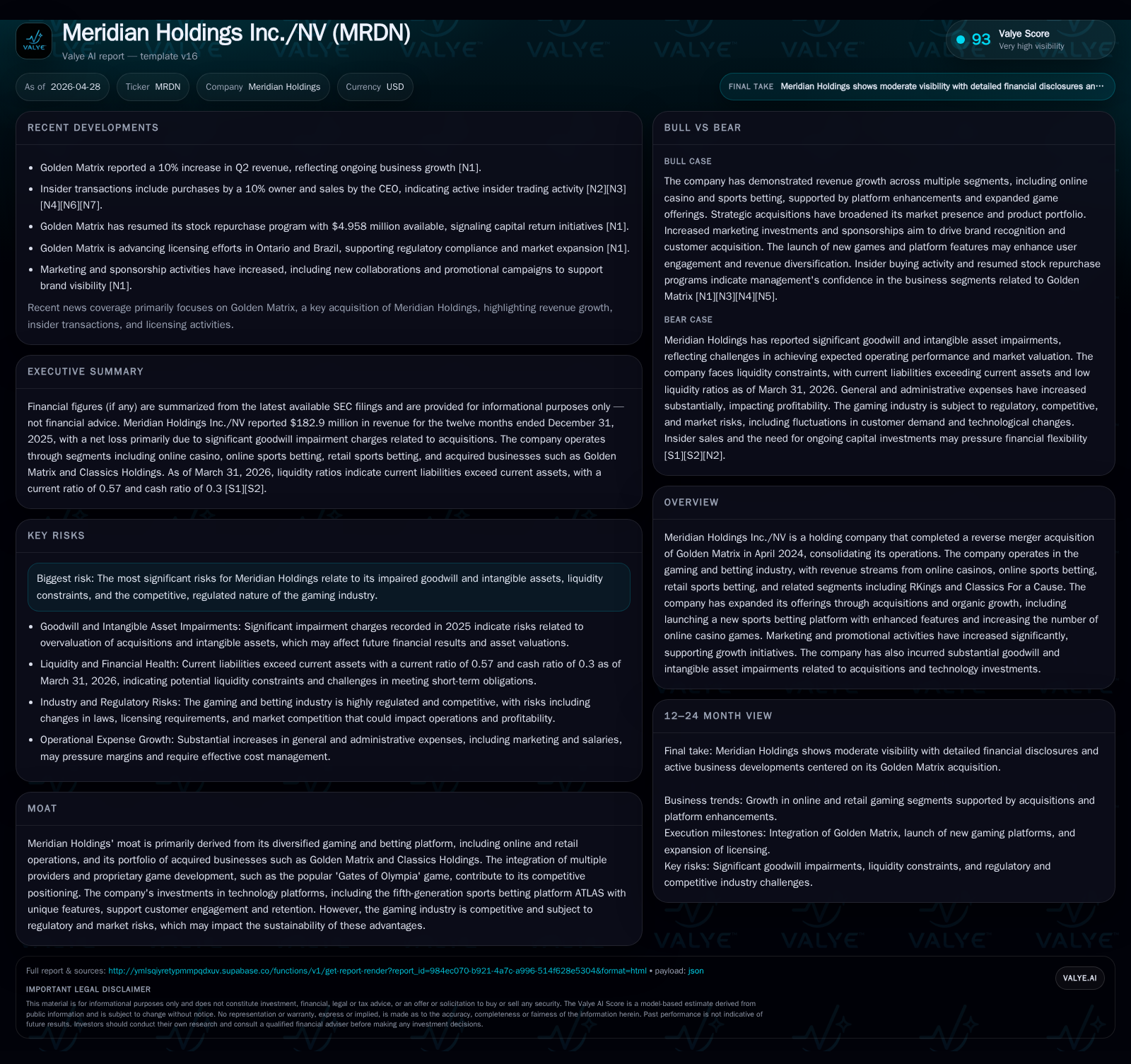
Meridian Holdings reported continued revenue growth driven by acquisitions and enhancements to its multi-channel gaming platform in Q1 2026. Despite expanding customer offerings through flagship products like the ATLAS sports betting platform and proprietary games such as Gates of Olympia, the company faces ongoing profitability pressure from significant goodwill impairments and steady marketing investments. Competitive pressures and regulatory complexities add to operational challenges, while liquidity remains constrained evidenced by a sub-1.0 current ratio. Close monitoring of upcoming product launches and litigation outcomes will be critical for assessing Meridian's path to sustainable growth.
Latest Quarterly Performance and Strategic Update
Meridian Holdings’ 10-Q for Q1 2026 reveals that the company continues to drive topline growth through strategic acquisitions including Golden Matrix and organic initiatives such as launching its next-generation ATLAS sports betting platform. The consolidated revenue increase is complemented by expanded online casino offerings and retail sportsbook activities that broaden Meridian's footprint across wagering segments [S2]. However, these growth efforts come at a cost. The quarter’s operating results reflect substantial goodwill and intangible asset impairments associated with prior acquisitions and technological investments, leading to large operating losses despite higher revenue.
The company has also intensified marketing expenditures in pursuit of active user acquisition and retention—a typical dynamic in this competitive sector—further pressuring margins. The simultaneous push for platform innovation alongside aggressive market expansion underscores Meridian’s investment-heavy approach to gain scale but highlights the challenge of managing profitability during rapid scaling periods [S3].
Business Model and Product Offering Overview
Meridian Holdings functions as a holding entity anchoring a portfolio of gaming-related businesses unified under its multi-channel platform strategy. At the core are online casino operations rich with proprietary content like the flagship "Gates of Olympia" slot game series which drives customer engagement. Alongside this suite are retail sportsbooks complemented by the company’s proprietary fifth-generation sports betting technology branded as ATLAS—a key differentiator providing enhanced user experience through innovative features designed to improve bet placement speed, risk management tools, and dynamic odds presentation.
This diversified revenue model also includes niche segments like RKings—focused on esports—and Classics For a Cause, which adds socially responsible gaming elements. The various acquired entities such as Golden Matrix extend Meridian's geographic reach across regulated markets while helping integrate complex backend platforms for unified operation. This enables cross-selling opportunities between online casino users and sportsbook clients, fostering higher lifetime value per customer [S1].
Economically, each segment carries distinct unit economics: online casinos benefit from high-margin proprietary games reducing supplier royalties; sportsbooks require continuous tech upgrades and data feeds incurring ongoing costs; retail operations add fixed overhead but grant stable cashflows from physical locations. Balancing these cost structures amid customer acquisition costs is pivotal for Meridian’s path to profitability.
Competitive Positioning Within the Gaming Industry
The gaming industry’s structure is fragmented yet dominated by large incumbents with entrenched regulatory licenses across key jurisdictions. Meridian competes on both product innovation—through its proprietary titles and advanced sportsbook tech—and multi-channel integration enabling seamless user experiences across digital and retail touchpoints.
However, several challenges temper its competitive moat: dependence on third-party content providers alongside in-house development creates complexity in licensing fees; sustaining compliance across diverse regulatory regimes increases operational overhead; maintaining gaming licenses requires consistent investment in governance frameworks; pricing pressures emerge amid crowded marketplaces with many operators vying for limited discretionary spend.
Switching costs are moderate; customers can easily move platforms based on game variety or odds competitiveness unless strong brand loyalty or exclusive products exist. Meridian's portfolio strength lies in blending ownership/control over select content with scalable tech infrastructure (ATLAS) that competitors may find costly or time-consuming to replicate fully [S2]. Yet the firm remains sensitive to shifts in regulations or aggressive competitor promotions that could erode share.
Key Growth Drivers and Emerging Constraints
Growth levers include expansion of Meridian's proprietary game library which directly supports organic engagement increases in online casinos. Simultaneously, scaling retail sportsbook operations in licensed regions adds transactional volume diversity reducing single-channel exposure risk.
The ATLAS betting platform's ongoing updates—with improved interfaces and new bet types—serve to boost margins by attracting higher-value wagerers who demand sophisticated market options. Enhanced marketing campaigns have been pivotal to capitalize on these product improvements driving volumetric gains despite challenging market dynamics.
On the other hand, significant impairment charges reflecting overvalued goodwill/intangible assets weigh heavily on earnings quality and underlying balance sheet strength. Continued marketing investments necessary to sustain momentum limit near-term margin improvement potential.
Legal disputes connected to RKings acquisition earnholdback amounts introduce uncertainty concerning contingent liabilities though resolutions appear manageable within quantified provisions [S1]. Regulatory oversight changes could impose further constraints requiring adaptive cost structures or delaying market entries.
Regulatory and Market Risks Impacting Meridian Holdings
Meridian reiterates previous disclosures that emphasize risks inherent in obtaining/maintaining gaming licenses across jurisdictions characterized by evolving rulesets. Its reliance on third-party content providers subjects operations to supplier contract risks including price volatility.
Litigation stemming from acquisition agreements (notably a GBP 500k holdback dispute with RKings counterseller) remains unresolved but is financially provisioned downwards reflecting management's expectation of settlement below initial claims [S1]. Cybersecurity risks specific to gaming platforms also represent possible disruption vectors affecting player trust and company reputation.
Macroeconomic factors influencing consumer discretionary budgets directly affect wagering volumes; recession or inflationary pressures could dampen demand unpredictably.
Importantly, no material change in the risk environment was noted in the latest quarterly filing relative to prior annual disclosures confirming stability albeit persistent uncertainties inherent to the sector’s nature [S8].
Liquidity, Leverage, and Financial Health Snapshot
As of March 31, 2026, Meridian held approximately $15.75 million in cash against total debt near $12.9 million yielding a net cash position slightly positive by about $2.9 million [F1]. The current ratio stands at 0.57, reflecting current assets of approximately $30.5 million against current liabilities of about $53.3 million [F1]. This ratio indicates tight short-term liquidity conditions.
Such a balance sheet configuration suggests ongoing stress in meeting near-term obligations without additional financing or asset monetization strategies—especially relevant given sizable operating losses reported during continued expansion phases [F1]. Interest expense increased modestly year-over-year reflecting incremental borrowings or costlier credit terms.
Overall financial flexibility appears limited which may necessitate careful capital allocation prioritizing liquidity preservation amid ambitious growth spend patterns witnessed recently [S2].
Near-Term Catalysts and Management Guidance to Watch
Investors should monitor progress on integrating Golden Matrix assets more fully into Meridian’s ecosystem enabling cross-selling efficiencies anticipated post-acquisition. Further game releases expanding proprietary libraries would be meaningful demand signals particularly if coupled with positive user engagement metrics presented publicly or informally.
Upcoming iterations or feature rollouts for the ATLAS platform remain critical execution points providing insight into whether technical differentiation sustains user retention amid fierce competitive offers.
Resolution timelines surrounding pending litigation matters will be important as clarified contingencies impact cash flow outlooks.
Management guidance on quarterly revenue trends combined with commentary addressing margin compression versus marketing efficacy will reveal ability to balance growth/profitability trade-offs going forward.
Potential strategic partnerships or financing events referenced in investor communications can provide capital infusion clues alleviating current liquidity constraints supporting longer-term scalability initiatives [S3].
This analysis is prepared solely for informational purposes based on publicly available SEC filings without any recommendations regarding investment decisions related to Meridian Holdings Inc./NV (MRDN). All financial metrics are cited directly from referenced filings where applicable.
Disclaimer: This is research-only, informational analysis and not investment advice. It may include AI-generated interpretation and general industry context. Always verify important details using primary sources.

Comments