
AT&T Advances with Fiber Growth and 5G Expansion Despite Legacy Segment Decline
Q1 2026 results highlight strong subscriber gains and strategic fiber acquisition while legacy copper revenues diminish.
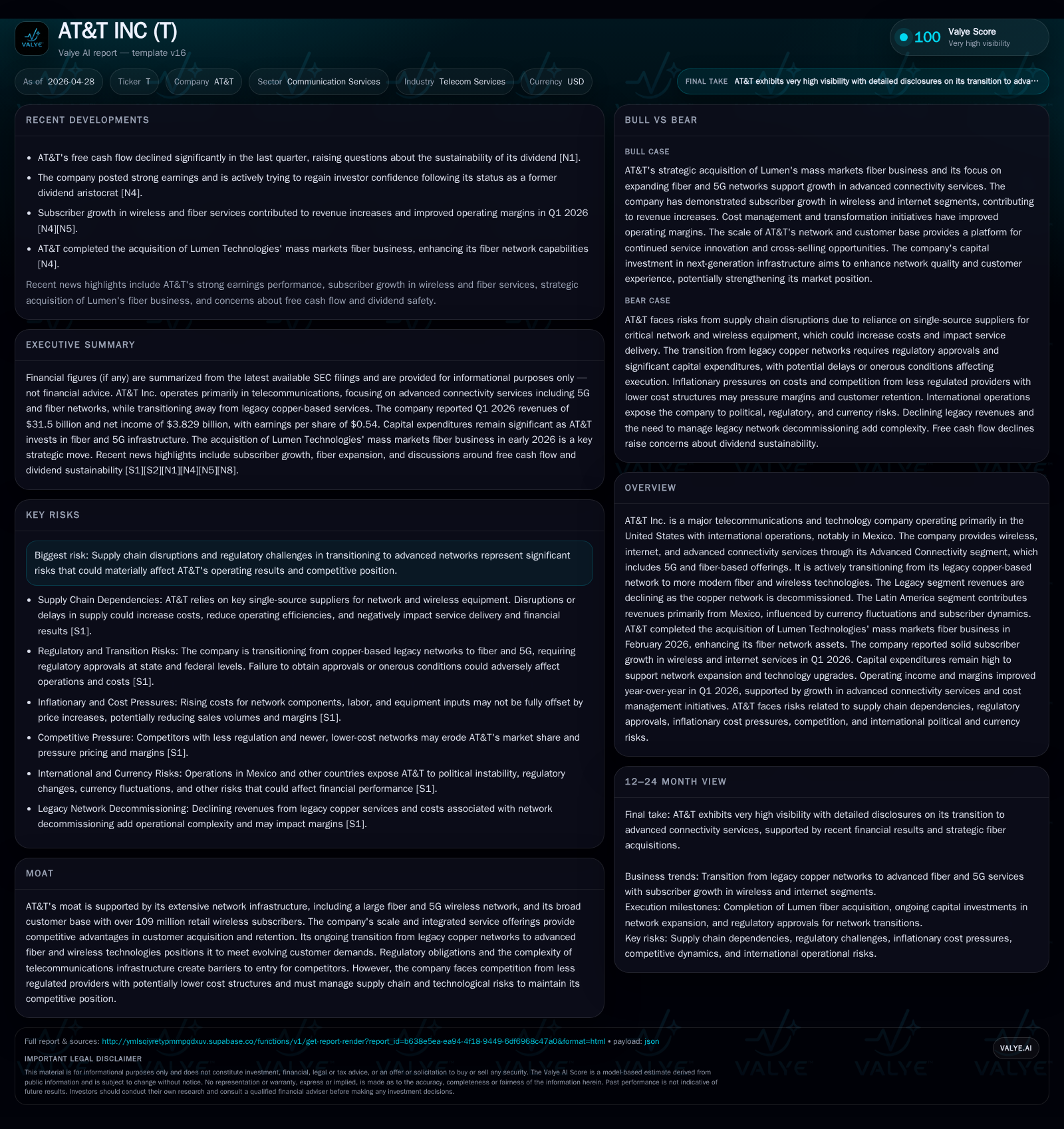
AT&T’s Q1 2026 operating update showcases solid growth in its Advanced Connectivity segment driven by wireless and fiber customer additions, including the integration of Lumen’s mass markets fiber business. The Legacy copper network continues to shrink, reducing revenues and costs in that segment. Latin America sees higher revenues but margin pressure from Mexico’s regulatory changes. AT&T leverages scale and network transitions as competitive moats, though rising costs, pricing pressures, and regulatory risks persist. Cash flow softened partly due to elevated capital spending and reduced DIRECTV distributions. The company’s path centers on expanding fiber and 5G to drive durable demand and margin improvement.
Recent Operating Update
AT&T's Q1 2026 report (10-Q filed April 27) presents a clear picture of transformation within the company’s core telecommunications business [S2]. The company realigned its segments into Advanced Connectivity, Legacy, and Latin America to align reporting with strategic shifts. Advanced Connectivity—comprising domestic 5G wireless, fiber internet, and related services—posted revenue growth of 4.7% year-over-year reaching $28.5 billion driven by service revenue gains (+3.6%) and equipment sales (+9.3%). Wireless service revenue alone grew by 1.7%, underscoring the success in retail customer expansion particularly in underpenetrated categories and converged accounts [S4],[S27].
Importantly, AT&T completed the acquisition of Lumen Technologies’ mass markets fiber business early February 2026 [S8], materially expanding its fiber footprint—a crucial asset in broadband where capacity constraints are increasingly a competitive differentiator. Fiber access translates into nearly all-visible demand growth for home internet: fiber revenues grew by over 21%, while AT&T Internet Air (fixed wireless) revenues more than doubled as it launched into new markets [S27]. This contributed to a net gain of approximately 584,000 total internet connections including both fiber (+292,000) and fixed wireless (+292,000), with total internet connections now at nearly 14.8 million compared to just over 11 million a year ago [S12].
Conversely, the Legacy segment—which delivers legacy copper-based voice and data services—is shrinking swiftly as expected: revenues fell by more than a quarter (-25.3%) while operating expenses fell about -14%, reflecting active decommissioning efforts [S12]. These trends underline AT&T’s deliberate migration from copper to fiber/wireless platforms—a capital-intensive but strategically necessary pivot given customer preferences and regulatory pressures.
The Latin America segment derives primarily from Mexico operations where revenue was up sharply (+20.8%), buoyed by favorable foreign exchange rates as well as subscriber growth despite losses in prepaid customers due to a new mobile line identification law [S12]. However, operating margins fell substantially (from ~4.4% down to ~1.7%), pressured by increased equipment costs, bad debt expenses, depreciation, and FX headwinds on expenses.
Wireless subscriber metrics reinforce momentum yet competitive challenges: retail wireless subscribers rose +158,000 to total approximately 109.3 million at quarter-end [S27], although postpaid phone churn worsened slightly to 0.89% from prior-year’s 0.83%—a sign of ongoing pricing pressure in a highly contested market.
Despite these operational advances, cash flow from operations declined $1.5 billion year-over-year to $7.6 billion for Q1 due primarily to absence of $1.4 billion DIRECTV distributions compared with prior year plus elevated capital spending totaling about $5.1 billion (including vendor financing payments) versus roughly $4.5 billion last year [S6].
Stock repurchases continue aggressively with $2.3 billion bought back during the quarter under board authorizations approved currently through January 2026 [S16].
Business Model Insight
AT&T generates revenue principally via subscription fees for wireless voice/data plans alongside wired broadband subscriptions—primarily via its Advanced Connectivity division—as well as equipment sales tied to upgrading or onboarding customers [S1]. The shift from legacy copper infrastructure toward modern fiber optics and expansive nationwide 5G networks creates dual avenues for growth: higher service quality driving customer additions/upsells as well as operating-cost efficiency gains from retiring depreciated legacy assets.
Equipment sales represent a meaningful supplemental income generator influenced heavily by handset upgrade cycles which are annualized across millions of retail users; this is evident from the double-digit jump (9.3%) in quarterly equipment revenue amid high wireless sales volume [S4],[S27]. The convergence strategy—offering bundled services across wireless & wireline connectivity—strengthens switching costs against competitors such as Verizon or cable providers.
Additionally, AT&T operates a Latin America segment focused on Mexico; this area is prone to currency volatility and regulatory shifts impacting subscriber counts especially prepaid mobile customers who can be more price-sensitive [S12].
A notable strategic lever is infrastructure ownership: AT&T’s massive footprint of owned fiber assets coupled with extensive licensed spectrum underpins its differentiation versus smaller or MVNO competitors reliant on leasing few assets or third-party networks.
Industry Structure & Competitive Positioning
The telecom industry is characterized by high capital intensity due to network deployment costs and regulatory oversight aimed at ensuring universal coverage and service quality [S7],[S10]. AT&T’s moat rests heavily on its scale: over 109 million retail wireless subscribers grant significant bargaining power for handset procurement plus distribution reach unmatched by most rivals outside Verizon or T-Mobile.
Competitors face barriers stemming from spectrum licensing complexity and capital requirements for fiber rollout—areas where AT&T continues investing aggressively post-Lumen acquisition [S8],[N10]. Regulatory factors add complexity; compliance with FCC rules on broadband deployment, IP transition mandates, privacy/security standards plus labor union negotiations—which represent ~43% workforce unionization—impact cost structures [S23],[S26],[S7].
AT&T also faces supply chain risks notably around semiconductors impacting network gear availability amid AI-driven market demands for enhanced connectivity hardware—pushing procurement costs upwards potentially limiting near-term margins if pricing power does not hold [S1].
Growth Drivers & Constraints
Key growth drivers include:
- Continued migration toward fiber residential broadband from copper enabling higher ARPU (average revenue per user) via enhanced speeds/services.
- Expansion of fixed wireless access leveraging available spectrum provides incremental connections without full-fiber deployment cost.
- Subscriber additions within underpenetrated categories enabled by bundled offerings across advanced connectivity services.
- Momentum from recent Lumen fiber acquisition increases addressable market footprint.
- Steady growth in business segment through advanced connectivity offers targeting enterprise digital transformation needs.
Growth constraints entail:
- Legacy segment erosion reducing certain revenue streams though lowering associated costs.
- Competitive churn pressures increasing marketing/sales spend potentially compressing margins.
- Inflationary cost pressures for devices/components alongside labor could limit margin expansion if price pass-throughs falter.
- Regulatory uncertainties impacting spectrum auctions or operational conditions especially around environmental or health litigations concerning infrastructure deployments.
- Foreign currency volatility affecting Latin America segment revenues/expenses requiring hedging or operational adjustments.
What to Watch Next
Investors should monitor:
- Quarterly progress on net adds in both fiber/net internet connections beyond fixed wireless arrivals.
- Churn trends particularly in postpaid phone lines as pricing dynamics intensify among four major wireless players.
- Impact of regulatory developments regarding broadband buildout obligations and related subsidies/licensing conditions.
- Integration progress of Forged Fiber LLC formed post-Lumen deal including success with planned equity partnerships sharing capex burdens.
- Capex pace sustaining necessary rollout velocity without unduly pressuring free cash flow generation given legacy cash flow declines noted recently [N1].
- Management commentary on supply chain improvements or inflation mitigation strategies especially relating to device availability/costs.
Financial Profile Snapshot
While this analysis prioritizes operating context over detailed financial metrics, current balance sheet shows cash & equivalents at approximately $12 billion with liquidity supported amidst large gross debt around $144 billion—producing net debt hovering near $132 billion as of latest data points ([F1]). This leverage reflects heavy infrastructure investments typical for major telecom operators but underscores need for consistent operating cash flow generation going forward given sizable ongoing capex commitments (~$5 billion quarterly).
Operating income margin improvements noted (Q1 margin roughly above previous year) indicate effective cost control balanced against growth investments yet will require ongoing vigilance given inflationary trends [S6],[S27]. Cash flow reduction partly stems from loss of non-recurring DIRECTV distributions implying future free cash flow depends more critically on core operations effectiveness.
Conclusion
AT&T is clearly deep into a strategic evolution phase characterized by deprioritizing legacy technology in favor of ramping advanced connectivity offerings supported by vastly expanded fiber networks and robust 5G deployments. Its scale advantages combined with newly acquired assets position it competitively for structural demand shifts favoring high-speed broadband access driven by cloud adoption, streaming content proliferation, remote work ecosystems, and emerging industrial IoT needs requiring low-latency networks.
Nonetheless, challenges persist around customer churn management amid aggressive competition, cost inflation pressures particularly in equipment supply chains, regulatory uncertainty regarding deployment mandates plus exposure to fluctuating economic cycles notably impacting discretionary consumer spending on premium data plans or devices.
With clear operational accountability reflected through segmented reporting post-copper decommissioning initiative alongside strong incremental subscriber metrics feeding revenue gains this quarter, the narrative tilts toward execution-focused structural growth reliance rather than cyclical reliance alone—a positive signal amid telecom sector vanguard leaders.
Disclaimer: This analysis is based solely on publicly filed documents as referenced; it does not constitute investment advice or valuation guidance but aims to provide an informed examination grounded in operational disclosures consistent with valuation research standards.
Disclaimer: This is research-only, informational analysis and not investment advice. It may include AI-generated interpretation and general industry context. Always verify important details using primary sources.

Comments