
17 Education & Technology Group Focuses on SaaS and AI Amid Regulatory Shifts
The company pivots from K-12 tutoring to SaaS offerings and AI-driven personalized learning under China’s evolving regulations.
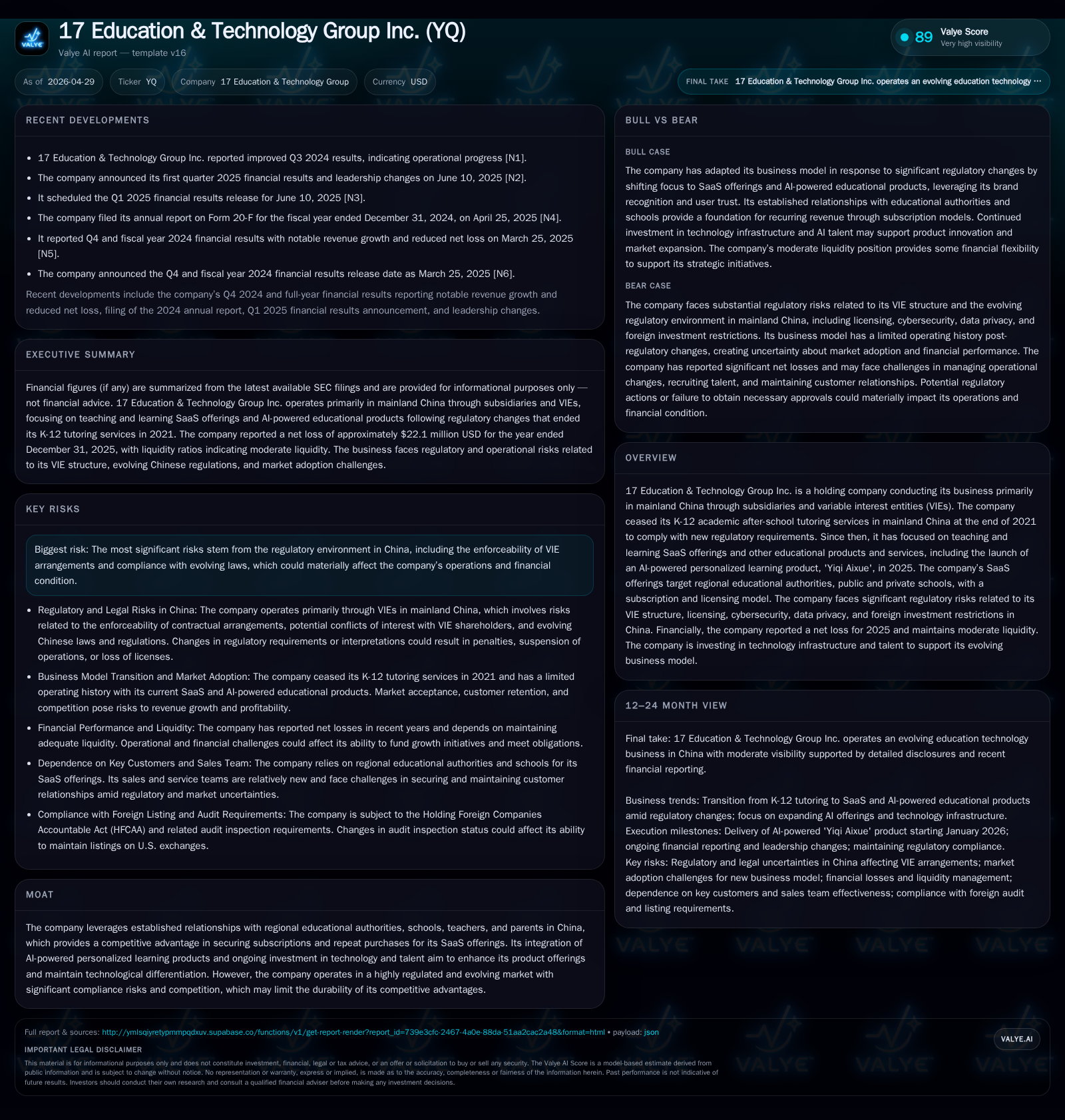
17 Education & Technology Group ceased its K-12 after-school tutoring business in mainland China at the end of 2021 due to stringent regulations. Since then, it has redirected efforts toward developing and scaling teaching and learning SaaS platforms, along with launching its AI-powered personalized learning product 'Yiqi Aixue' in 2025. The company's competitive position leverages strong relationships with educational authorities and schools but faces ongoing regulatory uncertainty impacting growth and operations. While operating cash flow turned positive in 2025, the business remains unprofitable with significant compliance risks tied to its VIE structure and evolving Chinese laws.
Recent Operating Update
The most determinative recent development for 17 Education & Technology Group Inc. (YQ) is its quarterly update disclosed on March 25, 2026 [S2]. The company reaffirmed its strategic pivot away from the prohibited K-12 academic after-school tutoring services in mainland China, which it ceased at the end of 2021 to comply with newly implemented government regulations known collectively as the Alleviating Burden Opinion. These regulatory changes fundamentally restructured the Chinese edtech market making traditional tutoring services for K-12 academic subjects untenable.
Post-cessation, YQ has fully focused on expanding its teaching and learning SaaS offerings launched in September 2021. These offerings are primarily subscription or license based products sold directly to regional educational authorities and schools, aiming to enhance in-classroom efficiency and modernize educational management through integrated software solutions [S1]. Moreover, a notable milestone was the commercial launch of "Yiqi Aixue," an AI-powered personalized learning product initiated in early 2026 following development throughout 2025 [S5][S13]. Early revenues include upfront payments collected during 2025.
While revenues currently remain modest compared to historical K-12 tutoring income—only approximately RMB106 million ($15 million) recognized in 2025 compared to nearly RMB190 million in prior years—the transition underscores a fundamental shift from volume-based tutoring to technology-enabled SaaS products [S1]. This entails building recurring revenue streams through long-term contracts rather than one-off course fees.
Business Model
17 Education & Technology Group operates primarily in mainland China via subsidiaries and variable interest entities (VIEs), leveraging contractual arrangements rather than direct ownership due to foreign investment restrictions [S1]. Revenue generation now centers around two key pillars:
Teaching and Learning SaaS Offerings: Delivered to public and private schools as well as regional education bureaus via subscription models, these cloud-based platforms facilitate digital management of curricula, interactive classroom tools, student assessment analytics, and teacher resource management.
AI-Powered Personalized Learning Product (Yiqi Aixue): Launched in late 2025 with revenues starting January 2026; targets individual students with customized learning plans powered by AI algorithms analyzing student data to tailor content delivery aimed at improving academic efficiencies.
This model shifts revenue mechanics from transactional tutoring fees mainly paid by parents or students toward institutional procurement cycles involving educational authorities as key payers. Volume drivers now depend on onboarding school districts and securing multi-year contracts linked to user counts or seats licensed per school.
Margins could benefit over time due to scalable cloud infrastructure but require meaningful upfront R&D investments exposing margins initially [S13]. Contract characteristics potentially improve cash conversion through prepaid annual licenses versus fragmented course sales. However, customer adoption requires trust-building with conservative government stakeholders accustomed to legacy textbook-based education systems.
Industry Structure and Competitive Position
The Chinese edtech sector is undergoing transformational regulation-induced consolidation that has removed many traditional private K-12 operators from the market or forced pivots like YQ’s [S5][S6]. The surviving landscape favors companies aligned with government objectives—improving public school teaching efficiency rather than purely commercial after-school tutoring.
YQ’s moat lies chiefly in its established network among regional education authorities and schools cultivated over a decade of providing tutoring services prior to regulatory bans. This entrenched presence facilitates access for SaaS deployment relative to new entrants lacking local relationships.
Technologically, YQ aims for differentiation through integrating AI-driven personalized learning within broader classroom management solutions—an offering that increasingly resonates with digitally savvy schools seeking tailored learning outcomes attention [S13]. Nevertheless, given rapid advancements by competitors such as TAL Education (pivoting similarly), VIPKid’s transformation into broader EdTech platforms, ByteDance’s move into education technology leveraging massive data assets, plus numerous niche startups deploying AI tutors or content aggregators, competitive pressures remain intense.
Moreover, reliance on VIE structures subjects YQ uniquely to political risk uncommon among domestic-owned firms but prevalent among foreign-listed Chinese edtech companies [S1][S6]. Enforcement uncertainty around contractual arrangements threatens control over core assets held inside VIEs.
Growth Drivers
Several measurable vectors underpin potential expansion:
Contract Backlog & Licensing Deals: Growth depends on converting pilot programs into long-term contracts across municipalities willing to upgrade school digital capabilities.
User Penetration & Retention: Expansion beyond first-tier cities into lower-tier regions may drive volume increases aided by affordability of SaaS fees vis-à-vis tutoring cancellations.
AI Product Adoption: Successful monetization of "Yiqi Aixue" personalized learning products targeting consumers will validate new revenue streams beyond institutional sales [S13]. Early advance payments suggest initial market acceptance.
Government Compliance & Approvals: Maintaining necessary operating licenses like Value-added Telecommunications Business Operating License ensures uninterrupted product deployment while regulatory alignment can open prospects for expanded service permissions [S20].
Technological Investment: Continued hiring of AI specialists and data scientists supports innovation pipeline critical for sustaining relevance amid fast-evolving educational needs [S13].
Risks and Watchpoints
Despite strategic realignment, YQ confronts sizable challenges:
Regulatory Uncertainty: New laws regulating online education services continue evolving; failure or delay in obtaining permits may trigger operational disruptions or penalties impacting revenue continuity [S6][S8][S20].
VIE Structural Risk: Enforceability questions around VIE agreements expose the company to potential loss of control over core businesses if challenged by PRC authorities [S1].
Competitive Intensity: Large incumbents with greater scale or diversified offerings may out-invest YQ in product development or marketing share gains.
Limited Operational History Post-Pivot: Current business lines have operated only since late 2021; thus earnings volatility persists while market acceptance is still nascent [S16].
Capital Constraints: Although liquidity is stable as per latest figures ($35M cash), continued losses necessitate careful cost management or external financing which may be constrained by geopolitical tensions surrounding US-listed Chinese firms [F1].
What To Watch Next
Several near-term milestones will signal execution progress:
Quarterly SaaS subscriber increments reported alongside average contract durations indicating recurring revenue stability.
Revenue growth ramp from “Yiqi Aixue” showing traction among families outside institutional channels.
Updates on government licensing renewals or new approvals especially concerning AI product functionality compliance demonstrating regulatory acceptance.
Management commentary around technology investments or hiring plans illuminating innovation focus areas.
Changes in legal environment regarding overseas listing norms affecting fundraising capabilities given recent PRC emphasis on cybersecurity reviews [S19].
Financial Profile Summary (Latest Year-End)
Latest financial snapshot
The financials confirm ongoing unprofitability amid restructuring pressures but improving cash flows culminating in positive operating cash flow reported for FY2025 ($5.3M) indicate initial stabilization post-pivot [F1][S2][S12]. A current ratio close to two signals manageable short-term liquidity while legacy debt denominated mostly in RMB (~$12M equivalent) remains notable considering scale [F1].
Conclusion - Analysis Perspective
17 Education & Technology Group embodies a classic case of mandated industry realignment imposed by sweeping Chinese regulations that shuttered its legacy K-12 tutoring core. The company’s ability to pivot aggressively towards SaaS platforms with embedded AI personalization reflects both adaptation agility and commitment to leveraging accumulated educational relationships built over years serving China’s complex public education market.
Its cornerstone competitive advantage derives less from raw technology—which competitors can replicate rapidly—but from deep government ties facilitating crucial licensing deals required to penetrate public school ecosystems where purchasing decisions are often bureaucratic. However, this moat is fragile given opaque enforcement of VIE structures amid intensifying regulatory scrutiny endemic across all US-listed Chinese tech names. Demand appears more structural than cyclical given mandatory policy shifts restricting private tutoring; yet price sensitivity remains pronounced due to governmental budget constraints affecting school spending capacity.
The new business lines’ nascent operating history warrants caution; rapid investments in research talent and platform scalability should be monitored closely for ROI effectiveness. Successful commercialization of Yiqi Aixue could materially diversify revenues beyond B2B procurements into C-end consumer segments—albeit with higher volatility stemming from discretionary household spending influenced by macroeconomic trends.
Ultimately, YQ’s growth path hinges on navigating China's stringent multifaceted regulatory environment that governs both edtech content/services and capital markets participation—a tightrope walked carefully by all peers—with execution capability determining if it emerges as an innovator setting benchmarks or merely another casualty forced into protracted restructuring cycles.
This analysis is based exclusively on publicly available SEC filings as of April 29, 2026 ([S1], [S2], [S3], etc.) and Companyfacts dataset ([F1]). It does not constitute investment advice but aims at providing an informed industry perspective grounded in disclosed facts.
Disclaimer: This is research-only, informational analysis and not investment advice. It may include AI-generated interpretation and general industry context. Always verify important details using primary sources.

Comments