
Unum Group’s Q1 2026 Earnings Reveal Headwinds and Opportunities in Employee Benefits
Q1 results highlight pricing and claims challenges tempered by solid revenue growth across key segments.
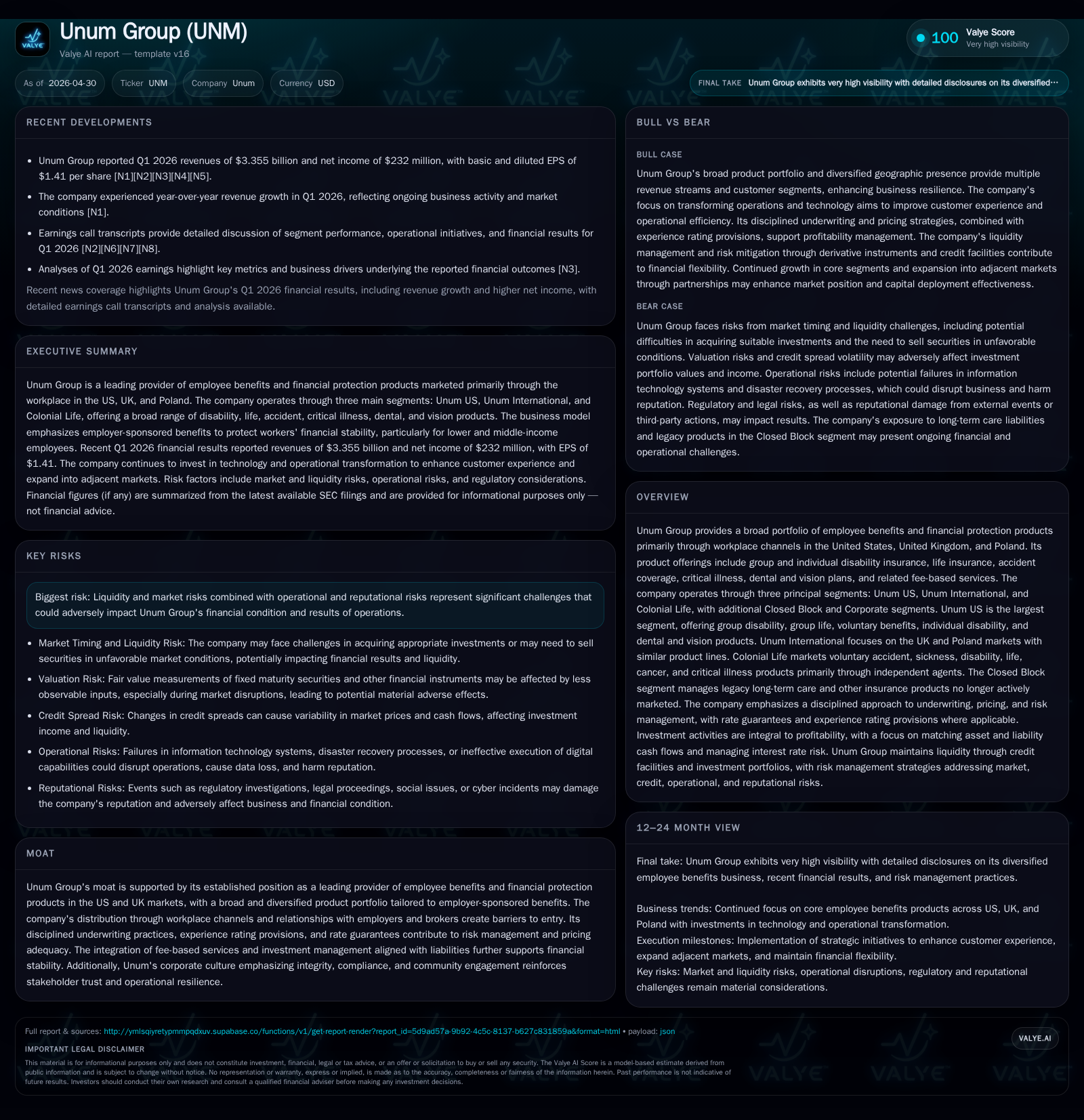
Unum Group reported first quarter 2026 results showing revenue growth offset by earnings below market estimates due to elevated claims and ongoing pricing pressures. The company’s broad employee benefits portfolio, focused on disability, life, and voluntary products primarily in the US, UK, and Poland, continues to face cyclical headwinds in claims incidence and regulatory repricing delays. Unum’s competitive moat is cemented by strong employer relationships and underwriting discipline, while growth drivers include expanding voluntary benefits adoption and international segment development. Risks from liquidity constraints, regulatory changes, and claim volatility remain salient for near-term outlook.
Latest Quarter Highlights and Their Strategic Implications
Unum Group’s Q1 2026 earnings release underscored a mixed operational environment marked by rising revenues but profitability that fell short of analyst expectations [S2][N1]. The April 29th 10-Q detailed a year-over-year increase in premiums across segments yet revealed elevated claims frequency within the group disability insurance line as a principal drag on margins. Claims incidence recently climbed due to socio-economic factors affecting workforce health and stability along with prolonged claim durations exacerbated by medical advances extending disability periods [S2][S4].
Despite ongoing pricing actions in the group voluntary benefits segment—offered largely on an optionally renewable basis—rate increases have encountered slower market acceptance. This delay tempers near-term margin improvement though provides flexibility to eventually restore profitability once price adjustments fully filter through the book-of-business [S1][S2]. The first quarter results also reflected investment income aligning with conservative asset-liability management frameworks amid moderate capital markets volatility.
The concurrent April 28th 8-K reaffirmed management’s commitment to strategic initiatives emphasizing digital transformation and customer experience improvements designed to promote retention in competitive workplace markets [S3][N2]. These efforts are viewed internally as crucial to navigating external pressures like regulatory scrutiny affecting product design and repricing agility.
Comprehensive Business Model and Product Portfolio Overview
Unum Group monetizes its offerings primarily through providing employer-sponsored insurance products designed to safeguard employees against financial hardship from illness, injury, or death. The operating model emphasizes broad product diversification across disability (both group and individual), life insurance (term, whole, universal), accident coverage, critical illness, dental, vision plans alongside related fee-based administrative services [S1].
Revenue streams derive chiefly from premiums paid by employers or employees under group plans plus individual policyholders for direct-to-consumer lines. The optional renewability feature embedded in group voluntary products permits management to reprice or exit contracts subject to regulatory approvals—a critical lever for maintaining underwriting discipline amid fluctuating claims environments [S1].
Unum Segments include:
- Unum US: The dominant contributor producing roughly two-thirds of consolidated premiums; products span group long- and short-term disability, life insurance, plus voluntary accident/dental/vision coverages.
- Unum International: Focuses on UK and Poland providing comparable products tailored to regional regulatory frameworks.
- Colonial Life: Markets voluntary accident, sickness, life, cancer-related coverages predominantly via independent agents targeting employer groups.
This segmentation facilitates targeted risk management adapted to local dynamics while reinforcing an integrated distribution approach centered on workplace channels that foster sticky client relationships due to embedded HR partnerships [S1][S2].
Competitive Positioning Within the Employee Benefits Industry
Unum’s competitive moat is anchored by longstanding relationships with employers/brokers complemented by disciplined underwriting rigor. The use of experience rating provisions—where premium adjustments reflect prior claims experience at account levels—limits adverse selection risks while rate guarantees preserve renewal certainty for policyholders [S1][S4].
The industry contends with pricing power constraints driven by regulated rate review processes particularly affecting guaranteed renewable contracts prevalent in group life/disability lines. Changes in societal attitudes towards work ethic or economic cycles such as unemployment spikes directly influence claim incidence rates leading to inherent volatility within the business model [S4][S11].
Furthermore, Unum faces pressure from entrenched insurers competing aggressively on price and technological capabilities as well as new entrants leveraging innovative enrollment platforms or alternative distribution models targeting employer groups. The balancing act between technological investment for improved user experience versus cost control remains pivotal in defending market share in this dynamic environment [S8][S12].
Drivers of Growth and Potential Expansion Avenues
Key levers for growth rest on broadening the adoption of voluntary benefits within existing client bases alongside geographic expansion mainly through Unum International’s UK and Poland segments [S1][S2]. Voluntary lines benefit structurally from demographic shifts favoring supplemental employee protections beyond core packages.
Unum is actively investing in digital enrollment tools and data analytics capabilities aiming to increase participation rates among lower- to middle-income earners—a traditionally underpenetrated cohort offering volume upside if engaged effectively [N2]. Fee-based administrative services integrated into these solutions also generate ancillary revenues potentially enhancing margin profiles.
Strategic capital allocation includes evaluating selective acquisitions or partnerships that expand adjacent product offerings or enhance distribution reach; however, evidence from recent filings emphasizes organic investment tempo over aggressive M&A currently [S2][N3]. Additionally, evolving regulation around family medical leave benefits may create mandated coverage opportunities boosting core volumes if navigated prudently.
Risk Factors and Operational Challenges Ahead
Market risk influences investment returns critical for supplementing underwriting results as fixed income portfolios must match liabilities precisely amid interest rate fluctuations.
Regulatory environments impose layered complexity particularly regarding approval delays for repricing actions or limitations placed on rate increases—constraints which can undermine profitability recovery following claims upswings. Privacy regulations also introduce incremental compliance costs impacting system scalability [S16][S22].
Operationally, reputational risk heightened by litigation or perceived maladministration of claims could erode stakeholder trust with direct consequences on renewal persistency rates. Management controls emphasize robust governance frameworks trying to preempt excessive risk-taking while balancing competitive business practices but uncertainty remains inherent given litigation unpredictability common within insurance sectors [S8][S17].
Key Upcoming Milestones to Monitor
Investors should focus on forthcoming quarterly updates clarifying whether claims experience trends continue exerting pressure or stabilize towards normalized levels conducive to margin improvement [S2][N2]. Regulatory decisions permitting or restricting premium rate adjustments across critical product lines will materially affect profitability pacing.
Progress reports on technology-driven enrollment enhancements supporting voluntary benefit penetration serve as non-financial demand indicators with medium-term ramifications for volume growth potential. Observing pace of international segment scaling into Poland particularly will help assess geodiversification effectiveness amidst local market conditions [N4].
Participation metrics during open enrollment periods provide timely signals about workforce receptivity toward supplemental financial protection amid prevailing economic uncertainties.
Concise Financial Profile: Balance Sheet and Capital Position
Financially, Unum reports net debt of approximately $3.76 billion as of March 31, 2026 per companyfacts data reflective of stable leverage consistent with prudent asset-liability duration matching strategies foundational in insurance operations [F1]. No material changes have emerged regarding liquidity risks or capital adequacy beyond previously disclosed annual filing parameters.
Capital structure supports regulatory surplus requirements across US and international entities enabling continued dividend capacity while safeguarding ratings critical for favorable funding terms. The investment portfolio remains weighted heavily in high-quality fixed maturities aligned with liability cash flow demands mitigating interest rate sensitivity risks typical in long-duration product lines [S5].
Disclaimer: This analysis is based solely on publicly available SEC filings dated through April 29, 2026; it refrains from any forward-looking statements or investment advice. All factual content is drawn exclusively from cited sources without extrapolation beyond stated evidence.
Disclaimer: This is research-only, informational analysis and not investment advice. It may include AI-generated interpretation and general industry context. Always verify important details using primary sources.

Comments