
Ten-League International Completes 1-for-10 Reverse Split as Singapore Equipment Demand Rebounds
After a 30% revenue jump in 2025, TLIH restructures share capital while managing liquidity and fleet expansion in concentrated Singapore infrastructure markets.
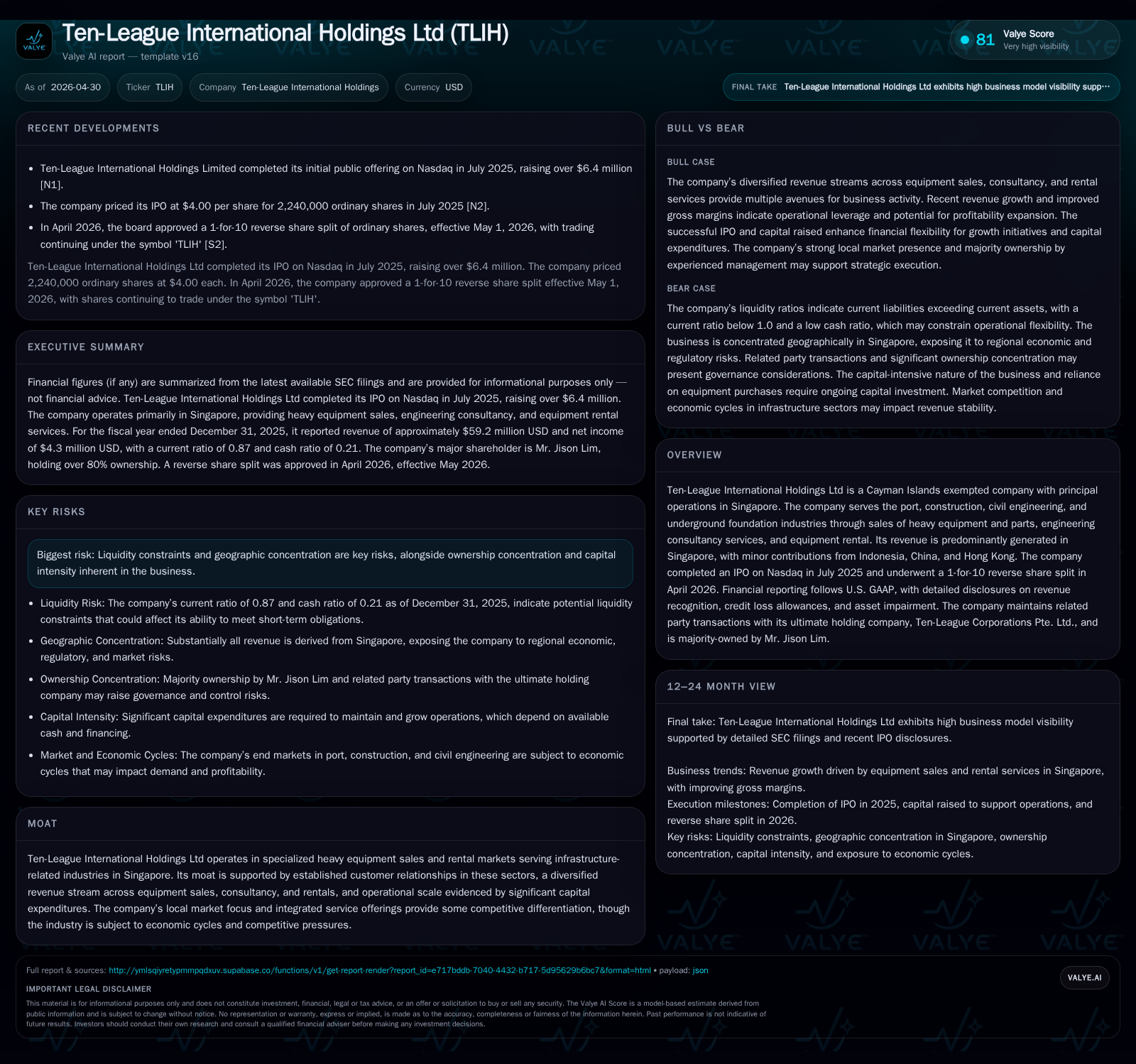
Ten-League International Holdings (TLIH) completed a 1-for-10 reverse share split effective May 1, 2026, aiming to enhance trading dynamics on Nasdaq. The company predominantly serves Singapore's port, construction, civil engineering, and underground foundation industries via sales of heavy equipment and parts, equipment rental, and engineering consultancy. Its revenue growth in 2025 rebounded significantly from last year’s decline, driven by higher product demand and improved rental margins. Despite operational scale and diversified services supporting competitiveness, TLIH faces liquidity pressures amid capital-intensive operations and geographic concentration risks. Close monitoring of working capital management, fleet utilization, and regional demand patterns will be critical to sustaining growth momentum.
Recent Operating Update
The most immediate development for Ten-League International Holdings Ltd (TLIH) is its board's approval of a reverse share split at a ratio of 1-for-10 announced in April 2026 ([S2]). Effective May 1, 2026, TLIH’s ordinary shares began trading on Nasdaq with the adjusted share count and new CUSIP number. This move follows shareholder approval at the extraordinary general meeting earlier in April ([S3]) where consolidation ratios between 2-for-1 and 20-for-1 were authorized allowing flexibility up to twenty-fold consolidation. The definitive setting at 1-for-10 reflects intentions to lift the per-share price above minimum Nasdaq thresholds and improve liquidity dynamics for investors ahead of forthcoming strategic execution.
No material changes to operating results were disclosed alongside the split announcement. However, this capital structure adjustment underscores the company's recent transition since its July 2025 IPO on Nasdaq and attempts to address early trading price challenges identified previously ([S10]).
Business Model Overview
Ten-League International Holdings operates primarily through three revenue streams servicing infrastructure-related sectors —sales of heavy equipment and parts; engineering consultancy services; and equipment rental ([S1]). The business footprint is heavily concentrated in Singapore (circa 96% of revenue as of FY25), with minor exposure to Indonesia, China, and Hong Kong.
Revenue recognition aligns with ASC 606 standards:
- Product Sales: constitute approximately 80% of revenue; recognized when physical possession transfers ex-works terms with legal title and risk passing to customers.
- Engineering Consultancy: lower proportion (~3%) with revenue recognized at completion and customer acceptance.
- Rental Income: accounts for ~17%; recognized pro-rata over lease terms using straight-line method reflecting effective asset yield.
Profitability within each stream showed improvement in fiscal year ended December 31, 2025 compared with prior periods due mainly to higher utilization rates for owned rental assets which reduced subcontracted rental expenses, better product mix favoring higher-margin units, and completion of unprofitable consultancy projects from prior years ([S25]).
Cost drivers emphasize procurement costs for heavy equipment inventories (valued conservatively at cost or net realizable value), depreciation charges on owned plant & equipment representing machinery fleets, outsourced subcontract work for rentals or projects, as well as workshop maintenance expenses critical given the asset-heavy profile ([S1], [S25]).
Customer contracts are typically backed by structured credit evaluation processes incorporating expected credit loss provisions consistent with ASC 326 guidance ([S1]), ensuring receivables are reasonably collectible despite some concentration risks.
Industry Structure and Competitive Position
TLIH operates within specialized heavy equipment markets catering predominantly to port operations, civil engineering works, construction activities, and underground foundation development — all sectors sensitive to macroeconomic swings given dependency on public infrastructure spending cycles.
Within Singapore's relatively concentrated market environment:
- TLIH leverages established client relationships across government-linked entities and large contractors engaged in port facilitation or construction projects.
- The integrated offering combining sales expertise, tailored consulting services for technical project support, plus flexible rental options presents differentiation against competitors who may only operate discrete segments.
- Capital intensity is elevated due to the need for sizeable investment in diversified equipment fleets that require upkeep under strict regulatory compliance frameworks salient in Singapore's industrial policy context.
Nonetheless there are notable constraints:
- The geographic concentration exposes TLIH disproportionately to singular sovereign economic policies affecting infrastructure budgets.
- Competition among regional heavy-equipment providers also pressures pricing power particularly for lower-specification units or commodity parts.
- Customer migration risk is mitigated but not eliminated by switching costs related to service integration and after-sales support frequency.
Growth Drivers
Infrastructure Renewals & Expansion: Singapore's continuous push to modernize port facilities alongside urban civil projects creates structural demand growth that benefits companies like TLIH providing essential machinery and maintenance support.
Rental Fleet Expansion: Increasing ownership of rental machines internally rather than subcontracting has improved margin profiles—this suggests management prioritizes capex deployment towards controlled asset bases enabling better utilization.
Diversified Services: Engineering consultancy income gains validate cross-selling capacity beyond pure equipment transactions adding stability during softer equipment sales periods.
Market Consolidation Post-IPO: With proceeds from its IPO fueling working capital needs as well as capital expenditures (~US$13.4 million spent on plant/equipment in FY25 [F1]), TLIH positions itself for expansion either organically or selectively through bolt-on acquisitions that would complement its primary sectors.
Risks & Growth Constraints
The company faces several headwinds:
Liquidity pressure: Despite improved cash flow from operations generating SGD ~26 million in cash inflows FY25 ([S14]), working capital demands remain pressing due notably to inventory build-up targeting maintenance of 60 60 inventory days ([S19]). Current ratio stands suboptimal at approximately 0.87 indicating short-term asset coverage challenges ([F1]). Vendor credit terms are limited which restricts financial flexibility from suppliers ([S7]).
Debt Levels: Total reported debt stood around SGD16.95 million end-FY25 with net debt near SGD8.64 million after cash adjustments signaling moderate leverage for an asset-heavy firm ([F1]). Bank loans are guaranteed personally by Chairman Jison Lim necessitating scrutiny on refinancing strategies post-IPO for sustainability ([S7]).
Wider Economic Volatility: Given reliance on cyclical construction and port traffic volumes intertwined with global trade flows affecting Singapore’s economy, downturns may sharply compress demand.
Shareholder Concentration: Mr. Jison Lim holds majority control which while providing strategic stability can raise governance considerations impacting minority shareholders' influence ([S1]).
What To Watch Next
Key milestone deliverables include:
- Monitoring post-reverse-split trading volume trends on Nasdaq initiated May 2026 influencing capital raising capability ([S2]).
- Updates on fleet acquisition plans or disposal schedules that may alter depreciation expense or rental availability impacting profitability ([S14], [S25]).
- Working capital management effectiveness evidenced by accounts receivable collections velocity improvements versus inventory turnover consistency critical to cash conversion cycles ([S19], [S11]).
- Potential announcements around geographic expansion initiatives targeting Indonesia or China markets could diversify risk concentration setbacks ([S1]).
- Progress reports on integration or launch of high-margin value-add consulting projects expected to increase consultancy contribution percentage over total revenue.
Financial Profile Summary
Latest financial snapshot
| Metric | Value | Period |
|---|---|---|
| Cash & equivalents | $8mm | |
| 2025-12-31 | ||
| Total debt | 16,953,000 SGD | |
| 2025-12-31 | ||
| Net debt | 8,644,000 SGD | |
| 2025-12-31 | ||
| Current assets | $34mm | |
| 2025-12-31 | ||
| Current liabilities | $39mm | |
| 2025-12-31 | ||
| Current ratio | 0.87x | |
| 2025-12-31 |
Source: SEC companyfacts cache [F1].
Financial data corroborates a business recovering from a cyclical trough with profitability margins expanding materially thanks to operational efficiencies in fleet management and contract mix improvements ([F1], [S25]).
This analysis synthesizes disclosures from Ten-League International Holdings Ltd's latest filings without providing investment recommendations or forecasts. Readers should consider broader market conditions alongside company-specific reports before forming conclusions about future performance.
Disclaimer: This is research-only, informational analysis and not investment advice. It may include AI-generated interpretation and general industry context. Always verify important details using primary sources.

Comments