
Mattel’s Q1 2026 Growth Boosted by Full Control of Mattel163 and IP Innovation Amid Cost Pressures
Mattel advances its digital gaming expansion and brand-driven strategy while managing margin pressures from tariffs and inflation.
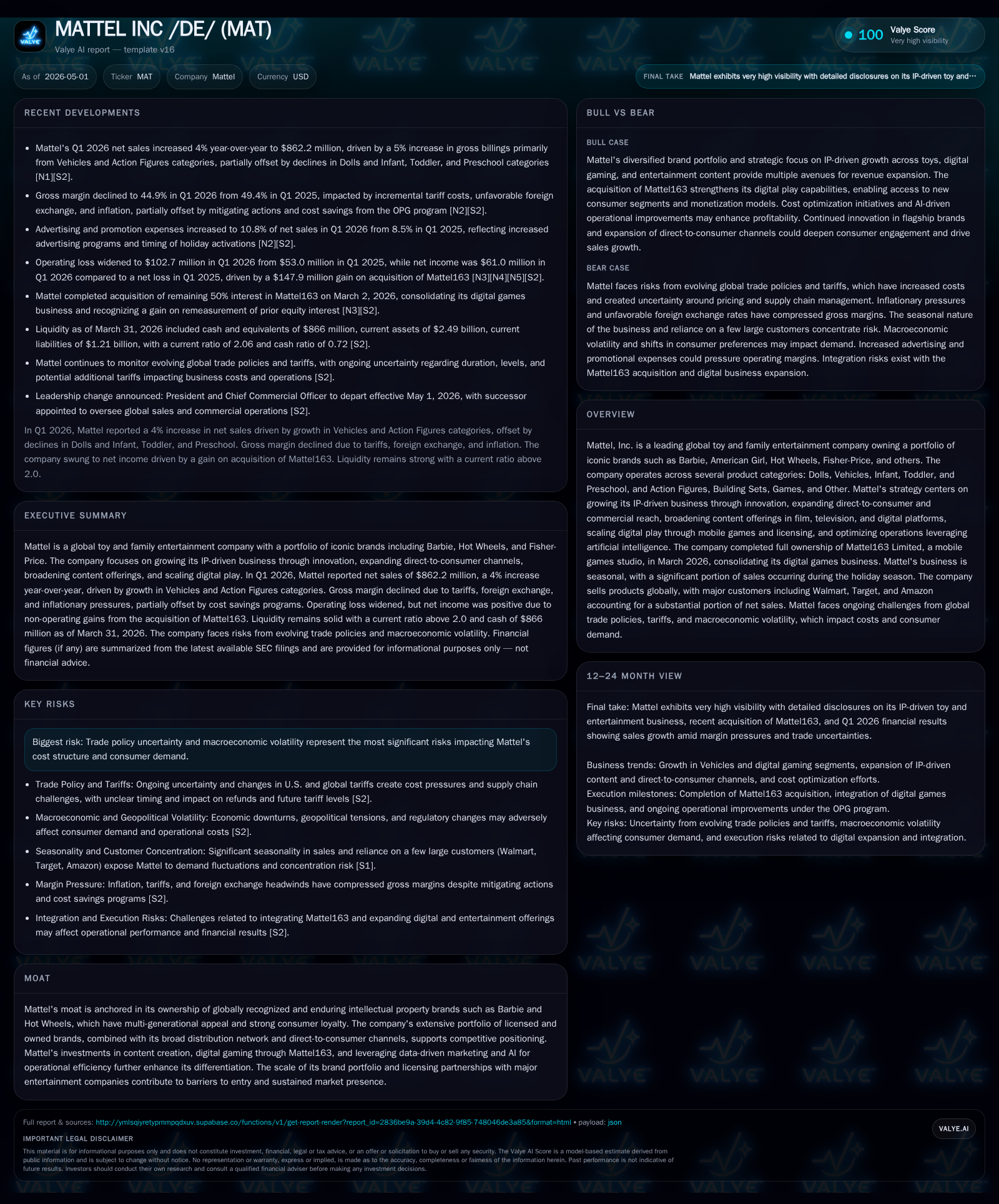
In Q1 2026, Mattel reported a 4% increase in net sales fueled by strength in Vehicles and the consolidation of Mattel163 after acquiring full ownership. Despite revenue growth, gross margins contracted due to tariff impacts, inflation, and unfavorable currency, partially offset by cost-saving initiatives. The company continues to execute on its IP-centric strategy, broadening digital play offerings and content while navigating geopolitical trade uncertainties. Liquidity remains solid with a cash balance of $866 million as of March 31, 2026.
Recent Operating Update
Mattel's first quarter of 2026 marked a pivotal step as the company completed acquisition of the remaining 50% interest in Mattel163 Limited, a mobile games studio focused on digital play. This move—finalized on March 2, 2026—enabled Mattel to consolidate Mattel163's results fully into its financials for the first time [S2][S18]. The purchase price paid was approximately $178.6 million including adjustments, which triggered a sizable one-time non-operating gain of $147.9 million as Mattel remeasured its previously held equity interest to fair value at acquisition date [S18].
Operationally, total net sales grew by 4% compared to Q1 2025, driven primarily by strength in the Vehicles product category which includes brands like Hot Wheels [S2][N1]. This increase is notable given headwinds from global inflationary pressures and tariff-related cost increments that weighed on margins.
On that note, gross margin contracted sharply from 49.4% last year to 44.9% this quarter. The gross margin decline largely reflects a confluence of factors: higher tariffs imposed on imports particularly from China and other countries during volatile trade policies; inflation impacting raw materials and logistics costs; and unfavorable foreign currency exchange rates impacting consolidated results [S2][S11]. Management highlighted that mitigating actions including pricing adjustments and cost-saving efforts under the ongoing Optimizing for Profitable Growth (OPG) program partially alleviated these pressures but could not fully offset them in this early part of the year [S2][S15].
Cash flows used for investing activities surged significantly to $143.6 million versus $31.3 million last year’s Q1 due largely to the Mattel163 equity buy-out alongside increased capital expenditures [S2]. Financing activity also saw increased cash usage mostly attributable to accelerated share repurchases totaling $208.3 million during the period.
Liquidity remains robust with cash and equivalents totaling $866 million at March-end and no outstanding borrowings under the company’s ample $1.4 billion revolving credit facility [S2][F1]. Available credit lines along with dependable operating cash flow positioning support working capital needs through seasonal fluctuations.
Business Model Overview
Mattel is a global leader in toys and family entertainment anchored by enduring intellectual property (IP) such as Barbie, Hot Wheels, American Girl dolls, Fisher-Price infant products, and others [S1][S2]. Revenue generation stems primarily from sales of physical toys across several product categories: Dolls; Vehicles; Infant/Toddler/Preschool products; Action Figures; Building Sets & Games; plus an Other category including plush toys linked to licensed franchises.
The business model emphasizes growing brand-driven revenue fueled by innovation cycles aligned with film releases or other content expansions that spark consumer interest. Products are distributed globally through mass retailers (e.g., Walmart), specialty stores (e.g., Toys “R” Us), e-commerce platforms (including direct-to-consumer), licensed channels, plus increasingly digital avenues.
A recent strategic shift has intensified efforts toward digital play via mobile games self-publishing and collaborations with Mattel163 offering game development expertise. This complements content creation breadth extending beyond traditional toys into film, television series, publishing rights licensing, location-based entertainment partnerships, and creator platforms representing new monetization streams [S1][S18].
Revenue mechanics involve a mix of upfront product sales where volume is influenced by seasonal cycles peaking at holidays; pricing power primarily derived from IP strength allowing premium or collectible positioning; licensing fees from third parties making use of characters/IP; plus ongoing revenue from newer digital offerings including mobile games backed by user engagement metrics.
Margins are sensitive to cost inputs including tariffs on imported goods, raw materials prices (plastic polymers etc.), labor costs tied to manufacturing hubs (primarily Asia), fulfillment expense volatility due to fuel/logistics inflation, as well as royalty fees on licensed properties. The company works actively on cost optimization programs such as OPG combining supply chain improvements with AI-driven operational efficiencies aimed at improving cash conversion.
Industry Structure & Competitive Position
The toy industry features intense seasonality with about half or more annual sales concentrated in Q4 holiday demand peaks. It is characterized by strong brand loyalty where iconic properties generate sustained repeat purchase behavior across multiple generations of consumers [S1][S18].
Competition includes other global majors like Hasbro Inc., LEGO Group (privately held), Spin Master Corp., Bandai Namco Holdings among others as well as myriad niche challengers targeting specialty categories or digital-native gaming platforms.
Mattel's moat rests heavily on its portfolio of globally recognized IP assets — Barbie being one of the world’s best-selling toy brands historically — combined with multi-channel distribution reach encompassing both brick-and-mortar retail giants and global e-commerce ecosystems [S1]. This scale underpins negotiated shelf space advantages plus access to leverage promotional events timed with media content launches.
Its strategic push towards expanding entertainment beyond toys through original film projects (e.g., Masters of the Universe theatrical launch) aims to reinvent established brands for broader audiences beyond traditional collectors to new child demographics internationally [S1]. Integration of digital gaming via Mattel163 also positions it advantageously relative to pure-play toy manufacturers lacking software/game development competence.
Growth Drivers
Brand-Led Innovation & Content Expansion
Mattel prioritizes breakthrough innovations within core brands targeting diversified end-user segments: adult fans/collectors alongside children through refreshed designs or immersive experiences [S2][S18]. Expanding franchise storytelling across film/TV/digital short-form content creates marketing synergies driving product awareness.
Digital Play & Gaming Integration
Full ownership of Mattel163 empowers vertically integrated capabilities spanning game development/publishing/customer acquisition which accelerates scale-up of digital monetization avenues — critical given shifting consumer habits favoring screen-based entertainment [S18]. Licensing and creator platform expansions further widen digital ecosystem reach.
Direct-to-Consumer Channel Expansion
First-party data utilization combined with targeted retail development supports growth outside traditional wholesale models enhancing margin profiles while capturing consumer insights enabling personalized marketing initiatives [S2].[N3]
Operational Efficiency Enhancements
Continued realization of savings from the OPG program leverages AI-enabled supply chain automation along with procurement optimization delivering sustainable cost reductions benefiting margins over time [S15].[S25]
Risks & Constraints
- Global Trade Policy Volatility: Ongoing uncertainty around U.S.-imposed tariffs affecting import costs create unpredictable expense headwinds despite mitigation efforts [S11].[N12]
- Macroeconomic Environment: Inflationary pressures reduce consumer discretionary spend potential; economic slowdown risks adversely affect retail ordering patterns especially given highly seasonal demand concentration [S2][S22]
- Currency Fluctuations: Foreign exchange movements negatively impact consolidated revenue figures due to global footprint incorporating numerous currencies [S2]
- Execution Risks: Expansion into digital realms requires managing integration challenges post-Mattel163 acquisition alongside maintaining innovation pipeline relevance against competitors with deep entertainment roots or agile digital offerings [S18]
- Supply Chain Disruptions: Shortages or delays in raw materials/components inflating costs or impacting shipment timing against tight retailer inventory strategies pose operational vulnerabilities [S2]
What To Watch Next
Key milestones include progress updates on new product rollouts supporting major IP franchises like Masters of the Universe scheduled for expanded launch phases throughout 2026-27 [S1].[N3]. Monitoring quarterly trajectory of gross margin recovery will signal effectiveness of tariff mitigation and operational efficiency initiatives post-Q1 contraction.
Digital play metrics tied to Mattel163 games self-publishing ramp—user engagement levels, revenue contribution mix changes—will serve as growth barometers for evolving business model diversification away from physical products alone [S18].
Further clarity on evolving U.S. trade policy direction especially tariff structures will be critical given their significant bearing on input costs shaping profitability outlooks [S11].[N12]. Seasonal ordering trends leading into peak Q4 results will validate underlying demand resiliency amid macroeconomic variability.
Financial Profile Summary
Latest financial snapshot
| Metric | Value | Period |
|---|---|---|
| Cash & equivalents | $866mm | |
| 2026-03-31 | ||
| Total debt | $2.4bn | |
| 2025-12-31 | ||
| Net debt | $1484mm | |
| 2025-12-31 | ||
| Current assets | $2.5bn | |
| 2026-03-31 | ||
| Current liabilities | $1211mm | |
| 2026-03-31 | ||
| Current ratio | 2.06x | |
| 2026-03-31 |
Source: SEC companyfacts cache [F1].
*Net debt is total debt less cash & equivalents providing effective leverage context [F1][S2][S5].
Operating cash flow turned negative in Q1 ($22.9 million outflow vs positive $24.8 million prior year) reflective partly of earnings dynamics but mitigated somewhat by improved working capital management offsets. Capital expenditures rose reflecting investment into growth platforms including digitization initiatives [S25].
Overall liquidity remains sufficient for working capital requirements with undrawn credit facilities ensuring flexibility ahead of seasonal sales peaks [S5].[F1].
This analysis synthesizes publicly filed SEC disclosures alongside recent market commentary without offering investment advice or recommendations.
Disclaimer: This is research-only, informational analysis and not investment advice. It may include AI-generated interpretation and general industry context. Always verify important details using primary sources.

Comments