
Arcadia Biosciences Confronts Strategic and Operational Crossroads in 2026
Recent operational updates and governance challenges significantly reshape Arcadia Biosciences’ pathway within agricultural biotechnology.
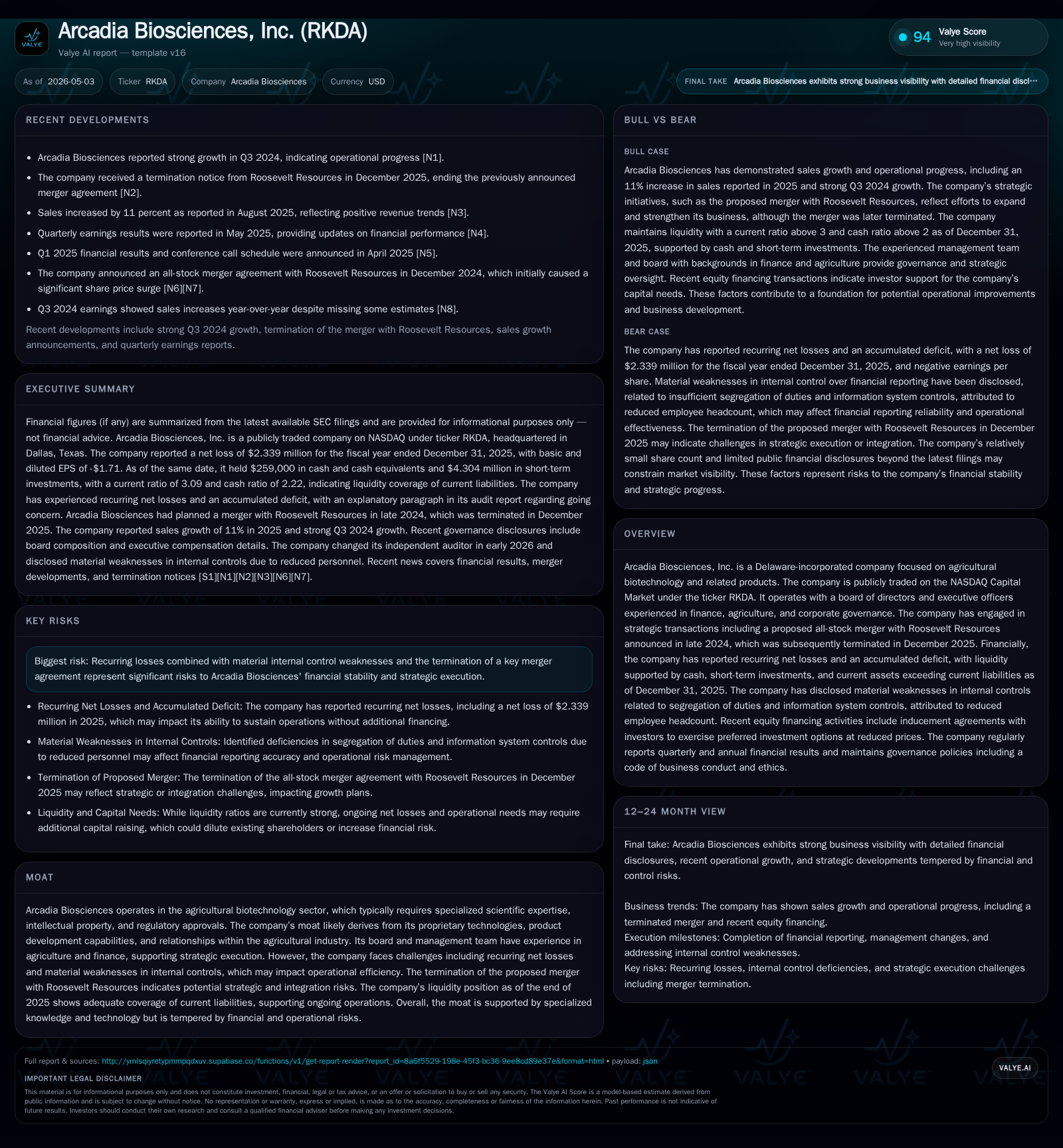
Arcadia Biosciences’ latest quarterly disclosures reveal governance shifts including dismissal of Deloitte as auditor and the termination of a landmark merger with Roosevelt Resources, highlighting critical internal control issues. The company’s core business remains focused on developing proprietary agricultural biotech products, though recurring net losses and material weaknesses in financial reporting controls constrain operational execution. Competitive advantages stem from specialized gene-editing know-how and regulatory navigation, but the failure to close strategic transactions limits growth flexibility. Near-term prospects depend on remediation of governance defects, successful commercialization of innovative traits, and effective capital management.
Latest Operating Update: Key Developments from Recent SEC Filings
Arcadia Biosciences’ most recent 10-Q filed November 7, 2025 [S2] serves as a foundational update that foreshadowed ongoing governance concerns. However, the pivotal change occurred in early 2026 when the company publicly disclosed the dismissal of its long-standing independent registered public accounting firm Deloitte & Touche LLP [S3], a move typically reflective of significant shifts in oversight or audit priorities. This transition was completed without disagreements or audit scope disputes between Deloitte and Arcadia but followed disclosures of material weaknesses in internal controls related to financial reporting systems and segregation of duties exacerbated by staff reductions [S16].
Concurrent with these governance developments was the formal termination of the previously announced all-stock merger agreement with Roosevelt Resources effective December 24, 2025 [S21], closing out an ambitious strategic transaction pursued since late 2024 but disrupted by delays and missed closing conditions. The end of this deal eliminates one channel for scaling Arcadia’s technology platform rapidly.
Management is actively engaging a successor auditor, Ramirez Jimenez International CPAs (RJI), effective March 30, 2026, aiming for continued compliance and restoration of internal control confidence ahead of upcoming quarterly audits [S16]. These intertwined events mark a clear inflection point where operational integrity and strategic adjustments must coalesce to stabilize growth trajectories.
Business Model Overview: Agricultural Biotechnology Products and Revenue Drivers
Arcadia operates within the agricultural biotechnology domain focusing on innovations that enhance crop yield, resilience, and quality through advanced genomics and trait development. The company generates revenue primarily via licenses granted to seed companies for proprietary genes or crop traits as well as direct sales of its products to agricultural producers [S1].
Its product offerings encompass genetically optimized seeds imbued with traits such as drought tolerance or improved nutritional profiles—critical attributes in global agriculture challenged increasingly by climate variability. Licensing contracts typically involve milestone payments tied to regulatory approvals or commercial adoption stages plus royalties based on volume sales downstream.
This model necessitates substantial upfront R&D investment combined with extended regulatory timelines. Benefits accrue from intellectual property protection that affords competitive differentiation by restricting competitor access to key genetic modifications. Customer relationships span seed companies who embed Arcadia traits into their portfolios and farmers who reap yield benefits directly or indirectly via supply chain partners.
The business mix remains development-heavy but aims for gradual revenue scale-up—pricing power is constrained by substitution risk but underpinned by entrenched switching costs derived from agronomic efficacy and trait optimization.
Competitive Positioning within Ag Biotech: Moat and Market Challenges
In an industry dominated by large multinational players controlling vast patent portfolios and distribution networks (e.g., Corteva, Bayer), Arcadia builds defensibility through specialized gene-editing capabilities targeting niche yet commercially relevant crops [S1]. Regulatory navigation expertise further erects barriers given the complexity associated with approvals worldwide for genetically modified organisms.
Its moat stems mainly from proprietary biotechnologies enabling precision genome editing that can be adapted rapidly to evolving agronomic challenges—a technically sophisticated asset difficult for entrants to replicate promptly. Moreover, the company’s network within the agricultural ecosystem supports technology validation through field trials and early-stage commercialization partnerships.
Nonetheless, Arcadia confronts competitive pressure from well-capitalized conglomerates capable of bundling traits across extensive seed lines as well as potential biosafety controversies that may stall customer adoption or impose regulatory costs. The failure to consummate the Roosevelt merger further weakens scale advantages that might have enhanced market clout or expanded product portfolio breadth.
Strategic Growth Drivers: Innovation Pipeline, Partnerships, and Market Adoption
Arcadia’s forward growth hinges on advancing its R&D pipeline featuring novel traits tailored for staple crops like wheat, rice, or soybeans—especially with climate resilience characteristics that align with increasing demand for sustainable agriculture solutions [S1][N1]. Progress milestones include successful regulatory submissions, trial yield data publication, and securing commercial licensing agreements reflecting farmer uptake potential.
Collaborative partnerships with seed companies remain critical channels not only for distribution but also joint development efforts leveraging combined expertise. Additionally, incremental innovation targeting secondary markets or specialty crops supplements headline pipeline projects.
The long-cycle nature of agricultural biotech means visibility into eventual revenue impact demands monitoring bookings/bookings conversion rates rather than near-term revenue spikes. Sustained investment in IP protection safeguards pipeline economics at each stage.
Risks and Constraints: Governance Issues, Financial Sustainability, and Merger Fallout
Persisting material weaknesses in internal controls over financial reporting cause elevated operational risk—reduced headcount affects segregation of duties essential for safeguarding transaction accuracy [S16]. Such deficiencies raise audit complication likelihoods which could result in financial restatements or impair investor confidence.
Financial sustainability is challenged by cumulative net losses exceeding $2 million annually despite steady current asset coverage [F1][S2]. Recurring operating deficits underscore dependence on external funding sources especially equity raises evidenced recently by inducement exercise agreements generating approximately $2.1 million gross proceeds at reduced option exercise prices [S19].
The aborted Roosevelt merger truncates a major strategic avenue potentially offering synergy realization benefits including expanded distribution reach or cost efficiencies [S21]. This setback reduces flexibility amid intensifying capital requirements inherent to biotech scale-up cycles.
Portfolio concentration risk emerges considering limited blockbuster product breadth so delays or failures in key launches could disproportionately impact outlook.
Upcoming Catalysts and What to Monitor Next
Key analytical focus points include release timing for first-quarter 2026 earnings which will update stakeholders on operational progress post-merger termination while offering insights into liquidity trends given recent financing activities [S3].
Close observation of management’s remediation plans addressing material internal control weaknesses is warranted since governance stabilization is prerequisite for normalized audit opinions and longer-term investor trust rebuilding.
Watch also for announcements of new partnership agreements or advancement in regulatory approvals—early signs here could materially alter projected revenue ramp scenarios.
Additional indicators encompass pipeline milestone achievements such as phenotype validation trials culminating successfully which underpin licensing negotiations.
Financial Position Snapshot: Liquidity, Leverage, and Profitability Metrics
Latest financial snapshot
| Metric | Value | Period |
|---|---|---|
| Cash & equivalents | $259,000 | |
| 2025-12-31 | ||
| Current assets | $6,356,000 | |
| 2025-12-31 | ||
| Current liabilities | $2,059,000 | |
| 2025-12-31 | ||
| Current ratio | 3.09x | |
| 2025-12-31 |
Source: SEC companyfacts cache [F1].
This financial snapshot confirms a nuanced runway where liquidity cushions exist balanced against persistent deficit spending requiring vigilant capital management.
This analysis is based solely on publicly available filings through early April 2026 without offering investment advice or price targets.
Disclaimer: This is research-only, informational analysis and not investment advice. It may include AI-generated interpretation and general industry context. Always verify important details using primary sources.

Comments