
Alamo Group Navigates Q1 Growth Through Strategic Acquisitions and Robust Dealer Network
Alamo Group reports steady first-quarter results underpinned by recent acquisitions and a diversified product portfolio amid a stabilizing supply environment.
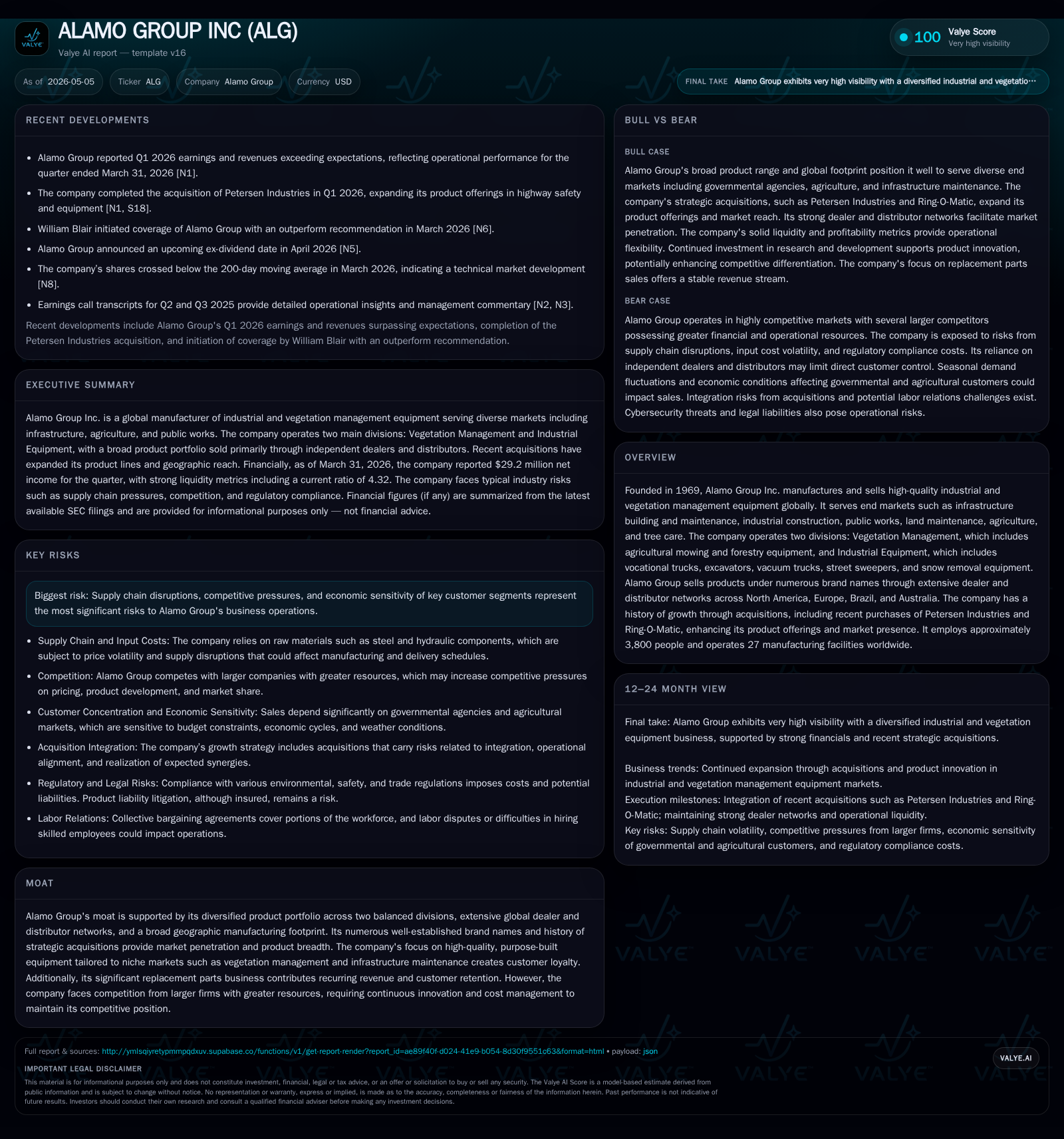
In its latest 10-Q filing for Q1 2026, Alamo Group demonstrated sustained operational resilience with stable order backlog and effective supply chain management despite ongoing market pressures. The company’s two-division model—Vegetation Management and Industrial Equipment—remains central to its strategy, supported by a wide geographical footprint and after-market parts revenue. Growth is fueled by recent strategic acquisitions like Petersen Industries and Ring-O-Matic, broadening product offerings and dealer reach. Risks remain in supply chain fluctuations and competitive intensity, but strong liquidity and backlog execution provide a steady platform for near-term growth.
Recent Quarterly Operating Performance and Why It Matters
Alamo Group’s latest quarterly disclosure in its Q1 10-Q filing dated May 4, 2026 [S2] reinforces a consistent trajectory of operational stability despite macroeconomic uncertainties. The company reported no material changes to risk factors since the prior year-end 10-K. Order backlog remains robust with management expecting most unfilled orders from end-2025 to ship during fiscal 2026 [S6]. This continuity indicates sustained demand across the firm’s diversified channels.
Notably, earnings and revenues for the quarter surpassed analyst expectations as corroborated by external news releases [N1]. Supply chain conditions showed improvement relative to prior periods though raw material price fluctuations continue to pressure margins moderately. The company’s outlook focuses on backlogs fulfillment while navigating ongoing supplier cost inputs.
Alamo Group’s Business Model: Diverse Products and Quality Focus
Alamo Group organizes its operations into two complementary divisions: Vegetation Management and Industrial Equipment [S1][S10]. The Vegetation Management Division encompasses agricultural mowing machines, forestry equipment, tree care products plus flail and rotary cutters acquired across decades via targeted purchases. Meanwhile, the Industrial Equipment Division includes vocational trucks (e.g., vacuum trucks, street sweepers), excavators, snow removal machinery, highway safety vehicles such as attenuator trucks from recent acquisition Royal Truck & Equipment [S27].
This divisional strategy integrates multiple legacy brands like Rhino, Morbark, Tiger Corporation, Timberwolf/Wolftrack in vegetation management along with Gradall®, VacAll®, Super Products® in industrial equipment [S10]. Each brand supports specific niche markets requiring high-quality purpose-built equipment designed to meet governmental contracts or commercial land maintenance.
Further strengthening distribution are over 27 manufacturing plants spread among North America, Europe, Brazil, and Australia alongside an extensive dealer network operating worldwide providing both wholesale machinery sales and aftermarket parts support [S1]. Replacement parts constitute about 16-17% of revenues annually [S25], underpinning a recurring revenue stream that fosters lasting customer relationships beyond initial equipment sales.
Industry Structure and Competitive Positioning
The global market for industrial and vegetation management equipment is fragmented yet fiercely competitive. Larger multinational manufacturers wield significantly greater resources than Alamo but tend to operate broader generalist portfolios [S6]. Alamo leverages its advantage through specialization in high-quality machinery targeted at government contractors, agriculture sectors, public works agencies, and tree care professionals [S10].
Pricing power is challenged by volatility in steel prices and other inputs; however, the company positions itself on superior craftsmanship, innovation pipeline efforts including 230 engineers dedicated to R&D annually investing roughly $11 million (0.7% of sales) into new product development [S15]. Regulatory compliance adds operational complexity but is handled rigorously via internal governance frameworks emphasizing cybersecurity risk oversight under the Audit Committee [S1].
Growth Drivers Fueling Expansion
Strategic acquisitions are central growth drivers. In January 2026, Alamo closed on Petersen Industries acquiring an established infrastructure-focused line for approximately $166.5 million cash [S19]. More recently acquired Ring-O-Matic expanded excavation equipment capabilities enhancing offerings in hydro excavation and sewer cleaning segments [S27]. These moves facilitate cross-selling benefits across divisions enhancing overall market penetration.
Product development continues aggressively with a balanced approach maintaining legacy product improvements while integrating newer technologies suited for evolving customer demands [S15]. Geographic expansion through existing operations in Europe (Netherlands-based Alamo Group The Netherlands) and Brazil (Herder and Santa Izabel brands) taps large agricultural markets complementing North American core operations [S20][S29].
Governmental infrastructure budgets remain a tailwind supporting steady demand especially within roadway maintenance equipment lines where specialized vocational trucks serve safety-critical functions. Seasonal sales programs with incentives aim to smooth demand fluctuations inherent due to weather variance impacting usage patterns [S15].
Risks and Constraints on Growth Momentum
Risks persist notably from potential supply chain instability which could delay delivery schedules or escalate input costs unexpectedly impacting margin profile [S6][S28]. The company recognizes its orders are cancellable anytime pre-shipment introducing some uncertainty on backlog conversion reliability.
Economic sensitivity also exists given large exposure to municipal agencies whose budget constraints or political shifts could alter procurement cycles negatively. Competition from significantly larger firms elevates pressure on pricing, innovation pace, and resource allocation forcing vigilant cost management [S6].
Legal exposures primarily arise from product liability claims intrinsic to heavy machinery manufacturing; although insured except for deductible retention levels these remain watchpoints that must be managed carefully [S4]. Compliance costs related to increasing regulatory requirements may also add incremental expense burdens going forward.
What to Watch Next: Near-Term Catalysts and Execution Benchmarks
Key indicators for monitoring Alamo’s progress include:
- Backlog shipment velocity: delivery pace versus order intake during 2026 will reflect true demand sustainability.
- Margin trends amidst any raw material price shifts revealing pricing power resilience or absorption capacity.
- Integration milestones for Petersen Industries and Ring-O-Matic acquisitions assessing synergy realization.
- Replacement parts sales growth as a proxy for installed base expansion and service engagement stability.
- Any supply chain disruption disclosures or changes in inventory dynamics documented in subsequent quarterly filings.
Investor communications around guidance updates post-Q1 will shed light on management’s evolving assessment of external conditions affecting execution strategies [S2][N1].
Financial Snapshot Supporting Operational Analysis
Latest financial snapshot
| Metric | Value | Period |
|---|---|---|
| Cash & equivalents | $195mm | |
| 2026-03-31 | ||
| Total debt | $275mm | |
| 2026-03-31 | ||
| Net debt | $80mm | |
| 2026-03-31 | ||
| Current assets | $984mm | |
| 2026-03-31 | ||
| Current liabilities | $228mm | |
| 2026-03-31 | ||
| Current ratio | 4.32x | |
| 2026-03-31 |
Source: SEC companyfacts cache [F1].
| Metric | Value (USD millions) |
|---|---|
| Cash & Equivalents | 195.2 |
| Total Debt | 275.5 |
| Approximate Net Debt | 80.2 |
| Current Assets | 983.6 |
| Current Liabilities | 227.8 |
| Current Ratio | 4.32 |
Alamo Group’s balance sheet as of March 31, 2026 displays strong liquidity with almost $200 million cash reserves offsetting gross debt of $275 million resulting in modest net leverage of around $80 million [F1]. This financial flexibility complements strategic acquisition funding capacity while buffering cyclical variances.
This analysis is based on publicly available SEC filings up to May 4th, 2026 ([S1], [S2], [S3], etc.), recent news reports ([N1]–[N3]), and verified quantitative data from companyfacts ([F1]). It aims solely to provide an informed qualitative assessment without investment advice or price forecasts.
Disclaimer: This is research-only, informational analysis and not investment advice. It may include AI-generated interpretation and general industry context. Always verify important details using primary sources.

Comments