
Oric Pharmaceuticals Pushes Forward With Rinzimetostat Clinical Advances and Financial Resilience
Oric Pharmaceuticals’ latest quarterly filing details clinical progress in prostate cancer treatment alongside a robust liquidity position that underpins continued R&D investment.
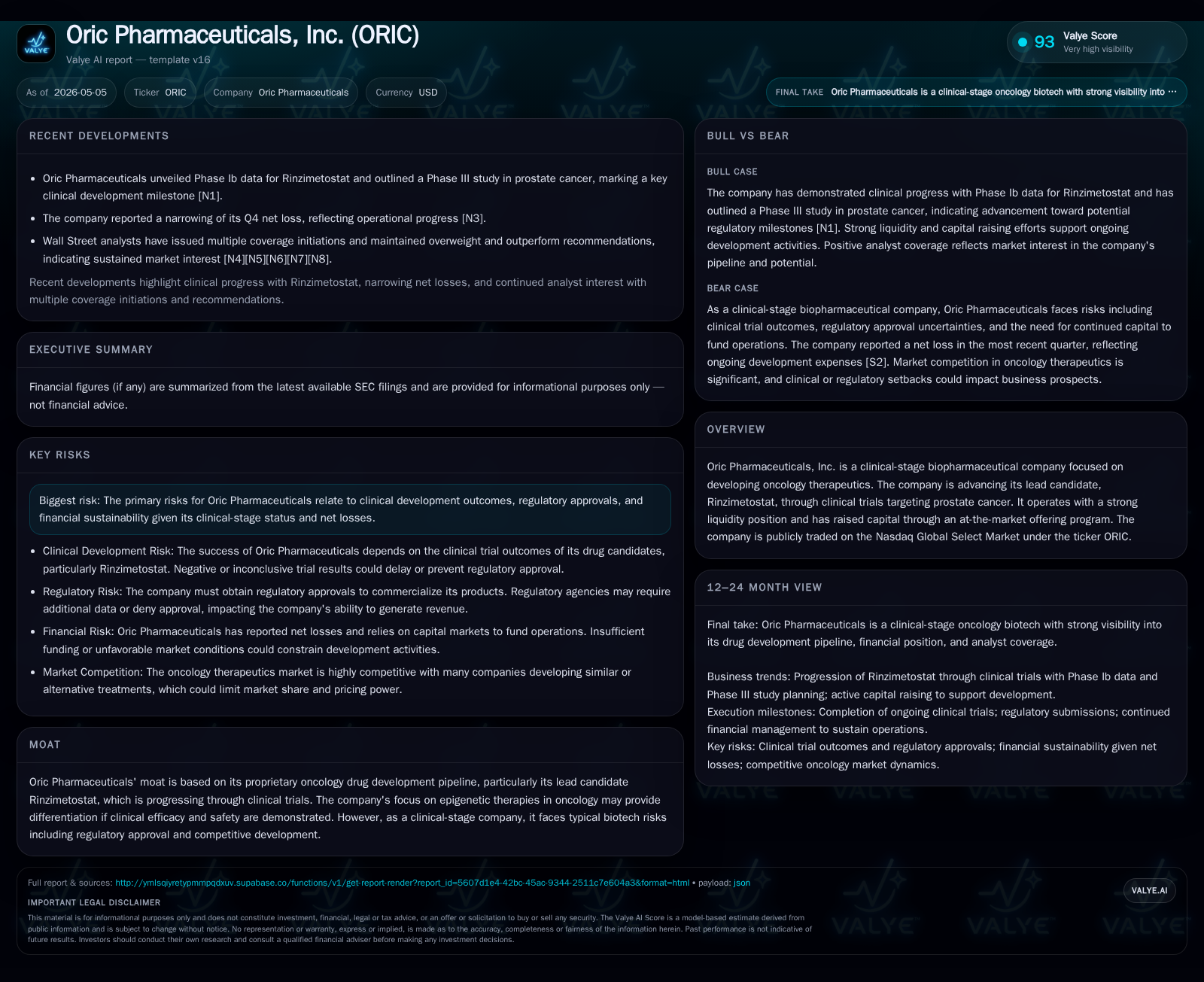
In its 2026 Q1 10-Q filing, Oric Pharmaceuticals reported meaningful clinical updates on its lead epigenetic therapy candidate, Rinzimetostat, advancing toward Phase III trials for prostate cancer. The company maintains a strong balance sheet with over $56 million in cash and a current ratio exceeding 16, supporting operational resilience amid ongoing net losses typical for clinical-stage biopharma. Oric’s focused oncology pipeline centered on epigenetic mechanisms positions it distinctively, though fundamental risks tied to clinical outcomes and regulatory paths remain critical. Near-term catalysts include pivotal trial readouts and enrollment milestones, with capital markets activities providing financial runway clarity.
Latest Quarterly Operating Update: Clinical Progress and Capital Status
Oric Pharmaceuticals’ first-quarter 2026 10-Q filing dated May 4 confirms continued advancement of its lead asset, Rinzimetostat (ORIC-944), an epigenetic inhibitor targeting prostate cancer. The company disclosed positive dose optimization data from its Phase Ib trials enhancing the dosing regimen, which forms the basis for its planned Phase III pivotal study. This is supported by a detailed presentation in an accompanying 8-K filing the same day outlining trial design specifics and patient enrollment progress [S2][S3].
Financially, Oric stands on firm footing with $56.4 million in cash and equivalents as of March 31, 2026. The current assets total approximately $290 million against liabilities near $17.8 million, yielding an exceptionally healthy current ratio of 16.33—indicating ample liquidity to fund ongoing operations well into the near term [F1],[S2]. This financial resilience is critical given the inherent long lead times and high burn rates typical of clinical-stage biopharma companies without commercial revenues.
This quarter sustains Oric’s operational momentum in oncology drug development supported by capital flexibility via an active at-the-market (ATM) offering program that replenishes resources as needed without immediate dilution pressure [S3].
Oric Pharmaceuticals’ Business Model and Therapeutic Focus
Oric operates as a clinical-stage biotechnology company largely dependent on its intellectual property surrounding innovative epigenetic therapies in oncology. The business model is characteristic of developmental biotech firms: value generation is driven primarily through successful clinical trial progression rather than product sales.
Rinzimetostat represents the cornerstone of this model—a histone methyltransferase inhibitor designed to modulate gene expression patterns implicated in prostate cancer progression. Revenue streams remain zero from commercial sales; instead, value manifests via milestone payments tied to clinical and regulatory developments and potential future partnerships or licensing deals [S1].
The emphasis on epigenetics distinguishes Oric’s portfolio from conventional chemotherapy or immunotherapy regimens by targeting fundamental transcriptional machinery with the potential for more durable disease control or combination synergy.
Competitive Positioning in Epigenetic Oncology Drug Development
The oncology drug development landscape is intensely competitive with numerous players focusing on diverse mechanisms including targeted small molecules, monoclonal antibodies, and emerging cell therapies. Oric’s niche lies squarely within epigenetic modulators—an area witnessing increasing interest due to promising preclinical rationales but relatively few late-stage assets.
Within prostate cancer therapeutics specifically, while androgen deprivation therapies dominate standard care, there remains a significant unmet need for novel agents addressing hormone-refractory or resistant disease states. Rinzimetostat’s entry point offers potential differentiation if efficacy endpoints are met.
Patents protecting Oric's molecular entities support competitive barriers; however, the crowded nature of oncology pipelines implies continuous innovation pressure and risk from competing candidates advancing faster or demonstrating superior profiles [S1].
Growth Drivers: Pipeline Expansion and Trial Milestones
Oric’s growth trajectory is anchored in near-term clinical milestones that serve as key demand drivers. The transition from Phase Ib dose optimization to full Phase III enrollment marks a crucial pivot point where scale-up intensifies both resource consumption and valuation prospects.
Positive interim readouts demonstrating safety or preliminary efficacy could materially impact external perceptions and partner interest. Moreover, label expansions or additional indications could broaden market potential if Rinzimetostat’s mechanism proves effective across multiple tumor types or settings [N4][S2][S3].
Parallel programs such as enozertinib (ORIC-114) may offer later-stage diversification but currently play a secondary role compared to the prioritized Rinzimetostat candidate.
Key Risks and Constraints: Clinical, Regulatory, and Financial Challenges
The pathway for Oric Pharmaceuticals is fraught with typical biotech uncertainties. Primary risks include:
- Binary clinical trial outcomes where failure in pivotal studies would severely undermine valuation and strategic options.
- Protracted regulatory review processes inherent in oncology approvals that can delay commercialization timelines.
- Financial sustainability concerns arising from persistent net losses that necessitate periodic capital raises potentially dilutive to shareholders.
While Oric manages these risks through robust trial design and capital management, the next phases will test execution rigor under increased scrutiny [S5][S22][F1].
Near-Term Watchpoints: Upcoming Data Readouts and Funding Activities
Investors should monitor several key operational catalysts across coming quarters:
- Enrollment completion data for the Phase III Rinzimetostat trial will indicate patient recruitment strength.
- Interim analyses or biomarker readouts may offer early signals ahead of final results.
- Equity issuance activity under the ATM program will provide visibility into funding runway duration.
Each serves as an explicit KPI impacting perceived risk/reward dynamics relevant for business partners and capital markets alike [S2][S3].
Financial Profile: Liquidity, Operating Costs, and Runway
Latest financial snapshot
| Metric | Value | Period |
|---|---|---|
| Cash & equivalents | $56mm | |
| 2026-03-31 | ||
| Current assets | $290mm | |
| 2026-03-31 | ||
| Current liabilities | $18mm | |
| 2026-03-31 | ||
| Current ratio | 16.33x | |
| 2026-03-31 |
Source: SEC companyfacts cache [F1].
A compact financial snapshot as of March 31, 2026 highlights Oric’s capacity to weather developmental expenditures:
| Metric | Value (USD) | Date |
|---|---|---|
| Cash & Equivalents | 56,396,000 | |
| 2026-03-31 | ||
| Current Assets | 290,233,000 | |
| 2026-03-31 | ||
| Current Liabilities | 17,771,000 | |
| 2026-03-31 | ||
| Current Ratio | 16.33 | |
| 2026-03-31 |
Operating loss remains substantial (approximately $143 million annually last reported), reflecting intense R&D spend without offsetting revenue streams [F1].
Overall capital adequacy supports sustained trial activities but underscores eventual dependence on successful financing rounds coinciding with milestone achievements or strategic transactions [F1][S2].
This analysis integrates the latest SEC filings with domain expertise to position Oric Pharmaceuticals’ current standing within the oncology biotech arena—highlighting how pipeline progress correlates directly with funding capacity amid inherent sector risks. Future performance critically hinges on ability to deliver robust clinical evidence demonstrating safety and efficacy while maintaining fiscal discipline before commercialization opportunities materialize.
Disclaimer: This analysis is provided for informational purposes only and does not constitute investment advice or recommendations.
Disclaimer: This is research-only, informational analysis and not investment advice. It may include AI-generated interpretation and general industry context. Always verify important details using primary sources.

Comments