
Pulmonx Corp Advances Adoption of Minimally Invasive COPD Therapy with Zephyr Valve
Pulmonx’s latest quarterly report highlights revenue growth and ongoing commercialization efforts for its flagship Zephyr Endobronchial Valve amid continuing operational losses.
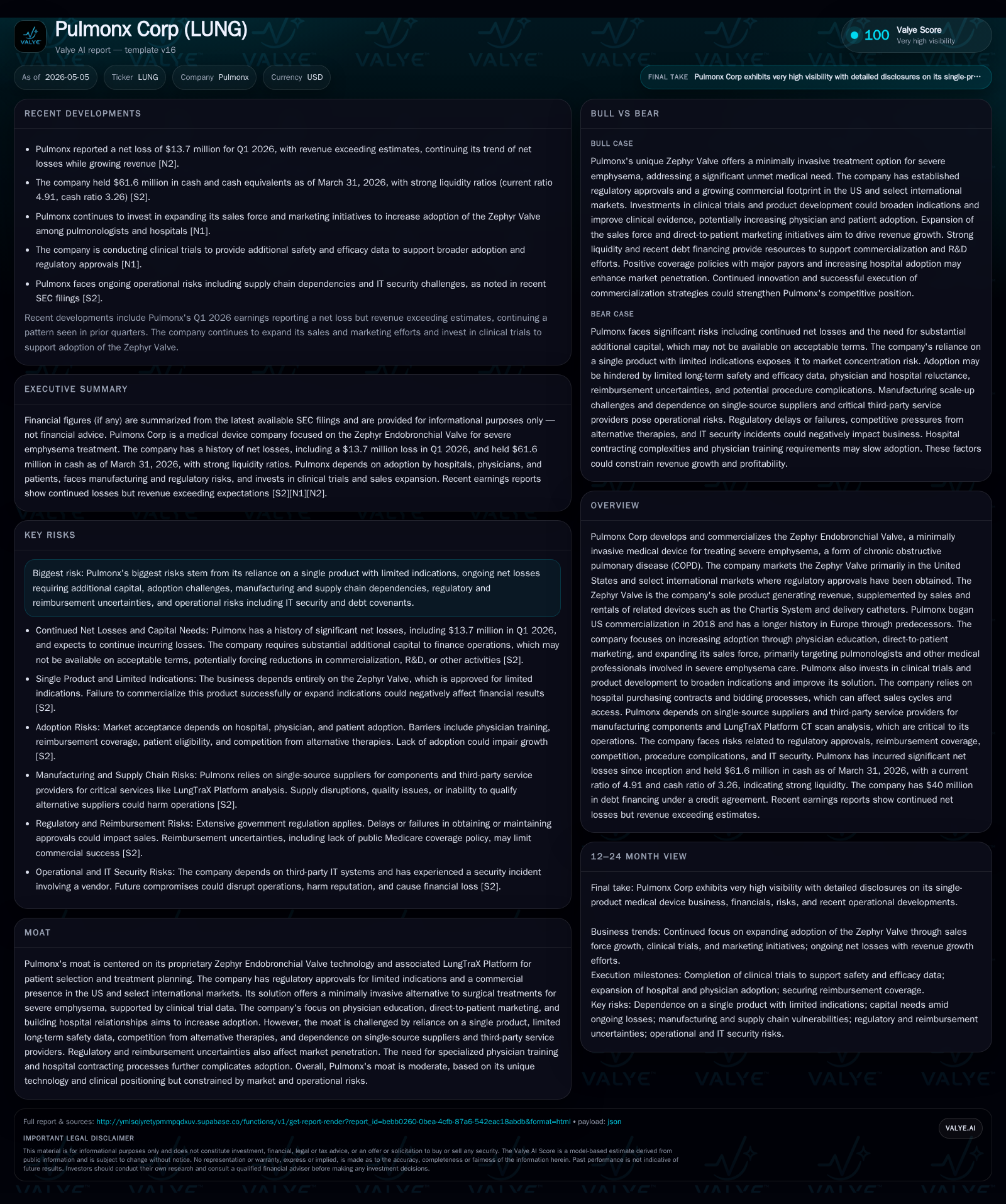
In Q1 2026, Pulmonx demonstrated continued progress in market adoption of its Zephyr Valve, the only FDA-approved minimally invasive solution for severe emphysema patients who are ineligible for surgery. Revenue exceeded estimates, reflecting expanded sales force efforts and strengthened physician engagement, although profitability remains elusive due to substantial ongoing investments and net losses. The company faces industry headwinds including reimbursement uncertainties, limited long-term safety data, and competitive pressures. Future growth depends on clinical trial outcomes supporting label expansions and further geographic penetration.
Latest Operating Activity and Commercial Progress
Pulmonx's first quarter report filed May 4, 2026 ([S2]) reveals solid commercial momentum despite persistent losses. Revenue surpassed expectations driven mainly by expanded penetration in the US market where direct sales continue to build physician adoption. The Q1 results showed growing implant volumes for the Zephyr Endobronchial Valve amid investments in sales force expansion targeting interventional pulmonologists at approximately 500 high volume hospitals nationwide. Alongside clinical engagement efforts and direct-to-patient outreach, these activities support incremental market gains albeit within still nascent total market development.
An April 29 event filing ([S3]) combined with earnings call transcripts ([N1][N2]) further emphasize Pulmonx’s execution focus on increasing awareness and utilization among specialist physicians managing severe emphysema patients refractory to conventional medical therapy or unfit for surgery. Clinical trial progress including advancement of the CONVERT II pivotal study for the adjunctive AeriSeal System plays a complementary role in broadening future treatment indications.
The quarter matters as it confirms early signs of acceptance within a conservative specialty field where device adoption hinges heavily on accumulating real-world evidence, payer acceptance, and hospital access protocols.
Pulmonx’s Business Model: Zephyr Valve and Related Offerings
Pulmonx derives nearly all its revenues from the patented Zephyr Endobronchial Valve—an implantable device designed to induce lung volume reduction via targeted occlusion of diseased lung lobes in severe COPD/emphysema patients. This minimally invasive approach provides an alternative to lung volume reduction surgery (LVRS), reducing procedural risk while improving lung function and quality of life metrics proven in multiple randomized controlled trials ([S1]).
Supporting products such as the Chartis Pulmonary Assessment System facilitate physiological testing during patient selection to optimize outcomes by identifying candidates without collateral ventilation—a known predictor of procedural success. The proprietary LungTraX Platform underpins this diagnostic-treat continuum enhancing clinical decision-making.
Commercial efforts concentrate on a direct sales model in core markets including the US, which accounted for 95% of revenue in 2025 ([S1]), complemented by distributor partnerships internationally. Sales reps specialize in building relationships with interventional pulmonologists who perform bronchoscopic procedures addressing severe emphysema symptoms.
Value propositions hinge on delivering meaningful improvements in airflow obstruction, exercise capacity, BODE Index scores linked to long-term survival advantage, while offering a less invasive risk profile versus surgery. However, adoption requires overcoming entrenched clinical practices, specialized physician training requirements, and payor reimbursement hurdles given complex Medicare processing structures ([S1]).
Competitive Environment and Industry Dynamics
The pulmonary intervention device space is fragmented with alternatives including competing valve systems like Olympus Corporation's Spiration Valve System and Broncus Medical's InterVapor System (non-US approved) ([S1], [S26]). Conventional options such as LVRS or transplant remain established but carry higher morbidity.
Pulmonx's moat centers on regulatory barriers—the FDA’s Premarket Approval (PMA) status confirms stringent safety/efficacy validation—and its comprehensive ecosystem combining implantable valve technology with advanced patient selection tools ([S1]). However, limitations include reliance on a single product focused on narrow indications restricted to severe emphysema without collateral ventilation; this constrains total addressable market size.
The payer landscape amplifies complexity since approximately three-quarters of potential patients are Medicare beneficiaries subject to variable Local Coverage Determinations (LCDs) rather than uniform National Coverage Determinations (NCDs). This fragmented reimbursement environment can slow hospital uptake due to inconsistencies in coverage policies ([S10]).
Operational risks include dependency on single-source suppliers for key components whose regulatory compliance failures could disrupt manufacturing continuity and gross margin profiles ([S18]). Furthermore, recent DOJ investigations culminating in settlement agreements highlight compliance risks pertaining to healthcare fraud statutes impacting marketing and reimbursement conduct ([S10]).
Growth Opportunities through Market Expansion and Clinical Innovation
Expansion strategies revolve around scaling the US salesforce aggressively to increase procedure volumes through heightened physician penetration at large pulmonology centers ([S21]). Internationally, Pulmonx blends direct selling with distributors seeking incremental market share growth in Europe and Asia Pacific regions where regulatory clearances exist but reimbursement variability restrains faster adoption.
Clinical innovation advances growth outlook beyond the Zephyr Valve core product line. The AeriSeal System—FDA Breakthrough Device-designated synthetic foam intended to occlude collateral ventilation pathways—is mid-trial (CONVERT II) aiming for PMA submission enabling treatment for patients previously contraindicated due to collateral channels ([S21]). Positive outcomes there would materially broaden addressable populations enhancing strategic diversification away from sole reliance on the valve platform.
At a technology level, ongoing enhancements of LungTraX aim to improve patient segmentation accuracy driving higher clinical success rates thereby supporting broader guideline inclusion globally.
Patient awareness campaigns combined with physician education modules target earlier identification of eligible candidates among symptomatic COPD populations not responding adequately to pharmacotherapy—a structural market driver given aging demographics and underdiagnosis trends noted in epidemiology studies ([N1]).
Risks and Constraints Impacting Market Penetration
Key risks outlined in filings spotlight sustained operating deficits—net losses exceeding $54 million annually threaten path-to-profitability absent accelerated revenue growth or cost discipline ([F1], [S2]). Capital needs are expected to persist requiring debt or equity financing amid market volatility concerns.
Reimbursement uncertainties loom large: lack of consistent Medicare NCD coverage creates uneven treatment accessibility hampering hospital willingness to invest resources into new device programs ([S10]). Patient safety considerations also impact adoption; adverse event risks including pneumothorax or rare fatal complications necessitate lengthy post-market surveillance diminishing provider enthusiasm until longer-term datasets mature ([S7]).
Regulatory compliance pressures remain acute following investigations related to marketing practices under federal Anti-Kickback statutes resolved via settlement agreements disrupting management focus ([S10]). Intellectual property challenges potentially arising from patent litigation within a litigious medtech field impose additional uncertainty over exclusivity rights ([S17]).
Single product dependence increases vulnerability should competitors prevail with more versatile offerings or if emerging pharmacologic agents reduce interventional referrals by improving baseline symptom control ([S26]). Supply chain fragility involving critical component sourcing exposes manufacturing cadence risks that could lead to lost revenue opportunities or margin compression if alternative suppliers cannot meet standards rapidly enough ([S18]).
Key Milestones and Upcoming Catalysts to Watch
Investors and stakeholders should monitor several upcoming developments: completion and data release from the CONVERT II pivotal trial assessing AeriSeal's efficacy will influence future FDA filings potentially opening new patient segments; any expansion of label indications for Zephyr Valve solidifying clinical guideline endorsements; updates around reimbursement policy especially shifts toward national Medicare coverage would alleviate adoption bottlenecks; ongoing scaling results from US commercial team reflecting physician usage rates at target hospital systems; capital raise or refinancing activities impacting liquidity posture; regulatory actions concerning compliance programs post-DOJ settlement could affect operating licenses or require remedial measures ([S2], [S3]).
Quarterly revenue performance aligned with implant volumes alongside backlog or bookings disclosures may serve as practical proxies for demand trajectory.
Financial Overview: Liquidity, Leverage, and Profitability Snapshot
Latest financial snapshot
| Metric | Value | Period |
|---|---|---|
| Cash & equivalents | $61.57 million | |
| 2026-03-31 | ||
| Total debt | $63.28 million | |
| 2026-03-31 | ||
| Net debt | $1.7 million | |
| 2026-03-31 | ||
| Current assets | $92.75 million | |
| 2026-03-31 | ||
| Current liabilities | $18.91 million | |
| 2026-03-31 | ||
| Current ratio | 4.91 | |
| 2026-03-31 |
Source: SEC companyfacts cache [F1].
As of March 31, 2026 ([F1]), Pulmonx held approximately $61.57 million in cash and equivalents against $63.28 million in total debt resulting in a near-neutral net debt position (~$1.7 million).
It does not constitute investment advice or recommendations. Financial figures are drawn directly from cited sources without projection or extrapolation beyond stated periods.
Disclaimer: This is research-only, informational analysis and not investment advice. It may include AI-generated interpretation and general industry context. Always verify important details using primary sources.

Comments