
Twist Bioscience Scales Silicon-Based DNA Platform with Expanding Biopharma Reach
Q2 2026 results showcase Twist's platform growth momentum amid ongoing investment to support commercial scaling and biopharma service expansion.
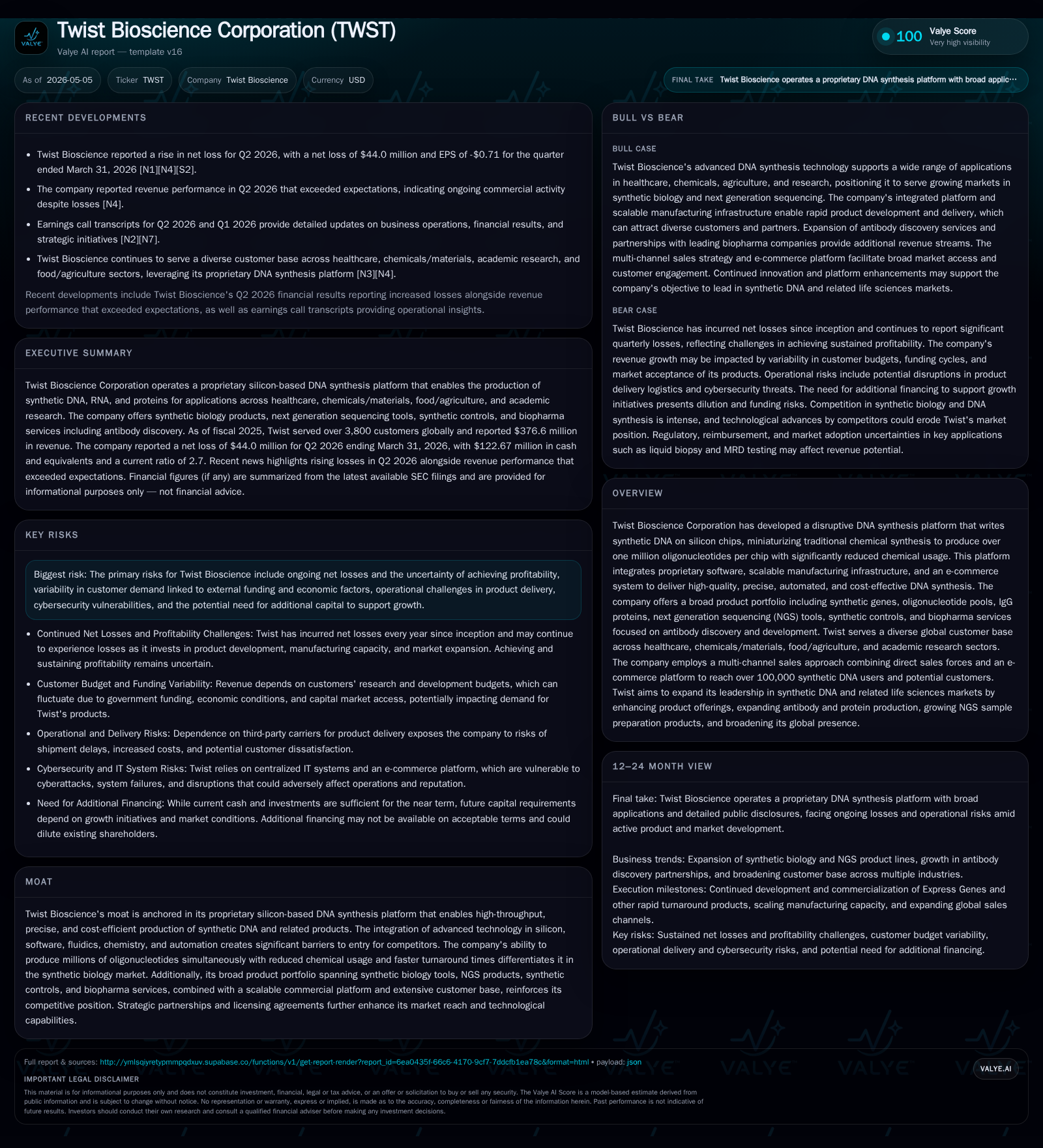
In its Q2 2026 filing, Twist Bioscience reported revenue exceeding expectations despite widening net losses, reinforcing the company's commitment to scaling its proprietary silicon-based DNA synthesis platform. The firm continues broadening its product portfolio and deepening partnerships in healthcare and biopharma services, leveraging its tech moat. Risks persist around profitability and demand variability, while the company’s strong liquidity position supports ongoing investments. Monitoring operational execution on new product adoption and commercialization pace will be key.
Q2 2026 Operational Highlights and Developments
Twist Bioscience’s latest quarterly filing (Q2 ended March 31, 2026) reveals a continued trajectory of top-line growth accompanied by escalating net losses. The company reported revenues that outpaced analyst consensus estimates while acknowledging rising operational expenses linked to scaling manufacturing throughput and expanding its biopharma service capacities [S2][N3]. Despite deeper quarterly losses driven by investments in automation enhancements and expanded R&D initiatives supporting antibody discovery platforms, management underscored this spending as essential to capture emerging market opportunities in synthetic biology [N5]. The recent event filing reaffirmed no material change in risk factors but emphasized operational focus on customer acquisition efficiency and platform integration improvements [S3].
This duality of scaling revenues alongside widening net losses typifies early-stage capital-intensive biosynthesistech firms aiming for long-term growth over near-term profitability.
Business Model: Silicon-Based Synthetic DNA Platform and Product Portfolio
At its core, Twist Bioscience leverages a proprietary silicon chip-based platform that miniaturizes traditional oligonucleotide synthesis into a massively parallelized "writing" process capable of producing over one million DNA fragments per chip. This approach significantly reduces chemical consumption by approximately 99.8%, offering both environmental benefits and cost efficiencies relative to legacy plate-based methods [S1][S13]. The integration of automated fluidics systems with proprietary software management and a seamless e-commerce ordering experience generates an end-to-end industrialized workflow enabling rapid turnaround times—a critical advantage given the sensitive timelines in biotechnology research.
The company’s synthetics portfolio encompasses:
- Synthetic genes and fragments tailored for research applications across therapeutics development, agriculture biotech innovations, and materials science.
- Next generation sequencing (NGS) tools, including library preparation kits optimized for liquid biopsy testing and population genomics.
- Sensitive synthetic controls serving quality assurance roles in both NGS assays and RT-PCR applications.
- Biopharma services that deliver integrated antibody discovery solutions combining in vivo/in vitro screening with AI-driven characterization assays aimed at accelerating drug candidate identification and optimization [S13][S21].
Customers span healthcare firms pursuing novel therapeutics, chemical companies engineering bio-based materials like spider silk or biodegradable additives, food/agriculture innovators focused on sustainable crop genetics, as well as academic researchers leveraging precision DNA constructs for basic science exploration. This multi-industry reach is supported by a multi-channel commercial organization comprising direct sales forces specialized across synthetic biology customers and NGS users alongside an efficient e-commerce sales portal facilitating custom oligo requests globally [S19].
Industry Dynamics and Twist’s Competitive Advantages
Synthetic biology is marked by intense innovation cycles underpinned by rapid technological progress in gene synthesis techniques. In this environment, Twist Bioscience's silicon synthesis technology forms a significant barrier to entry via substantial IP protections and scalability advantages derived from miniaturization of chemistry on silicon chips. Its ability to scale oligonucleotide yields on a single chip far beyond conventional methods has positioned Twist distinctly from competitors relying on traditional column- or plate-based chemistry.
Further reinforcing this moat is the sophisticated ecosystem Twist has built around its platform—integrating advanced software algorithms for synthesis optimization; automated manufacturing processes; plus a direct-and-digital sales network addressing tens of thousands of potential users worldwide [S1]. A continuous process improvement culture targets throughput ramping while maintaining quality standards critical for regulated sectors such as diagnostic device manufacturers using CE-marked NGS reagents in Europe.
However, rapid advances in synthetic biology tools keep technology obsolescence a recurring risk requiring persistent R&D investment. Supply chain dependencies on single-source components—such as specialized silicon wafers essential to manufacturing—also present operational vulnerabilities [S26]. Strategic partnerships help mitigate these constraints by enhancing distribution channels and augmenting product capabilities.
Drivers of Growth: Innovation, Market Penetration, and Strategic Partnerships
Key growth levers identified include:
- Expansion of product portfolio: Moving beyond DNA oligos into RNA constructs (mRNA vaccines/proteins), improved synthetic controls for assay accuracy, and enhanced NGS sample prep kits targeting emerging applications like minimal residual disease detection.
- AI-driven platform enhancements: Leveraging machine learning to optimize synthesis protocols could improve yield consistency while reducing cycle times further.
- Biopharma service growth: Deepening collaborations with pharmaceutical partners through integrated antibody discovery platforms emphasizing speed and comprehensive biochemical characterization enhances revenue streams via licensing fees plus milestone royalties from 442+ active partnerships registered as of fiscal year-end 2025 [S17].
- Geographic expansion: Broadening reach into Asia-Pacific markets with growing genomic research capacity expands addressable market size.
- Commercial infrastructure scaling: Hiring specialized sales personnel focused on complex solution selling across healthcare and industrial life sciences sectors drives higher client conversion rates despite typical six to nine months onboarding lead times [S19].
These drivers relate directly to measurable KPIs such as increasing number of active customer programs leveraging both synthetic biology products alongside biopharma discovery services—the convergence underscoring the platform’s strategic value proposition [N1].
Risks and Constraints: Profitability, Market Demand Variability, and Supply Dependencies
Despite operational advances, Twist Bioscience faces several notable headwinds:
- Ongoing net losses: The company has consistently recorded net losses every period due to aggressive investments needed for R&D scale-up and market penetration. Profitability remains uncertain over the near term [S1][F1].
- Customer demand volatility: The synthetic biology end markets are often dependent on external funding cycles within biotech ventures or academic grants which can fluctuate materially impacting reorder behaviors—no long-term fixed contracts govern minimum purchases exacerbating revenue visibility challenges [S28].
- Single-source supplier risks: Dependence on a sole supplier for certain critical materials integral to the silicon synthesis process introduces supply chain fragility that could delay capacity expansion if disrupted [S26].
- Cybersecurity exposures: Centralized IT systems underpin critical operations including order processing; breaches or disruptions pose operational risks with potential material impacts on business continuity [S28].
- Capital requirements: Sustained growth requires continued access to financing sources; unfavorable capital markets conditions or dilution concerns may constrain required funding availability at favorable terms [S26].
Management highlights ongoing efficiency improvement programs geared toward partially offsetting cost inflation while maintaining quality standards; however execution risks remain as scale complexity grows.
Key Upcoming Milestones and Indicators to Monitor
Investors will want to track several metrics over coming quarters:
- Quarterly revenue growth trends with margin progression revealing operational leverage gains or pricing pressures.
- Deployment progress of AI-integrated synthesis workflow elements that may accelerate yield enhancements or reduce production cycle times.
- Adoption rates of newly launched mRNA/protein products along with expanded NGS sample prep kits signaling successful product diversification.
- Renewal rates or milestone achievements within existing biopharma collaborations pointing toward durable partnership value extraction.
- Stability metrics related to supply chain continuity—especially availability/timeliness of silicon chip inputs.
- Cash burn rate relative to liquidity providing clarity on runway adequacy for achieving targeted commercial scale [N1][S3].
These leading indicators will help differentiate between cyclical demand fluctuations versus structural uptake accelerations driving sustainable valuations.
Current Financial Profile and Liquidity Position
Latest financial snapshot
| Metric | Value | Period |
|---|---|---|
| Cash & equivalents | $123mm | |
| 2026-03-31 | ||
| Current assets | $323mm | |
| 2026-03-31 | ||
| Current liabilities | $120mm | |
| 2026-03-31 | ||
| Current ratio | 2.7x | |
| 2026-03-31 |
Source: SEC companyfacts cache [F1].
As of March 31, 2026, Twist Bioscience reported cash & equivalents totaling $122.7 million paired with nominal debt obligations (approximately $0.83 million last detailed in September 2021) supporting a robust liquidity profile conducive to ongoing investment activities [F1]. The current ratio stands at a healthy 2.7x indicating solid short-term liquidity coverage relative to $120 million in current liabilities [F1].
These resources underpin flexibility for capex initiatives expanding manufacturing capacity alongside increased R&D spend necessary for evolving the DNA synthesis platform into adjacent molecular products such as RNA therapeutics components or protein assays. While net losses persist reflecting ongoing investment rather than cash flow deficits threatening solvency balance-sheet strength remains an enabler amidst late-stage commercialization efforts.
| Metric | Amount (USD) | Period End |
|---|---|---|
| Cash & Equivalents | $122.7 million | |
| 2026-03-31 | ||
| Total Debt | $0.83 million | |
| 2021-09-30 | ||
| Current Assets | $323.4 million | |
| 2026-03-31 | ||
| Current Liabilities | $120.0 million | |
| 2026-03-31 | ||
| Current Ratio | 2.7 | |
| 2026-03-31 |
Disclaimer: This analysis is based solely on publicly available information from SEC filings ([S1],[S2],[S3]), news transcripts ([N1],[N3],[N5]), company financial snapshots ([F1]), and Valye proprietary research excerpts. It does not constitute investment advice.
Disclaimer: This is research-only, informational analysis and not investment advice. It may include AI-generated interpretation and general industry context. Always verify important details using primary sources.

Comments