
Tidewater Inc. Charts Post-Quarter Challenges and Growth Strategy Refinement
Tidewater's latest quarterly results reveal operational pressures amid market volatility yet underscore strategic fleet consolidation and expansion initiatives.
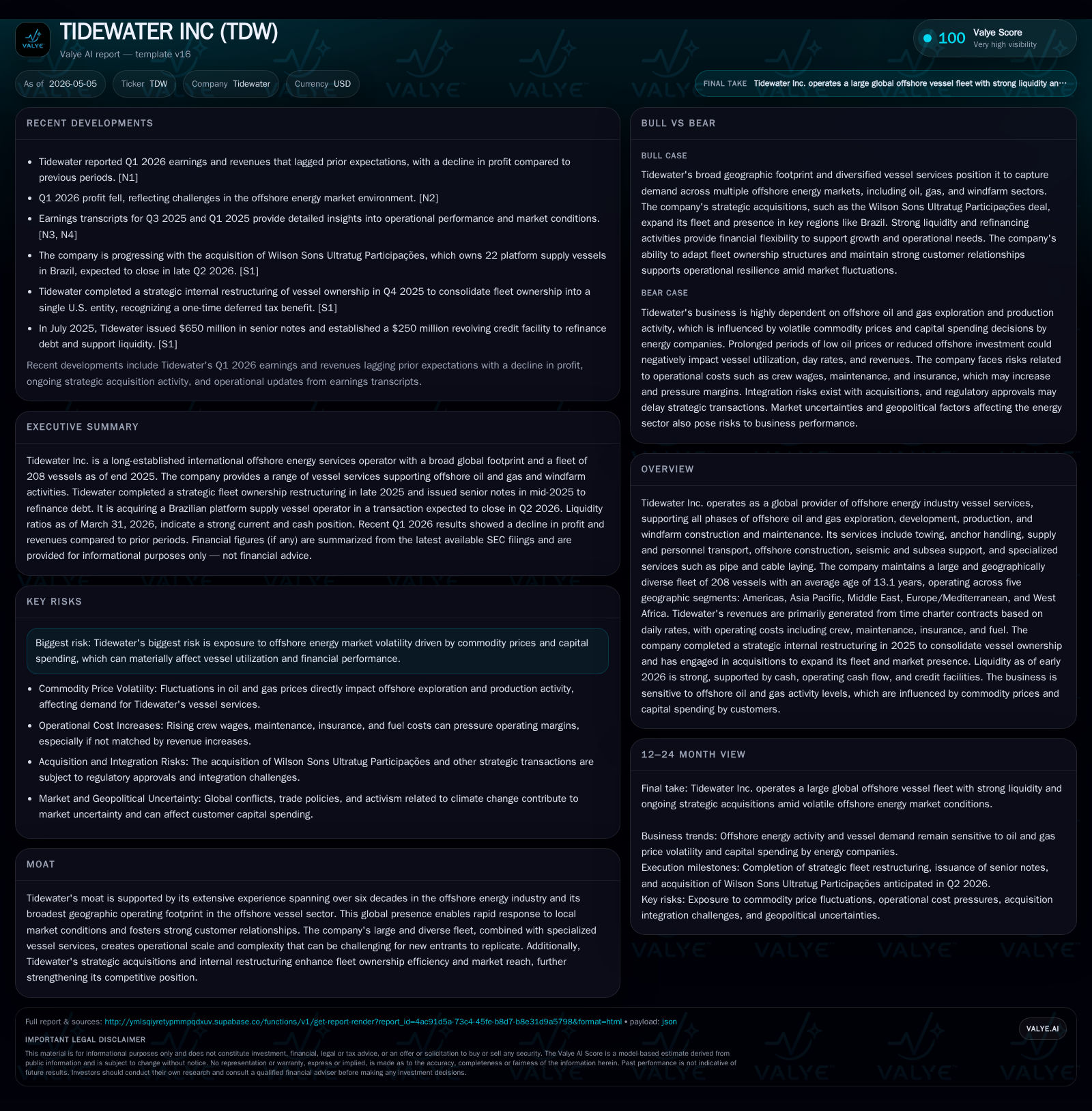
In its Q1 2026 report, Tidewater Inc. experienced revenue and earnings shortfalls attributed to weaker offshore activity and vessel utilization rates. Despite these near-term headwinds, the company is advancing a significant acquisition in Brazil alongside internal fleet consolidation efforts aimed at enhancing operational efficiency. Tidewater’s broad, specialized global fleet and strong geographic footprint sustain competitive advantages in the capital-intensive offshore vessel sector, though demand remains closely tied to commodity price cycles and offshore capex trends. Upcoming integration of new assets and monitoring of market rate trends will be critical by mid-2026.
Latest Quarterly Operations and Market Reaction
Tidewater Inc. reported operating challenges in the quarter ended March 31, 2026 [S2]. Revenues lagged expectations as vessel utilization rates softened amid subdued offshore activity levels precipitated by cautious capital spending from energy customers. Industry reports highlighted that daily time charter rates faced pressure in key regions coincident with the slower offshore exploration and production ramp-up seen early in the year [N1], [N5]. While the firm maintains a diversified portfolio geographically and by vessel type, the macro environment's cyclical nature impacted first quarter earnings notably.
Management commentary in the contemporaneous Form 8-K reaffirmed near-term headwinds but emphasized ongoing actions such as fleet consolidation completed late last year aimed at cost control and operational efficiency improvement [S3]. The share price response was muted following the release reflecting investor recognition of sector cyclicality but with anticipation on Tidewater’s strategic positioning.
Business Model and Service Offering Deep Dive
Tidewater generates most of its revenues through time-charter agreements where customers pay daily rates for the use of its vessels over contracted periods. This model provides relatively stable cash flows during contract tenure but exposes the company to market-day-rate fluctuations upon renewals or spot charters.
Its fleet comprises 208 vessels averaging about 13 years in age with capabilities supporting multiple phases of offshore oil & gas operations including towing, anchor handling, supply runs, personnel transfers, subsea construction assistance, seismic surveys, cable laying, as well as emerging offshore windfarm maintenance services. This diversification allows Tidewater to service various customer needs across five continents encompassing Americas, Asia Pacific, Middle East, Europe/Mediterranean, and West Africa segments [S1].
Operating costs for each vessel primarily include crew wages, routine maintenance and repairs, insurance premiums often influenced by regional maritime risk profiles, and fuel expenses whose pricing dynamics directly impact margins. Efforts around fleet age management and maintaining technical standards affect customer retention given increasing demands for specialized vessels tailored to complex offshore projects [S1].
The company’s extensive experience spanning more than six decades bolsters customer trust while its size facilitates economies of scale particularly in crewing logistics and drydocking planning.
Competitive Positioning Within the Offshore Vessel Industry
The offshore vessel services industry is notably capital intensive with high barriers to entry given the substantial investment required for acquiring modern fleets compliant with international safety/environmental standards. Tidewater’s globally distributed fleet enables quick response to shifting local market conditions—a material advantage over smaller regional operators constrained by narrower geographic reach.
Moreover, specialized service offerings such as pipe laying or cable installation provide differentiation from commoditized supply-only vessels. Regional regulations often mandate local content or taxation rules which complicate competitor entry strategies thereby reinforcing incumbents like Tidewater that have established multi-jurisdictional compliance frameworks.
By consolidating much of its fleet into a single wholly owned U.S.-based entity through an internal restructuring completed in Q4 2025, Tidewater has further enhanced its ability to optimize asset utilization while improving financing flexibility—a critical moat factor against new entrants or smaller players lacking scale or balance-sheet heft [S14].
Drivers of Demand and Growth Catalysts
Tidewater’s primary demand drivers remain linked to upstream spending patterns dictated by oil & gas price trends which influence offshore exploration intensity and field development timelines. Positive shifts in commodity prices typically translate into higher contract volumes and improved time charter day rates over medium term horizons.
The growing adoption of renewable offshore wind power platforms introduces a nascent source of vessel demand where Tidewater leverages existing subsea expertise for turbine installation and maintenance support activities—representing a structural growth opportunity that partially offsets fossil fuel sector cyclicality.
Strategically significant is Tidewater’s pending acquisition of Wilson Companies announced in February 2026—a transaction valued at approximately $500 million on a debt-free basis that expands its presence in Brazil via addition of 22 platform supply vessels servicing one of the world’s most active offshore basins. Closing is expected late Q2 ’26 pending antitrust approvals—this deal dovetails with Tidewater’s ambitions to increase scale in key markets while broadening service reach [S5], [S19].
Internal efficiencies from the recent fleet realignment initiative are poised to reduce overhead fragmentation allowing more disciplined capital allocation toward growth projects including targeted M&A or newbuild investments.
Key Risks, Constraints, and Market Sensitivities
Despite diversification efforts, Tidewater remains highly exposed to offshore market volatility driven chiefly by fluctuations in oil prices influencing customer capital spending decisions which materially affect vessel utilization levels. Times when clients defer exploration or production projects can result in idled vessels or significant price concessions at contract renewal.
Other notable constraints include fleet aging risks given a sizable portion of vessels over a decade old requiring higher maintenance expenditures which could pressure margins if not offset by contract premium pricing or utilization gains. Regulatory compliance burdens especially relating to environmental emissions standards impose additional cost layers which may impact competitiveness if not managed proactively.
Additionally, geopolitical challenges inherent in operating across multiple jurisdictions expose Tidewater to risks from local content laws, currency fluctuations affecting contract profitability, political unrest or changes affecting permitting procedures—all variables that can delay projects or alter demand locally.
Financing constraints remain a watchpoint considering sizable acquisition-related debt draws necessary if future M&A activity accelerates beyond anticipated levels.
Upcoming Milestones and Strategic Watchpoints
The near term focus lies on formal closure and integration of the Wilson Companies acquisition anticipated late Q2 2026 subject to regulatory clearance including from Brazilian antitrust authorities [S19], [S3]. Successful assimilation will determine incremental revenue synergies realization potential specifically within Brazil’s prolific ultra-deepwater developments.
Operator capital expenditure plans announced during upcoming quarterly earnings season will serve as barometers for demand trajectory along with spottier data points like day rate revisions from contract renewals across regions most impacted by energy investment cycles.
Monitoring vessel drydocks timing remains crucial as these scheduled maintenance windows temporarily remove ships from available charter inventory potentially affecting short-term utilization metrics.
Management commentary around pricing outlooks amidst evolving energy transition dynamics will be closely scrutinized given its signaling effect on contract negotiations and negotiating leverage over commodity-cycle peaks/troughs.
Financial Health Snapshot: Liquidity, Leverage, and Profitability
Latest financial snapshot
| Metric | Value | Period |
|---|---|---|
| Cash & equivalents | $552mm | |
| 2026-03-31 | ||
| Total debt | $669mm | |
| 2026-03-31 | ||
| Net debt | $116mm | |
| 2026-03-31 | ||
| Current assets | $900mm | |
| 2026-03-31 | ||
| Current liabilities | $270mm | |
| 2026-03-31 | ||
| Current ratio | 3.33x | |
| 2026-03-31 |
Source: SEC companyfacts cache [F1].
| Metric | Latest Value |
|---|---|
| Cash & Equivalents | $552.3M |
| Total Debt | $668.7M |
| Net Debt | $116.4M |
| Current Assets | $899.6M |
| Current Liabilities | $269.9M |
| Current Ratio | 3.33 |
Tidewater’s balance sheet features ample liquidity supported by over half a billion dollars in cash equivalents as of Q1-end providing working capital flexibility amid cyclical swings. Total debt stands at $669 million balanced against cash yielding a net debt position below $120 million illustrating measured leverage consistent with industry norms [F1].
The company has maintained covenant compliance under its revolving credit facility and senior notes with no immediate refinancing need while retaining capacity for opportunistic acquisitions such as Wilson Companies transaction noted previously [S2], [S3]. This financial stability serves as an enabler for continued execution on growth investments while weathering periodic demand troughs typical within offshore services business.
This analysis is based exclusively on publicly filed SEC disclosures dated through May 2026 combined with validated secondary sources related directly to Tidewater Inc.'s latest filings. All financial figures are reported USD values at stated fiscal periods without extrapolation beyond documented data. No investment advice or forward-looking guarantees are provided herein.
Disclaimer: This is research-only, informational analysis and not investment advice. It may include AI-generated interpretation and general industry context. Always verify important details using primary sources.

Comments