
Vornado Realty Trust Advances Redevelopment Amid Headwinds in Q1 2026
The REIT reported mixed first-quarter results, highlighting strategic acquisitions and redevelopment efforts against a backdrop of softness in same-store NOI.
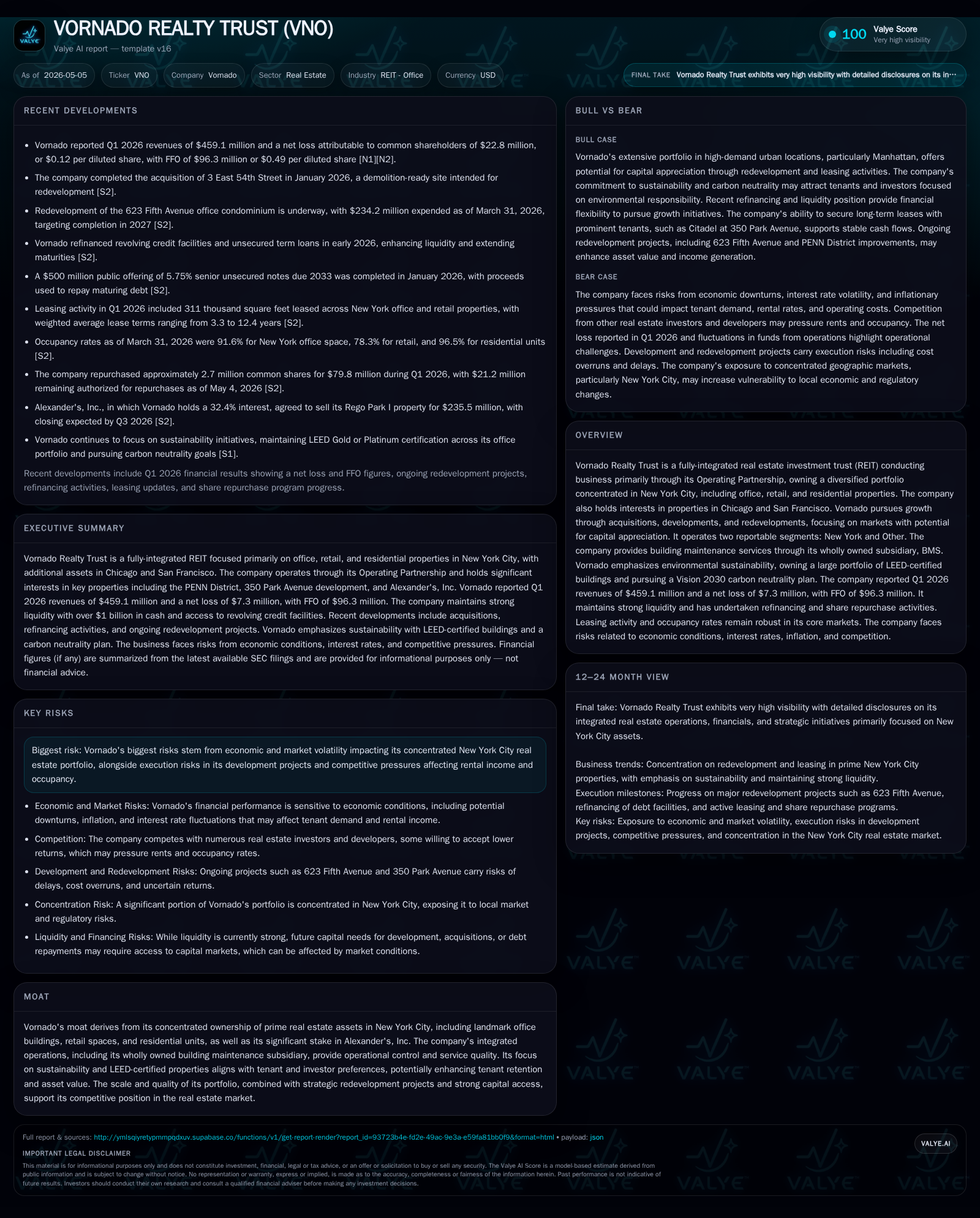
Vornado Realty Trust reported Q1 2026 revenues slightly lower than the prior year at $459.1 million with a net loss of $7.3 million but delivered funds from operations (FFO) in line with estimates at $96.3 million. The company is actively investing in high-profile redevelopment projects, including the 623 Fifth Avenue office condominium and a significant land parcel at 3 East 54th Street for future development. Despite pressures on same-store net operating income (NOI), Vornado’s concentrated New York City portfolio and its integrated operations through its wholly owned building services arm support its competitive positioning. Going forward, execution on redevelopment projects, leasing activity, and capital markets access will be critical growth drivers, while economic volatility and project risks remain key watchpoints.
Recent Operating Update
Vornado Realty Trust reported results for the first quarter ended March 31, 2026 [S2], revealing a nuanced operating environment that blends cautious top-line performance with strategic growth initiatives. Total revenues held near prior-year levels at approximately $459.1 million but were accompanied by a net loss attributable to common shareholders of $22.8 million compared to a net income of $86.8 million in Q1 2025 [S9]. The decline was partly influenced by increased operating expenses offsetting modest revenue improvements in same-store operations.
Despite the net loss, adjusted metrics indicate operational stability; Funds From Operations (FFO) attributable to common shareholders plus assumed conversions was $96.3 million or $0.49 per diluted share—matching analyst estimates [N4][S9]. This reaffirmed Vornado’s cash-generative ability during ongoing investment cycles.
Key asset-level performance noted a dip in same-store Net Operating Income (NOI) at share – cash basis which fell nearly 10% year-over-year to approximately $241 million [S11][S22]. The decline was largely driven by lower contributions from core New York office properties partly reflecting broader market softening pressures.
Strategic acquisition and development moves marked the quarter: notably, the acquisition of the demolition-ready parcel at 3 East 54th Street for $141 million consolidated earlier loan note purchases tied to this asset [S14]. This site offers substantial buildable square footage (~232,500 sq ft as-of-right zoning) central to Vornado’s Upper Fifth Avenue retail corridor holdings.
Moreover, active redevelopment is underway at the premium office condominium at 623 Fifth Avenue acquired late last year for $218 million; total projected investment stands near $450 million with delivery expected in 2027 [S16][S26]. This boutique office redevelopment represents Vornado’s commitment to repositioning assets during evolving office demand dynamics.
On the capital front, the company held cash and equivalents of approximately $1.08 billion as of March 31, 2026, alongside total debt of about $2.8 billion, resulting in net debt near $1.72 billion [F1]. This financial position supports ongoing development and acquisition programs as well as opportunistic capital deployment.
Business Model
Vornado Realty Trust operates predominantly as a fully-integrated Real Estate Investment Trust (REIT), with a core focus on owning and managing a diversified portfolio heavily weighted toward New York City real estate [S1]. Its business is conducted primarily through Vornado Realty L.P., where it holds majority ownership (about 90.9%). Revenue streams arise principally from rental income across its office, retail (including iconic street retail locations like Fifth Avenue), residential units within Manhattan, and additional interests in upscale properties in Chicago (THE MART) and San Francisco’s financial district (555 California Street).
Beyond real estate ownership, Vornado vertically integrates operations via its wholly owned Building Maintenance Services LLC (BMS) subsidiary which provides cleaning and security services not only internally but also externally—offering enhanced control over property service quality that supports tenant retention.
Revenue generation builds upon leasing contracts with commercial tenants whose rents are subject to market cycles yet reinforced by prime location benefits that underpin pricing power within NYC’s premium submarkets [S1]. The company pursues active redevelopment—via both repositioning existing assets like 623 Fifth Avenue or new development opportunities such as the acquired land parcel on East 54th Street—to drive long-term capital appreciation.
Margins fluctuate based on occupancy rates, tenant mix evolution (office versus street retail versus residential), maintenance cost efficiencies achieved through BMS integration, and timing-related lease commissions or concessions offered during leasing cycles.
Industry Structure and Competitive Position
The commercial real estate industry segments into multifamily residential, office space, retail properties, and mixed-use assets—Vornado spans multiple of these categories but maintains a dominant imprint within NYC office and retail spaces. Within this dense metropolitan market, competition intensifies from both local landlord-operators willing to accept varying return profiles and institutional investors seeking trophy assets.
Vornado’s moat resides chiefly in its scale—a portfolio including roughly 19.2 million sq ft of Manhattan office space spread across landmark addresses—paired with ownership stakes in related ventures such as Alexander's Inc., which controls notable commercial properties including the Bloomberg headquarters [F1][S1]. This concentration aids pricing power against smaller regional operators.
Additionally, having an integrated services arm (BMS) provides differentiated operational leverage uncommon among peers that often outsource maintenance; this vertical integration helps maintain higher service standards that are becoming increasingly valued by corporate tenants post-pandemic amid flexible workspace evolutions [S1].
As sustainability gains prominence among tenants and investors alike, Vornado’s extensive cadre of LEED-certified buildings aligns strategically with ESG demands—a factor likely benefiting tenant retention rates while potentially justifying premium rents over time [N8][S15].
Growth Drivers
Several factors underpin Vornado's path forward:
- Redevelopment Initiatives: Substantial investments like the renovation of the prestigious 623 Fifth Avenue property reconceive dated offices into boutique campuses tailored to current corporate tenant preferences seeking quality environments post-pandemic [S16]. Similarly, preparing the site at East 54th Street for future large-scale development enhances pipeline optionality.
- Leasing Momentum: Successfully securing leases post-redevelopment or acquiring tenancy expansions in prime areas could partially counter softer urban office demand witnessed recently; any pickup would drive same-store NOI recovery [N1][S9].
- Asset Dispositions: Disposing non-core or underperforming assets—evidenced by planned sale of Alexander’s Rego Park I property closing expected by Q3 2026—frees capital for higher-return deployment [S14][S18].
- Capital Markets Access: Recent refinancings extended maturities into late decade horizons while lowering borrowing costs (e.g., issuing new notes at sub-6% coupon rates), enabling cost-effective balance sheet management supporting growth projects [S18].
- Environmental Sustainability: Continued emphasis on energy-efficient upgrades under Vision 2030 carbon neutrality initiative meets evolving tenant preference vectors favoring ‘green’ buildings—potentially reducing vacancy risk over time [N8][S15].
- BMS Subsidiary Expansion: Growth in third-party building services offerings represents an ancillary revenue stream augmenting diversified cash flows beyond traditional rents [S1].
Risks / Watchpoints / Growth Constraints
Key risks tempering optimism include:
- Market Sensitivity: NYC commercial real estate remains sensitive to macroeconomic cycles; recession risk or prolonged remote work trends could suppress leasing velocity or pressure rental rates further especially in office segments where supply-demand mismatches continue to evolve [S9][N3].
- Execution Risk: Redevelopment projects carry typical cost overruns or timing delays risks—notably where permitting or construction inflation variables remain uncertain; any delay inflates carrying costs while pushing back revenue recognition windows [S16].
- Competitive Pressures: High competition from other institutional landlords willing to offer concession-heavy leases or accept lower returns can erode pricing power especially in subordinate market subsegments such as street retail or mid-tier offices.
- Interest Rate Fluctuations: Though recent refinancing improved tenor and terms, fluctuating interest rates could increase future borrowing costs affecting margins organically if further debt is issued for developments [S16][N7].
- Concentration Risk: Heavy geographic concentration (>85%+ of NOI contribution from NYC metro area) exposes company to localized economic/regulatory shocks unlike more geographically diversified peers.
- Dependence on Partially Owned Entities: Performance variability within Alexander's Inc., accounting for material shares of revenue/NOI via JV structures introduces risk related to third-party governance or asset disposal timing impacting consolidated results [S14].
What To Watch Next
Upcoming developments that merit attention include:
- Progress updates on leasing velocity and pre-leasing targets for redeveloped assets like 623 Fifth Avenue slated for tenant delivery around late 2027.
- Completion timing and gross/net returns realization from redevelopment spending tracked quarterly relative to initial guidance.
- Execution outcome from newly acquired 3 East 54th Street parcel demolition/delivery timetable confirming pathway towards future build-out.
- Closing milestone of Alexander’s Rego Park I sale slated within H2/23 establishing proceeds recycling efficiency.
- Continued trends in same-store NOI improvement or degradation providing evidence whether cyclical softness is stabilizing or worsening.
- Capital allocation decisions pertaining to share repurchases under existing board authorization vs opportunistic asset sales balances [S14].
- Impact assessments from general macroeconomic environment factoring labor conditions impacting construction costs or financing availability.
Financial Profile Snapshot (Q1 Ending March 31, 2026)
Latest financial snapshot
| Metric | Value | Period |
|---|---|---|
| Cash & equivalents | $1081mm | |
| 2026-03-31 | ||
| Total debt | $2.8bn | |
| 2026-03-31 | ||
| Net debt | $1718mm | |
| 2026-03-31 |
Source: SEC companyfacts cache [F1].
The company’s financial structure reflects prudent liquidity buffers supported by large revolving credit lines (~$2 billion collectively) alongside ample cash balances sufficient to cover near-term operating needs as well as development spending commitments totaling over $15 million currently outstanding construction contracts [S4][S5][S8][F1]. Refinancing activities completed early in the year extended maturities into the early next decade while marginally reducing interest spreads across secured revolvers and unsecured notes enhancing debt service flexibility.
Margin pressures evident in rising operating expenses (+$30 million vs prior year quarter) underscore inflationary cost components particularly within maintenance-related cost centers despite partial offsetting from higher same-store operational revenues primarily driven by re-leasing activities [S11][S17]. Transaction-related fees included also reflect ongoing investment program fees associated with acquisitions like those completed on East 54th Street property consolidation.
Disclaimer
This analysis is intended solely as an informational overview based on publicly available regulatory filings dated May 4–5, 2026 without any endorsement or recommendation regarding investment decisions pertaining to Vornado Realty Trust (VNO). Readers should conduct independent due diligence considering their own risk tolerances along with professional advisory inputs before acting upon this material.
Disclaimer: This is research-only, informational analysis and not investment advice. It may include AI-generated interpretation and general industry context. Always verify important details using primary sources.

Comments