
Boise Cascade Reinforces Market Position Through Strategic Share Repurchases and Integrated Manufacturing
The company’s Q1 2026 share repurchase activity underscores disciplined capital deployment within an integrated building materials platform balancing manufacturing and distribution.
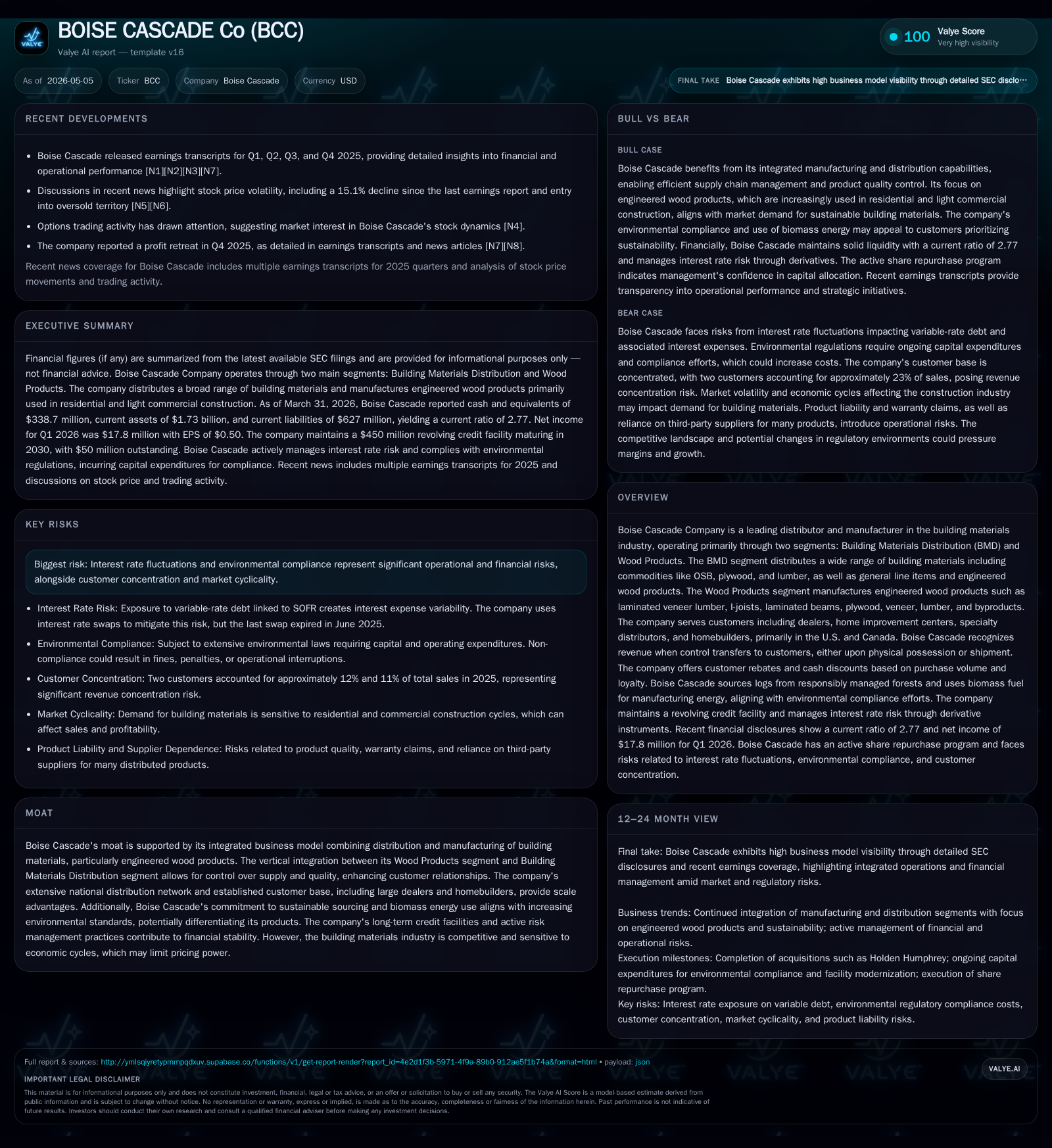
Boise Cascade executed opportunistic share repurchases totaling over 830,000 shares in Q1 2026 under a $300 million authorization, signaling confidence in its capital structure and market position. Its vertically integrated business model spans Building Materials Distribution and Wood Products manufacturing segments, offering scale and supply chain control that enhance customer loyalty and margin management. Growth drivers include demand resilience linked to housing trends, engineered wood product expansion, and sustainability initiatives aligned with tightening environmental standards. Key risks revolve around environmental compliance costs, interest rate exposure post-hedge expiration, and cyclical demand variability. Looking ahead, investors should monitor share repurchase pacing, supply chain dynamics, and quarterly earnings updates to assess execution amid industry cyclicality.
First Quarter Operational Highlights: Share Repurchases And Market Signals
In its Q1 2026 Form 10-Q filed May 4, Boise Cascade disclosed active share repurchase activity under an existing board-approved authorization totaling $300 million [S2]. During the quarter, the company repurchased 830,751 shares across January to March at a weighted-average price per share around $78.84. Notably, monthly purchases increased from approximately 308K shares in January ($80.93/share) to 361K shares in March ($73.53/share), reflecting opportunistic buying at declining prices amid industry volatility [S2]. The program remains open-ended with no expiration date, allowing the Board discretion to adjust or terminate at any time.
This sizeable buyback conveys management's commitment to capital discipline and confidence in Boise Cascade’s valuation amid a cyclical yet structurally evolving building materials sector [S16]. The immediate reduction of outstanding shares supports EPS accretion potential.
Business Model Nuances: Integrated Manufacturing And Distribution Dynamics
Boise Cascade operates two distinct but synergistic segments: Building Materials Distribution (BMD) and Wood Products manufacturing [S1]. The BMD segment markets commodities like oriented strand board (OSB), plywood, lumber alongside general lines and engineered wood products to customers spanning homebuilders, dealers, specialty distributors, primarily in North America [S7]. In parallel, the Wood Products segment manufactures engineered wood components including laminated veneer lumber (LVL), I-joists, laminated beams, plywood veneer logs, lumber, and byproducts [S7].
This vertical integration fosters operational control from raw material sourcing through final product delivery—a noteworthy advantage in an industry where supply chain disruptions impact margins [S1]. Control over production quality combined with broad distribution reach empowers Boise Cascade to offer volume-based pricing incentives such as customer rebates promoting loyalty and reducing switching costs [S1]. Integration also facilitates margin levers via cost efficiencies from internally supplied engineered products to its distribution network.
Competitive Positioning Within Building Materials: Scale, Quality, And Customer Reach
Boise Cascade ranks among leading U.S. building materials suppliers due to its expansive national footprint that covers manufacturing facilities complemented by extensive logistics capabilities [S1]. Its longstanding relationships with large homebuilders and dealer networks provide scale economies that are increasingly vital as commodity price fluctuations pressure smaller competitors.
The company’s emphasis on engineered wood products—comprising over one-third of BMD sales volume—positions it favorably as these higher-value products capture growing end-market demand for sustainable alternatives to traditional framing lumber [S7]. Furthermore, Boise Cascade's engagement with sustainability initiatives enhances brand differentiation amidst tightening regulatory regimes governing air emissions and wastewater treatment across mill operations [S1].
Customer retention benefits from structured rebate programs and volume discounts that create quantifiable stickiness within multi-year purchasing cycles common to construction supply chains [S1]. However competitive pressures from other distributors and alternative material substitutions remain persistent challenges alongside cyclicality inherent in residential construction volumes.
Growth Drivers: Demand Expansion, Product Mix Optimization, And Sustainability Initiatives
Structural demand growth is linked mainly to housing market fundamentals in North America where demographic trends sustain new construction starts despite occasional macroeconomic pauses [N1][N3]. Engineered wood segments offer attractive growth prospects driven by better performance characteristics relative to commodity lumber—including strength-to-weight ratios favorable for taller structures—and enhanced design flexibility.
Boise Cascade's recent acquisition of specialized distributors further expands its product portfolio into siding and decking categories complementing core offerings [S11]. Meanwhile investments in biomass energy utilization align operational capability with escalating environmental compliance costs, potentially improving operating efficiency while serving customers increasingly focused on sustainable sourcing credentials [S1][N3].
Product mix improvements toward engineered solutions typically support higher gross margins while mitigating pure commodity exposure sensitive to raw material price swings.
Risks And Constraints: Environmental Regulations, Interest Rate Exposure, And Market Cyclicality
Environmental compliance remains a substantive risk vector; Boise Cascade faces ongoing obligations related to air emissions controls, wastewater discharges, hazardous waste management and site remediation—requiring capital expenditures and operational adjustments that could compress margins or limit capacity utilization [S1][S22]. Additionally unresolved legal investigations concerning importation practices represent contingent liabilities currently estimated near $6 million—a risk factor management actively monitors [S22].
Market cyclicality is inherent given dependence on residential building activity subject to macroeconomic cycles influenced by factors such as mortgage rates access to credit availability which dictate demand elasticity for building materials [S22]. This cyclicality directly affects working capital intensity due to inventory financing dynamics typical for distributors.
What To Monitor: Future Earnings Guidance, Share Repurchase Trajectory, And Industry Trends
Key upcoming gauges include quarterly earnings announcements expected per usual reporting cadence with detailed segment profitability commentary potentially signaling adjustment in share repurchase tempo depending on liquidity outlooks shared at investor events or 8-K disclosures [S3][N2]. Monitoring shifts in housing start data nationally plus regional trends provide critical leading indicators impacting both volumes and pricing power.
Additionally watch for ongoing developments regarding environmental investigations or regulatory changes imposing incremental compliance costs or operational constraints. Execution progress integrating recent acquisitions expanding specialty distribution channels may surface as mid-cycle growth catalysts beyond cyclical headwinds [N4].
Supply chain cost inflation trends affecting fiber supplies warrant close scrutiny as they directly influence Wood Products segment operating margins. Progress advancing engineered wood product innovations optimized for sustainable construction represents strategic optionality enhancing long-term differentiation.
Latest Financial Snapshot: Liquidity, Capital Structure, And Shareholder Returns
As of March 31, 2026, Boise Cascade held cash and equivalents of approximately $339 million against current liabilities of about $627 million, resulting in a strong current ratio near 2.77, indicating ample short-term liquidity [F1]. Approximately net debt after subtracting cash from reported debt stands around $99 million reflecting conservative leverage supporting ongoing ability to fund discretionary share buybacks without compromising capital flexibility.
The company’s disciplined retirement policy mandates immediate cancelation of treasury shares upon repurchase enhancing shareholder equity metrics over time while incurring excise tax costs allocated against retained earnings—all emphasizing long-term capital return orientation backed by consistent cash flow generation capability.[S4]
This analysis is based solely on provided SEC filings dated up through May 2026 supported by current financial data snapshots. It neither recommends nor advises any investment action but aims to present an informed business overview consistent with publicly filed disclosures.
Disclaimer: This is research-only, informational analysis and not investment advice. It may include AI-generated interpretation and general industry context. Always verify important details using primary sources.

Comments