
Williams Companies Advances Pipeline Expansion with Strong Q1 Results
Williams reports robust first-quarter performance driven by contract-backed pipeline capacity growth and continued regulatory progress on expansion projects.
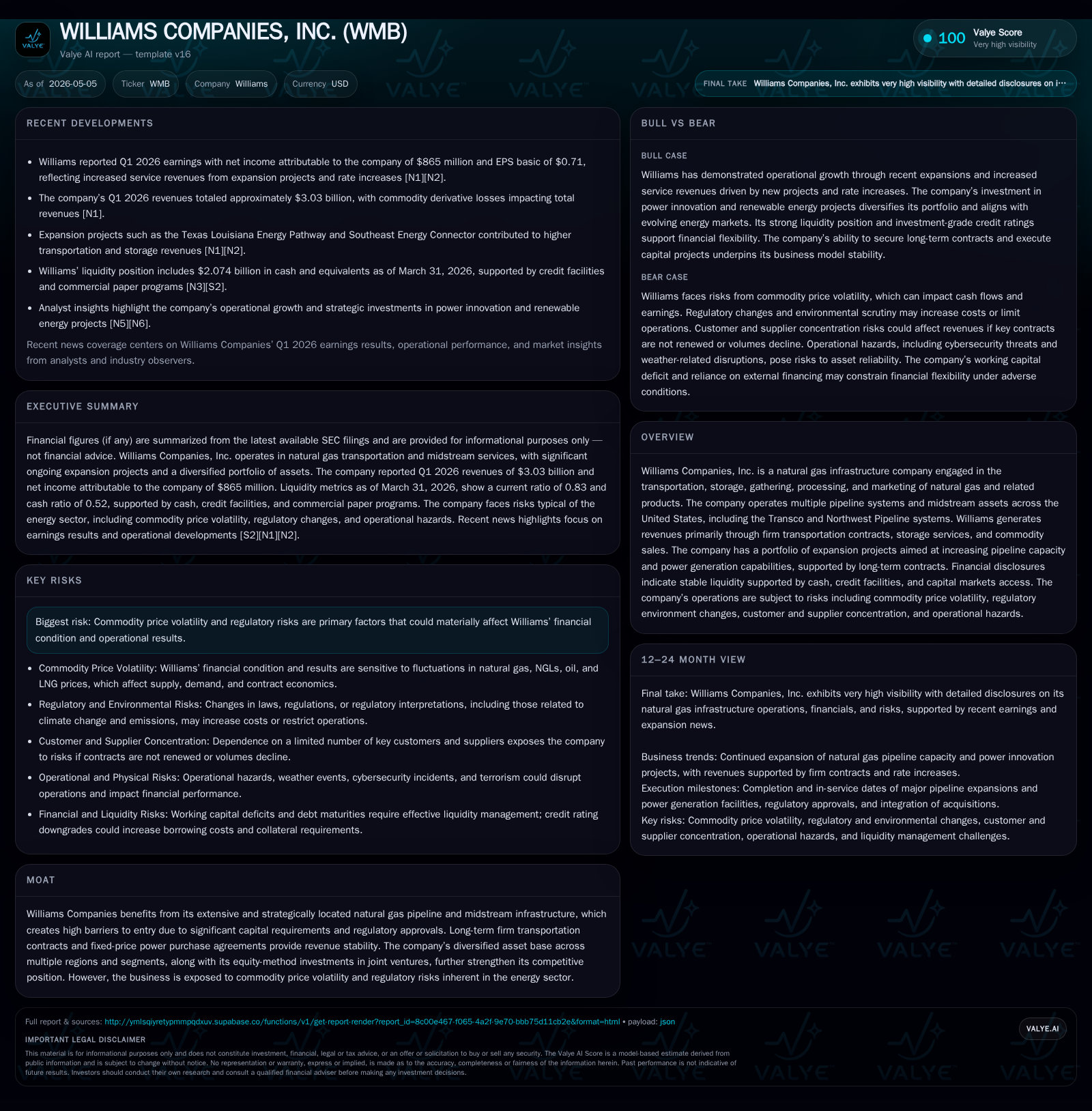
In its latest quarterly filing, Williams Companies highlighted significant progress in its midstream natural gas infrastructure expansions, including key projects like Gillis West and Southeast Supply Enhancement advancing towards commercial service. The company’s business model, anchored by long-term firm transportation contracts across strategic pipeline systems such as Transco and Northwest Pipeline, underpins revenue stability despite commodity price volatility. With substantial capital expenditures planned for 2026, Williams benefits from high barriers to entry in the sector but faces risks from regulatory delays and customer concentration. Financially, Williams maintains adequate liquidity with $30.1 billion in long-term debt offset by $950 million in cash and a recent dividend increase.
Latest Quarterly Operating Review and Significance
Williams Companies' May 4, 2026 10-Q filing reveals tangible near-term achievements underpinning its growth strategy. Notably, the Gillis West expansion project received FERC prior notice in April 2026, aiming to bolster Transco’s transmission capacity by an additional 115 Mdth/d with a potential in-service date late this year [S2]. This complements the January 2026 FERC approval of Southeast Supply Enhancement, an ambitious project adding nearly 1,600 Mdth/d along the Southeastern U.S., targeting operational readiness by Q3 2027 [S2]. Earlier regulatory advances include Northeast Supply Enhancement’s certificate reissuance and environmental permit approvals through late 2025 [S2]. Concurrently, the company highlighted strong Q1 financial results with net income attributable to Williams increasing 25% year-over-year alongside higher service revenues propelled by rate hikes effective April 1, 2025, and reinforced firm contract volumes [S24][N2]. These developments confirm both operational momentum and growing contracted throughput capacity.
Williams’ Midstream Business Model and Revenue Base
Williams Companies primarily generates revenue through fee-based services tied to natural gas transportation, storage, gathering, processing, and marketing via extensive pipeline systems like Transco and Northwest Pipeline (NWP) [S1]. The firm transportation component is central—contracts establish fixed reservation fees largely insulated from spot commodity price fluctuations owing to take-or-pay provisions embedded within tariff structures [S8][S14]. Consequently, revenue streams embody structural stability regardless of volume or market pricing variability.
Firm contracts are complemented by ancillary earnings from commodity sales linked to its gas and NGL marketing activities; however, total revenues predominantly derive from predictable long-term commitments underpinning cash flow reliability [S24]. Williams serves an industrial customer base including utilities such as Duke Energy (9% of Transco's revenue) and Puget Sound Energy (31% NWP revenue), reflecting concentration yet secured contract adherence [S20][S25]. The company’s product mix covers a strategic spectrum from transmission bottlenecks alleviation to storage capacity expansions enhancing supply flexibility.
Competitive Positioning in U.S. Natural Gas Infrastructure
In the tightly consolidated U.S. midstream sector, Williams commands a competitive moat powered by its substantial asset scale—the Transco system alone spans pivotal demand centers enabling pricing leverage on contracted capacity [S1]. Regulatory hurdles like Federal Energy Regulatory Commission (FERC) approvals impose formidable entry barriers deterring new competition due to capital intensity combined with legal complexities inherent in interstate pipeline certification [S14]. This restricts supply-side entrants while favoring incumbents’ ability to negotiate firm contracts backed by pipeline scarcity value.
Sector concentration enhances Williams’ strategic position against smaller players unable to match geographic reach or operating scale. Its equity-method investments create diversification buffers mitigating segment-specific cyclicality while bolstering market presence across regions stretching from Gulf Coast hubs to Northeast delivery points. While emerging renewable energy dynamics invoke transition risks for fossil-fuel-related infrastructure over longer horizons, midstream pipelines remain critical conduits for natural gas demand expected to persist structurally over the next decade given energy mix considerations.
Growth Catalysts: Pipeline Extensions and Capacity Expansion
Capital investment remains a vital growth vector for Williams with multiple high-profile projects underway:
- Gillis West Expansion: Filed with FERC April 2026; adds ~115 Mdth/d capacity serving Louisiana-to-Texas corridors; earliest commercial operation slated Q4 2026 pending approvals [S2].
- Southeast Supply Enhancement: Completed FERC approval January 2026; massively expands receipt-to-delivery points along Virginia through Alabama adding ~1,600 Mdth/d; targeted service date Q3 2027 [S2].
- Northeast Supply Enhancement: Certificates renewed Aug/Oct-November 2025 with state water permits secured; catering primarily Pennsylvania-New York markets with ~400 Mdth/d extra capacity on track for Q4 2027 start [S2].
- Line 200 (Driftwood Pipeline): Connecting pipelines to Louisiana LNG facility; operator role confirmed; planned Q2 2028 operation; capacity up to ~3,100 Mdth/d bolsters export infrastructure [S2].
- Pine Prairie Phase IV Storage Expansion: Enhances existing Gulf Coast storage working gas capabilities (+10 Bcf); slated for Q4 2028 service commencement [S2].
- Dalton Lateral II: Expected formal FERC application filing in 2027 expanding delivery from Station 115 supporting power generation growth prospects [S2].
These expansions solidify future revenue visibility given high take-or-pay contracting backed by precedent agreements secured pre-construction—mitigating development risk. By enhancing regional connectivity and export capability amid growing domestic gas demand particularly in southern jurisdictions served by Transco’s network, these projects position Williams competitively while deepening strategic infrastructure moats.
Risks and Headwinds: Regulation, Commodity Exposure, and Capital Needs
Despite contractual protections stabilizing revenues against commodity price swings [S8], Williams faces ongoing regulatory risk inherent to pipeline buildout requiring multi-jurisdictional approvals which may delay or constrain project commencements potentially deferring EBITDA growth [S14]. Protracted permitting processes or adverse rulings could hinder timely capitalization on demand growth opportunities.
Customer concentration presents counterparty risk—while major utilities signing long-term contracts afford some credit protection there remains possibility of renegotiations or defaults triggered by energy market shifts or bankruptcy proceedings given cyclical pressures faced by counterparties [S20][S25]. Furthermore additional capital requirements of roughly $7 billion projected for full-year 2026 necessitate continued access to debt markets or alternative financing given existing indebtedness exceeding $30 billion as of March-end quarter [F1].
Operational hazards typical of pipeline business (integrity risks, environmental liabilities) coupled with evolving energy policy frameworks heighten complexity further introducing potential cost escalations or asset impairment concerns over time [S14].
Key Upcoming Milestones to Monitor
The following milestones will be critical gauges of execution discipline and growth trajectory:
- Receipt of final regulatory approvals for Dalton Lateral II anticipated early-mid active filing stage in calendar year 2027 [S2].
- Completion schedules for Northeast Supply Enhancement project operations during late 2027 providing incremental throughput benchmarks.
- Line 200 commissioning progress tied closely to Louisiana LNG export demand cycles targeting mid-2028 start.
- Quarterly earnings updates tracking rollout impacts of newly operational capacity additions driving incremental fee-based revenues; material variance across guidance or execution timing would bear close scrutiny.
- Capital expenditure pacing updates evidencing resource allocation efficiency amidst competing large-scale infrastructure investments planned through several years ahead.
Monitoring these will provide near-real-time feedback on whether backlog conversions align with management guidance reflecting sustained contract wins reinforcing the firm take-or-pay revenue base.
Current Financial Structure and Liquidity Assessment
Latest financial snapshot
| Metric | Value | Period |
|---|---|---|
| Total debt | $30.1bn | |
| 2026-03-31 | ||
| Net debt | $28.0bn | |
| 2026-03-31 | ||
| Current assets | $3.3bn | |
| 2026-03-31 | ||
| Current liabilities | $4.0bn | |
| 2026-03-31 | ||
| Current ratio | 0.83x | |
| 2026-03-31 |
Source: SEC companyfacts cache [F1].
At quarter end March 31, 2026, Williams held $2.07 billion in cash and equivalents alongside total debt of approximately $30.1 billion resulting in net debt positioning around $28.0 billion considering cash offsets [F1]. The company sustains a current ratio below unity at roughly 0.83 indicating ongoing working capital deficits; however, substantial remaining credit facility availability totaling around $3.75 billion plus absence of commercial paper outstanding provide ample near-term liquidity buffers against operational or market volatility shocks [F1].
Interest coverage benefits from stable operating incomes augmented by increasing tariff recoveries supporting ongoing dividend payouts which rose recently from $0.50 per share quarterly in prior periods to $0.525 starting March quarter underscoring confidence in cash flow stability [S7].
Overall financial condition appears balanced but dependent upon successful project execution timelines aligning with forecasted cash flows sufficient to fund maturities reducing refinancing dependencies over time.
This analysis draws exclusively on verified SEC filings dated through May 4, 2026 ([S1]-[S29]), supplemented by validated news sources ([N1]-[N14]) without speculative projections beyond disclosed company data. It reflects objective assessment grounded in documented operational facts concerning Williams Companies' recent developments within its sectoral context.
Disclaimer: This is research-only, informational analysis and not investment advice. It may include AI-generated interpretation and general industry context. Always verify important details using primary sources.

Comments