
New Mountain Finance Corp Posts Mixed Q1 Update While Facing Portfolio Valuation Pressures
Q1 2026 results reveal investment income decline and portfolio headwinds, underlining challenges in NMFC's middle-market focus and capital strategy.
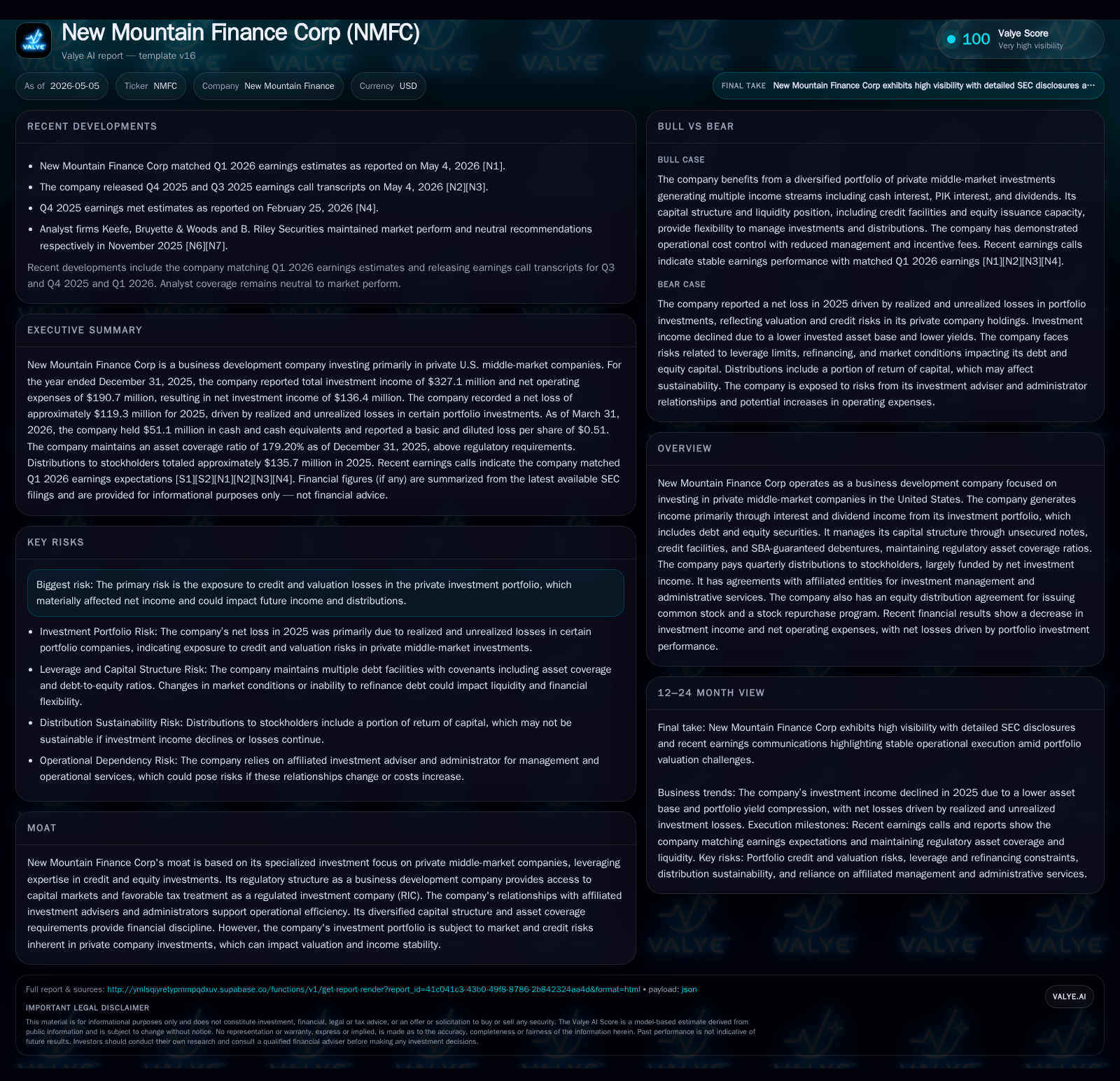
New Mountain Finance Corp reported a notable decrease in investment income for Q1 2026, reflecting valuation pressures in its private middle-market portfolio. The company’s disciplined capital structure remains intact with robust asset coverage ratios despite net losses driven by unrealized portfolio depreciation. NMFC’s business model centers on generating income through debt and preferred equity investments, supported by regulatory advantages as a business development company. Near-term growth hinges on recovery in portfolio valuations, effective capital deployment, and stable distributions amidst credit market dynamics.
Latest Quarterly Operating Update: Q1 2026 Insights from NMFC’s 10-Q
New Mountain Finance Corp’s (NMFC) latest quarterly filing dated May 4, 2026, outlines a mixed operational performance amid pressures from its private middle-market investment portfolio [S2][N1]. The company reported a decline in investment income for the quarter driven by lower all-in yields and valuation headwinds affecting portfolio assets. Management highlighted that net operating expenses were lowered partially due to fee waivers, including incentive fee reductions tied to softer income performance.
Despite the decrease in gross investment returns, NMFC successfully maintained its quarterly distributions at consistent levels aligning with prior periods. This stability underscores the firm’s commitment to steady shareholder payouts even as the underlying asset valuations fluctuate. An event filing accompanying the earnings release reiterated these points without material surprises in forward guidance or strategic shifts [S3].
Business Model and Investment Portfolio Composition
NMFC operates as a regulated business development company focused on providing debt and preferred equity financing to U.S.-based private middle-market companies [S1]. Its revenue streams primarily comprise interest income from senior-secured loans alongside dividend income from preferred equity stakes. Additionally, other non-recurring fees such as prepayment and amendment fees supplement revenues.
The BDC structure affords NMFC favorable tax treatment as a regulated investment company (RIC), which mandates distributing substantially all net investment income to shareholders quarterly [S1]. The company leverages affiliate relationships through contractual agreements with New Mountain Capital subsidiaries for investment advisory services and administration functions, enabling operational efficiencies.
NMFC’s product mix is strategically balanced between secured debt instruments that offer predictable cash flows and equity-related positions that provide upside potential but add volatility. The firm closely monitors asset coverage ratios mandated by the Investment Company Act of 1940 to maintain regulatory compliance while optimizing leverage usage.
Competitive Position within the Business Development Company Space
Within the crowded BDC sector, NMFC distinguishes itself by specializing exclusively in U.S. private middle-market companies—a niche requiring deep credit expertise and active portfolio management [S1]. This focus imposes higher due diligence standards but offers differentiated risk/return profiles compared to broadly syndicated loan funds or large-cap direct lenders.
NMFC employs a diversified capital structure comprising unsecured notes across various maturities and interest rates, revolving credit facilities with investment-grade counterparties, and SBA-guaranteed debentures that are excluded from senior security asset coverage calculations [S1]. These features grant financial agility while conforming to asset coverage minimums.
Operationally, NMFC benefits from economies of scale achieved through affiliated management platforms which reduce overhead costs relative to smaller peers. Its sustained access to both debt and equity capital markets facilitates opportunistic funding actions such as ATM common stock issuance programs and share repurchase initiatives enhancing shareholder value under conducive conditions.
Growth Drivers Shaping Near-Term Demand and Income Streams
Near-term growth catalysts for NMFC hinge heavily on external credit cycle developments alongside internal execution:
- Portfolio Valuation Recovery: Improvement in private company earnings post-cyclical pressures could enhance unrealized appreciation gains converting into realized income over time [S2].
- Capital Raising Flexibility: Expansion of ATM equity issuance limits suggests readiness to tap public markets efficiently when pricing is favorable to fund new investments or refinance existing obligations [S1].
- Fee Structure Dynamics: Incentive fee arrangements are sensitive to net investment income trajectories; modest fee waivers have alleviated expense pressure while aligning interests [S2].
- Selective Portfolio Deployment: Ongoing origination pipeline of middle-market lending opportunities provides avenues for accretive yield enhancement if credit conditions stabilize.
These drivers collectively form measurable KPIs such as book yield progression, distribution sustainability metrics, and pipeline volume growth—all instrumental for future operating improvements.
Risk Factors and Potential Constraints Impacting NMFC’s Outlook
Key risks identified remain consistent with prior disclosures without material updates during Q1 2026:
- Credit Quality Volatility: Concentration risks inherent within private middle-market companies expose NMFC to potential downgrades or defaults impinging on cash flows and valuation marks [S2][S1].
- Valuation Sensitivity: Market-driven fluctuations cause pronounced swings in unrealized gains/losses impacting net income continuity despite stable underlying cash collections.
- Distribution Coverage Uncertainty: Dependence on net investment income means any sustained erosion could pressure dividend adequacy affecting investor confidence.
No significant new risk factors surfaced in the latest risk disclosures or quarterly filings; however, continuous monitoring remains necessary given cyclical economic exposures.
Key Upcoming Milestones and Indicators to Watch
Market participants should focus on several executional indicators:
- Q2 earnings announcements for signs of stabilization or improvement in net investment income versus Q1 declines.
- Updates on portfolio seasoning effects manifested via commentary on private company performance trends during earnings calls.
- Capital markets activity including share repurchases or ATM offering utilization signaling management views on stock valuation attractiveness.
- Management commentary around fee waivers or incentive compensation policy adjustments reflective of evolving profitability scenarios [S3][N1].
These milestones will provide directional clarity regarding NMFC’s trajectory amidst ongoing credit environment uncertainties.
Current Financial Position and Capital Structure Snapshot
| Metric | Value | Period |
|---|---|---|
| Cash & equivalents | $51.13 million | |
| 2026-03-31 | ||
| Total debt | $1.33 billion | |
| 2026-03-31 | ||
| Net debt | $1.28 billion | |
| 2026-03-31 |
Source: SEC companyfacts cache [F1].
As of March 31, 2026, NMFC held cash and equivalents of approximately $51.13 million against total debt approximating $1.33 billion resulting in net debt near $1.28 billion [F1]. Management has actively maintained diverse unsecured notes issuances complemented by revolving credit lines including SBA-guaranteed debentures excluded from senior security calculations providing further collateral support [S1]. These financial arrangements underpin consistent liquidity availability for new investments or distributions even amid short-term portfolio performance volatility.
This analysis is based solely on information available as of early May 2026 derived primarily from SEC filings including the latest Form 10-Q dated May 4, 2026 ([S2], [S3]) combined with historical context from the company’s February 24 annual report ([S1]) and current financial snapshots ([F1]). It aims to provide an informed synthesis of New Mountain Finance Corp’s operational positioning without offering investment advice.
Disclaimer: This is research-only, informational analysis and not investment advice. It may include AI-generated interpretation and general industry context. Always verify important details using primary sources.

Comments