
Aqua Metals Advances Sustainable Battery Recycling Despite Financial Challenges
Recent filings reveal Aqua Metals' progress and ongoing hurdles in scaling its proprietary lithium battery recycling technology under capital and legal pressures.
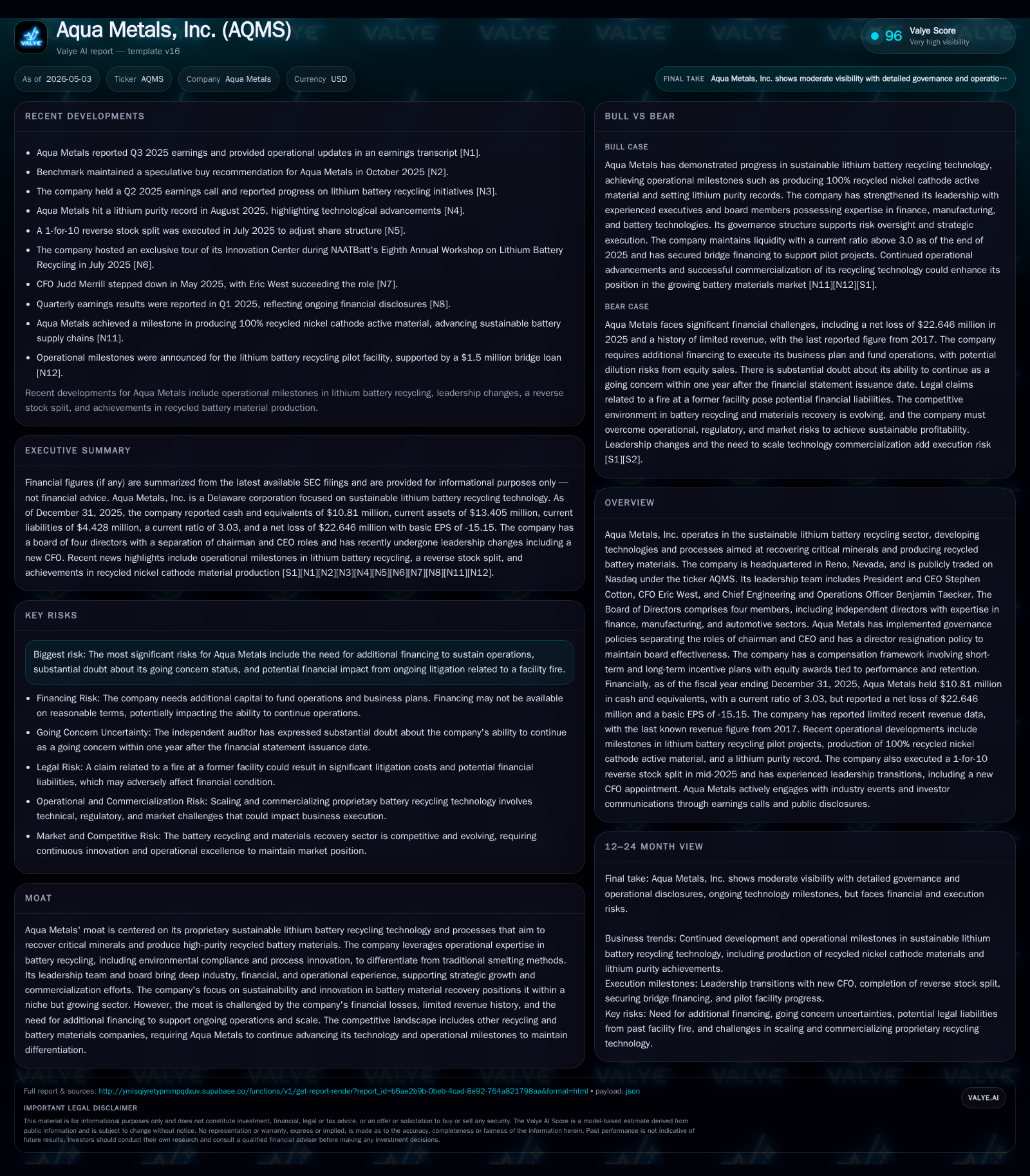
Aqua Metals, Inc. continues to develop its innovative electrochemical lithium battery recycling technology aimed at critical mineral recovery and sustainable manufacturing. The latest quarterly and event disclosures confirm the company’s focus on operational advancement despite significant financial losses, ongoing litigation linked to a prior facility fire, and a persistent need for additional financing. While the company’s differentiated technology and governance structure position it within a niche with notable growth potential, challenges around capital availability, legal risks, and commercial scale-up constrain near-term prospects. Observers should monitor financing efforts, revenue development, litigation outcomes, and capacity expansion milestones closely.
Latest Operational Developments and Significance
Aqua Metals' most recent quarterly filing as of November 12, 2025 ([S2]) reveals critical insights into its near-term operating realities. The company executed a registered direct offering in October 2025 raising about $13 million in gross proceeds, which materially improved its cash position following September quarter-end cash close to $3.6 million. Despite this capital infusion boosting working capital to roughly half a million dollars before the raise, Aqua Metals reiterates that substantial additional financing will be necessary within the upcoming twelve months to fund ongoing operations and advance its business plan. This financing gap reflects not a one-time challenge but an operational reality for this pre-commercial tech developer still incurring heavy losses.
Moreover, management disclosed continued uncertainty regarding going concern status based on cumulative operating deficits and cash burn rates documented since fiscal 2024. The company is also contending with potentially significant litigation costs linked to a lawsuit over a November 2019 fire at its former TRIC facility; adverse rulings could impose multi-million-dollar payments if costs claimed by opposing parties prevail ([S2]). This litigation remains unresolved as of the report date yet represents a material risk factor influencing both operating reserves and capital allocation strategy.
The March 31, 2026 event filing ([S3]) essentially reiterates these themes alongside an update on year-end financial results that continue to chart heavy net losses exceeding $22 million. This filing emphasizes that while revenues remain modest given early-stage commercialization — historical top-line essentially dated back to earlier years — the company's priority is transitioning from pilot scale trials toward commercial-scale module deployments using its electrochemical recycling processes.
Business Model: Technology, Products, and Competitive Differentiation
Aqua Metals operates within the specialized sustainable lithium battery recycling sector where it seeks to disrupt incumbent smelting operations through proprietary electrochemical recycling technology ([S1]). This patented process enables extraction of critical minerals such as lithium, cobalt, nickel, and manganese from spent batteries while avoiding the high emissions and environmental hazards characteristic of traditional smelters.
Revenue generation flows principally from licensing this technology or operating recycling facilities using the Company’s clean technology platform. The underlying economics hinge on converting recycled feedstock into high-purity recovered materials with quality comparable or superior to virgin mined inputs — an increasingly valued proposition amid tightening regulatory mandates around sustainability in battery manufacturing supply chains.
Importantly, Aqua Metals emphasizes operational excellence that includes compliance with evolving environmental regulations coupled with process innovations that reduce safety risks often associated with smelting plants ([S1]). This combination strengthens customer value propositions by lowering lifecycle carbon footprints and enhancing traceability within circular economy models. The company targets battery manufacturers, recyclers seeking cleaner methods, or strategic partners interested in integrating scaled sustainable recovery solutions.
Leadership depth further reinforces execution capability. President & CEO Stephen Cotton brings extensive commercialization experience across tech industries; CFO Eric West leads financial strategy aligned with public market expectations; COO Benjamin Taecker provides operational insights rooted in prior senior roles at large-scale lead acid battery recyclers where emissions reductions were achieved at scale ([S13]). Governance practices include separation of Chairman (Vincent L. DiVito) from CEO roles ensuring independent oversight alongside robust director resignation policies supporting accountability ([S1]).
Industry Overview and Competitive Dynamics
Battery recycling is experiencing rising global attention driven by accelerated electric vehicle adoption timelines pushing raw material demand curves upward ([S1] analysis). However, industry structure remains fragmented with incumbent players largely relying on conventional pyrometallurgical smelting techniques that generate significant carbon emissions as well as costly environmental remediation.
Emergent technologies like Aqua Metals’ electrochemical system attempt to circumvent these long-standing challenges by delivering modular scalability coupled with lower regulatory burdens often impacting smelters due to hazardous emissions permits ([S1]). However, barriers include capital intensity required for plant build-outs, uncertain customer adoption patterns given the nascent state of such alternatives, and entrenched supplier relationships within existing supply chains.
Among competitors are companies focusing on mechanical augmentation approaches or hydrometallurgical treatments aiming at higher efficiencies but often facing tradeoffs between purity outputs versus throughput rates. In this context, Aqua Metals claims differentiation via producing among the purest recycled lead products globally — indicative of potential upgradeability for wider battery chemistries — supported by committed R&D efforts focused on improved yield curves ([S1]).
Regulatory environments provide tailwinds as governments worldwide enact stricter mandates for sustainable sourcing of critical minerals emphasizing recycled content thresholds fostering broader market access for compliant suppliers.
Growth Catalysts: Technology, Market Demand, and Strategic Initiatives
Several key factors underpin Aqua Metals’ growth trajectory:
- Electrification trends driving exponential increases in end-of-life lithium-ion batteries entering recycling streams offer scalable feedstock volumes necessary for cost-effective plant operation ([S3]).
- Demonstrated advancements in scaling electrochemical recycling from pilot phases towards commercial throughput enable incremental margin improvements as yield optimizations mature ([S3]).
- Ongoing pursuit of partnerships including licensing deals or joint ventures leveraging Aqua Metals’ core IP creates avenues for rapid geographic expansion absent full-capital investment burdens generally borne by operators directly ([S1], [S3]).
- Sustainability-focused procurement policies by manufacturers incentivize their downstream recyclers to adopt cleaner processes thereby expanding accessible addressable markets aligned with Aqua Metals’ value proposition.
While detailed backlog metrics or pipeline conversion ratios are not publicly disclosed at this time per filings ([S3]), management commentary suggests gradual transition from research/development expense profiles toward early-stage revenue recognition reflecting commercial customer wins or strategic accord signings.
Risks and Constraints: Capital Needs, Legal Exposure, and Market Penetration
The overriding risk theme pertains to liquidity sufficiency highlighted repeatedly across SEC disclosures ([S2]). Even after securing $13 million gross proceeds via October 2025 equity raises, sustained operational expenses combined with ongoing organizational scale-up necessitate further capital injections either via debt refinance options or equity issuances which carry dilution risks.
Legal exposure stemming from unresolved claims related to the TRIC facility fire imposes contingent liabilities potentially materializing into large cash outflows if court adjudications favor defendants seeking reimbursement of over $3 million for legal fees plus related costs ([S2]). This uncertainty complicates budgeting forecasts and investor confidence.
Execution risks remain ever-present during scale-up phases involving complex electrochemical plants where pilot successes must translate consistently into reliable production units amidst fluctuating commodity prices impacting recovered materials margins.
Additionally, transforming market receptivity into stable contract flows requires navigating legacy supplier incumbencies resistant to disruptive entrants plus managing competitive price pressures should commoditization ensue within recycled content integration sectors.
Upcoming Milestones and Key Performance Indicators
Stakeholders should closely follow several indicators that could validate or impede recovery narratives:
- Quarterly liquidity reports verifying cash runway extensions post-financing rounds indicating ability to sustain bridge periods between funding events ([S3]).
- Revenue line expansions evidencing commercial client acquisitions beyond proof-of-concept engagements showcasing scalability ([S3]).
- Public announcements detailing plant commissioning progress or successful demonstration projects validating technical scalability.
- Legal case settlements or favorable rulings mitigating substantial cost uncertainties linked with litigation exposure noted in filings.
- Disclosures regarding partnership formations granting access to new markets or enabling technology licensing traction crucial for network effects leverage ([S1], [S3]).
Current Financial Position Snapshot
Latest financial snapshot
| Metric | Value | Period |
|---|---|---|
| Cash & equivalents | $11mm | |
| 2025-12-31 | ||
| Current assets | $13mm | |
| 2025-12-31 | ||
| Current liabilities | $4mm | |
| 2025-12-31 | ||
| Current ratio | 3.03x | |
| 2025-12-31 |
Source: SEC companyfacts cache [F1].
As of December 31, 2025 the company's balance sheet presents approximately $10.8 million in cash reserves against minimal total debt just above $0.3 million resulting in a current ratio suggesting moderate short-term liquidity adequacy. However, persistent operating losses exceeding $23 million annually underscore structural financial strain requiring timely refinancing actions for ongoing viability.[F1] This financial snapshot complements strategic discussions highlighting funding needs as primary gating factors ahead.
This analysis integrates publicly filed information up through April 30, 2026 without speculative projections beyond documented facts. It aims strictly to assess current company fundamentals within evolving industrial contexts rather than provide investment recommendations.
Disclaimer: This is research-only, informational analysis and not investment advice. It may include AI-generated interpretation and general industry context. Always verify important details using primary sources.

Comments