
Enzon Pharmaceuticals Transitions to Viskase Holdings with Merger Completion and Operational Reset
Enzon Pharmaceuticals completed its merger with Viskase Companies, marking a pivotal shift from a royalty-based pharmaceutical entity to an industrial packaging holding company.
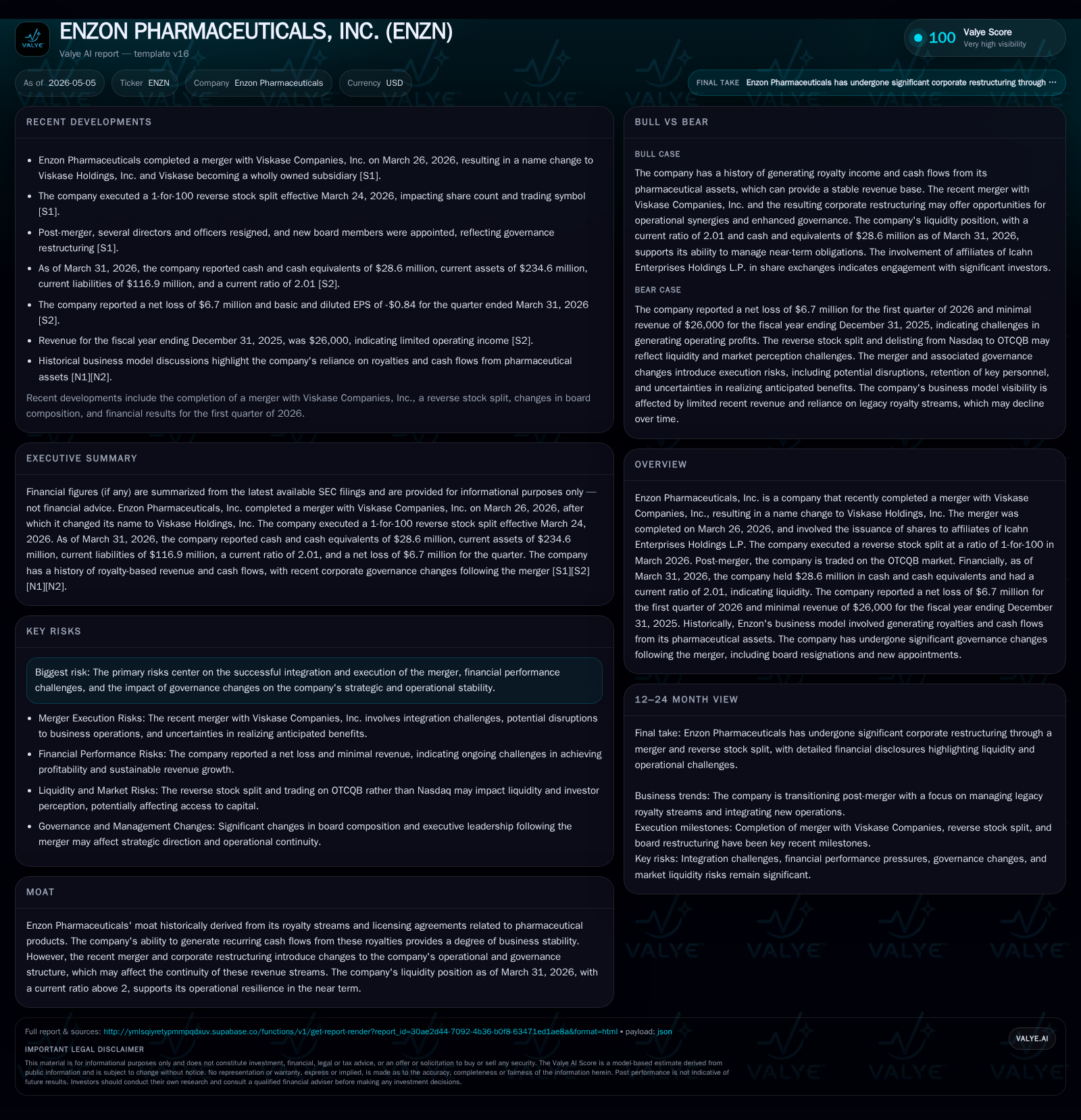
In the latest quarter ending March 31, 2026, Enzon Pharmaceuticals consummated a merger with Viskase Companies, Inc., changing its corporate identity to Viskase Holdings, Inc. The transaction included a significant reverse stock split and the exchange of preferred stock for common equity. Post-merger, Enzon’s traditional pharmaceutical royalty revenues have largely ceased, with the company reporting minimal revenue and ongoing net losses reflecting legacy costs and restructuring activities. The operating pivot centers on integrating Viskase’s business in collagen casing manufacturing for the food industry, marking a sharp departure from Enzon’s past royalty-driven pharma model. While liquidity remains adequate with a current ratio above 2, elevated net debt poses financial discipline challenges. Governance changes and merger execution now shape the near-to-medium term outlook amid industry-specific competitive dynamics.
Recent Operating Update
The most consequential recent development for Enzon Pharmaceuticals, Inc. emerged in Q1 2026 with the March 26 completion of its merger with Viskase Companies, Inc. Following the transaction, Enzon rebranded as Viskase Holdings, Inc., reflecting a strategic transformation from its former pharmaceutical royalty-centric profile toward an industrial manufacturing holding company [S2][S18]. A facilitating 1-for-100 reverse stock split was executed shortly prior to closing [N1][S26].
The merger involved share issuance to affiliates of Icahn Enterprises Holdings L.P. through conversion of Series C Preferred Stock into common shares as part of the reorganization process [S19]. As a result, Enzon's legacy pharmaceutical operations have been largely absorbed or divested, shifting operational focus entirely to Viskase's core business.
Financially, while reported revenue remained negligible at $26,000 in calendar year 2025 — consistent with Enzon's winding down pharma royalties — the company registered a net loss of $6.7 million during the first quarter of 2026 reflecting ongoing corporate overheads and merger-associated costs [F1][S2]. Liquidity remains solid at $28.6 million cash reserves with a current ratio standing at 2.01; total debt is $130.8 million with net debt approximating $102.2 million as of March 31, 2026 [F1].
Board governance witnessed changes with appointments including CEO Thomas D. Davis joining the board amid resignations of directors Peter Shea and Randolph Read during late April [S3]. These steps indicate ongoing structural realignment informed by new strategic imperatives following integration.
Business Model Transition
Historically, Enzon Pharmaceuticals operated primarily as a royalty-generator within biotechnology/pharmaceutical sectors. Its revenue derived from licensing agreements enabling third parties to commercialize proprietary drug technology and formulations, yielding intermittent but predictable cash flow streams over patent lives.
Post-merger however, Enzon no longer functions predominantly as a pharmaceutical royalties collector but has transitioned into owning and controlling Viskase Companies’ manufacturing operations specializing in collagen casings used largely in meat processing industries [S1]. This represents a fundamental transformation—from intellectual property monetization to direct industrial product manufacturing.
Viskase produces natural collagen casing products that serve food processors requiring compliant packaging solutions capable of meeting stringent food safety regulations worldwide. These products embed deeply into complex value chains involving meat producers, processors, distributors, retailers, and ultimately consumers demanding quality assurance linked to natural casing attributes.
Revenue generation involves sales contracts with food manufacturers based on volume delivered. Pricing depends on raw material costs (collagen sourced primarily from animal hides), production complexity, and competitive market dynamics including synthetic alternatives such as cellulose or plastic casings.
Margins typically relate strongly to operational efficiencies within highly automated manufacturing environments alongside scale economies achieved through capacity utilization optimization. Customer relationships are characterized by long-term supply agreements reflecting industry reliance on quality consistency and service reliability.
Industry Structure and Competitive Position
The global collagen casing industry serviced by Viskase operates within a concentrated supplier landscape dominated by few large producers possessing integrated supply chains controlling raw material sourcing through finished goods distribution. Barriers to entry arise from technical expertise required for collagen processing plus regulatory compliance hurdles in food-grade product certification.
Competitors broadly comprise firms offering synthetic casings competing on cost-effectiveness versus natural casings favored for premium product positioning by processed meat producers targeting niche markets emphasizing ‘natural’ attributes. Demand fluctuates based on meat consumption patterns which exhibit some cyclicality but overall positive growth trends driven by rising global protein demand.
Viskase holds notable market share given historical scale leadership supported by robust R&D capability developing specialty casings tailored for application-specific attributes (e.g., cooking performance or flavor penetration). Its extensive geographic footprint facilitates responsiveness to regional demand trends across North America, Europe, Asia-Pacific regions.
Growth Drivers
Key growth catalysts for Viskase within Viskase Holdings include:
- Rising Meat Consumption: Expanding middle-class populations globally fuel demand for processed meats entailing casing usage.
- Regulatory Environment: Increasing requirements around preservative reduction spur demand for natural casing solutions viewed as cleaner label alternatives.
- Innovation & Customization: Tailored collagen casing offerings addressing niche culinary preferences enable price premiums.
- Operational Efficiency Gains: Capacity expansion combined with lean production methods can enhance margins.
- Expansion into Adjacent Markets: Potential development into other food packaging or related biomaterial opportunities leveraging core collagen expertise.
Key indicators will encompass revenue growth rates reflective of protein market demand shifts along with margin progression highlighting efficiency gains post-integration.
Additional attention should center on disclosures regarding:
- Debt management plans or refinancing activity addressing leveraged balance sheet profile;
- Further management or board updates clarifying strategic vision;
- Progress against synergy targets arising from consolidation;
- Any announcements targeting new product introductions or market expansions within collagen-based biomaterials;
- Updates related to legacy pharmaceutical obligations or residual royalty income streams if any persist post-merger.
Guidance scenarios remain limited currently due to transformative operational rerouting; thus quarterly remarks provide best insight vectors moving forward.
Financial Profile Summary
Latest financial snapshot
| Metric | Value | Period |
|---|---|---|
| Cash & equivalents | $29mm | |
| 2026-03-31 | ||
| Total debt | $131mm | |
| 2026-03-31 | ||
| Net debt | $102mm | |
| 2026-03-31 | ||
| Current assets | $235mm | |
| 2026-03-31 | ||
| Current liabilities | $117mm | |
| 2026-03-31 | ||
| Current ratio | 2.01x | |
| 2026-03-31 |
Source: SEC companyfacts cache [F1].
| Metric | Value (USD) | Period End |
|---|---|---|
| Revenue | $26,000 | |
| 2024-12-31 | ||
| Operating Income | -$5,311,000 | |
| 2025-12-31 | ||
| Net Income | -$3,409,000 | |
| 2025-12-31 | ||
| Cash & Equivalents | $28,619,000 | |
| 2026-03-31 | ||
| Total Debt | $130,834,000 | |
| 2026-03-31 | ||
| Current Ratio | 2.01 | |
| 2026-03-31 |
Liquidity is adequate reflecting more than twice coverage of short-term liabilities; net debt stands near $102 million indicating a leveraged capital structure requiring active management [F1]. Revenue remains nominal due to historical phase-out of pharma income streams prior to business transition completion [F1][S2].
Conclusion
Enzon Pharmaceuticals' recent merger consummation marks one of corporate reinvention: transitioning away from an asset-lite pharma royalty model toward operating control over an industrial manufacturer specializing in collagen casings serving global food processors. This decisive shift transforms risk profile from cyclicality linked to pharma patent expirations toward more stable yet competitive industrial markets guided by evolving protein consumption trends.
While liquidity appears sound post-close with meaningful cash buffers supporting near-term resilience amid losses stemming from integration activity – elevated leverage coupling with governance turnover point to material execution risks requiring monitoring. The company’s growth trajectory now aligns closely with Viskase’s product innovation success and ability to capitalize on growing consumer demands for natural food packaging solutions under tightening regulatory regimes. The next several quarters will reveal how well these structural factors convert into sustained profitability under the new corporate umbrella constituted by Viskase Holdings.
Disclaimer: This report is for informational purposes only and does not contain investment advice or recommendations.
Disclaimer: This is research-only, informational analysis and not investment advice. It may include AI-generated interpretation and general industry context. Always verify important details using primary sources.

Comments