
Cantor Equity Partners I Confronts SPAC Competitive Pressures Ahead of Merger Deadline
The company recently amended its business combination agreement expanding its board, signaling governance adaptation amid liquidity constraints and a competitive acquisition environment.
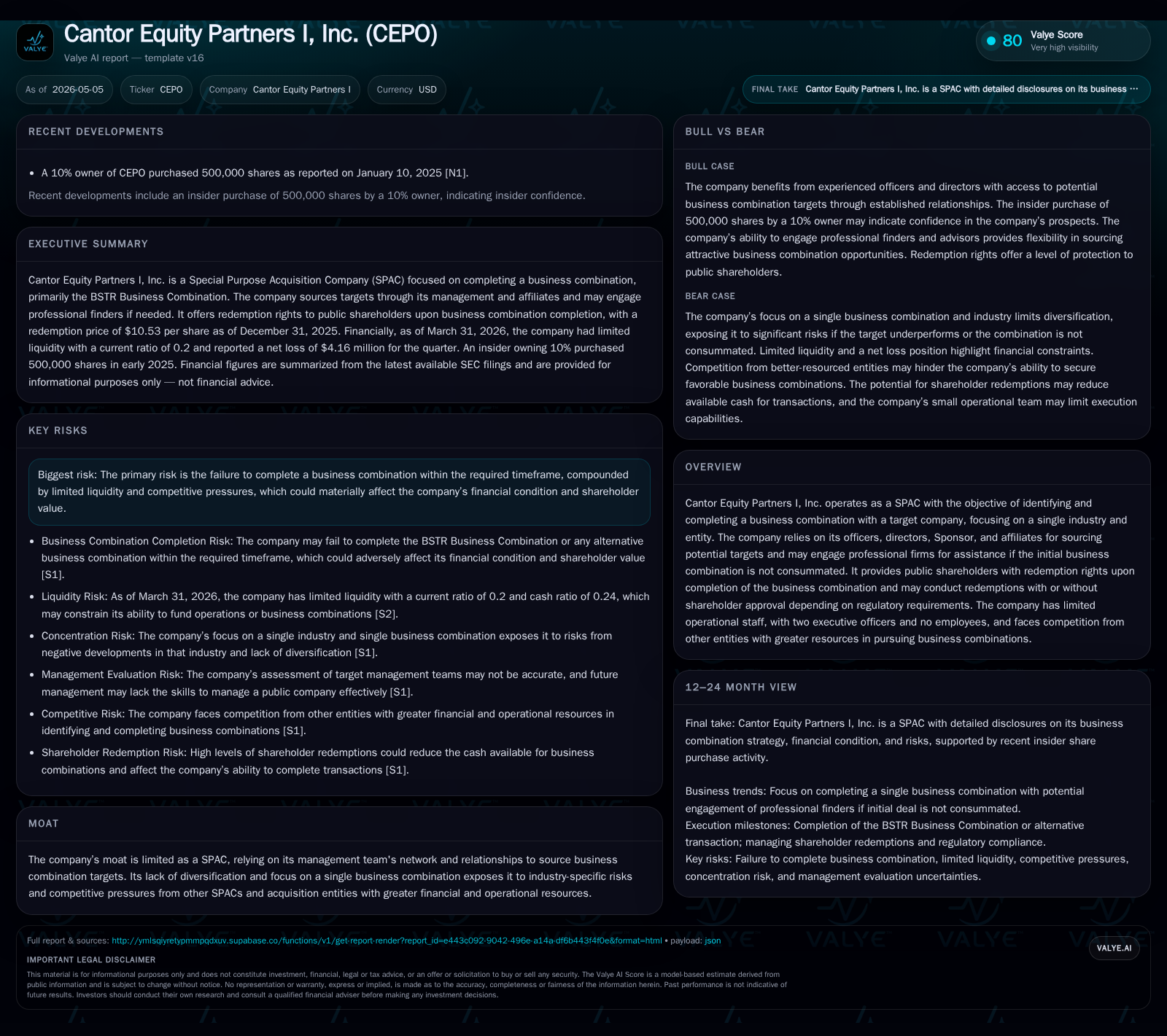
Cantor Equity Partners I, Inc. (CEPO) disclosed in its latest 10-Q filing that it executed Amendment No. 1 to its Business Combination Agreement, expanding the size of the acquiring entity’s board from five to seven members. This governance shift suggests heightened complexity and a need for broadening oversight as CEPO approaches its merger deadline. Operating with limited financial resources and a lean organizational structure, CEPO faces intensified competitive pressures among Special Purpose Acquisition Companies (SPACs), compounded by redemption risks and liquidity shortfalls. The company’s growth trajectory hinges primarily on successful deal closure, managing shareholder redemptions, and securing private investment placements that can support transaction execution.
Recent Quarterly Developments: Board Expansion and Strategic Moves
Cantor Equity Partners I disclosed an important operational development in its most recent quarterly filing dated May 4, 2026. The company executed Amendment No. 1 to its Business Combination Agreement on March 25, 2026, increasing the size of Pubco's board of directors from five to seven members effective upon closing of the business combination [S2], [S3]. This expansion reflects a deliberate governance recalibration likely aimed at strengthening oversight capabilities as CEPO advances toward finalizing its merger.
This move underscores management's recognition of increased transaction complexity or the need for additional expertise on Pubco’s board to facilitate decision-making and address potential contingencies associated with closing. Such adjustments often accompany later-stage merger phases where multiple stakeholder interests converge, including public shareholders exercising redemption rights, private placement investors, and regulatory assessments.
Business Model Overview: SPAC Dynamics and Target Acquisition Strategy
CEPO operates as a Special Purpose Acquisition Company (SPAC) formed primarily to identify, negotiate, and consummate a single business combination within a defined timeframe [S1]. The company's revenue model is contingent upon completing this transaction rather than generating operating income through traditional product or service offerings.
Strategically, CEPO relies heavily on the business networks of its officers, directors, Sponsor, and affiliates for sourcing acquisition targets rather than engaging professional acquisition firms upfront [S1]. While the use of finders or advisers remains an option if initial deals falter, the company presently pursues an internal relationship-driven approach that conserves capital but may limit target pipeline breadth.
A key feature impacting shareholder dynamics is the provision of redemption rights following announcement of a business combination. Public shareholders can elect to redeem their shares; however, those voting shareholders face a cap restricting redemptions to aggregated excess shares above 15% of total public shares when approval is sought without tender-offer rule repurchases [S1]. This mechanism aims to maintain sufficient remaining float necessary for listing requirements and deal viability.
CEPO's operational structure is deliberately sparse—consisting of two executive officers without additional employees—allowing low fixed overhead but placing significant dependence on sponsor leadership for execution expertise [S1].
Industry Context: Competitive Landscape Among SPACs and Acquisition Entities
The SPAC industry remains intensely competitive with numerous entities vying for quality targets amid rising regulatory scrutiny over shareholder protections and transaction disclosures. CEPO faces competition predominantly from better-capitalized sponsors who combine financial heft with broader advisory resources enabling faster deal sourcing and enhanced negotiation leverage [S1], [S2].
Given CEPO's limited operational bandwidth and capital base—evidenced by modest cash reserves relative to liabilities—it must navigate these headwinds prudently. Additionally, focusing exclusively on one business combination introduces concentration risks; failure to consummate leaves CEPO exposed without diversified fallback options beyond engaging external finders post-failure.
The broader marketplace also contends with cyclical factors influencing SPAC appeal such as general equity market volatility, investor sentiment on de-SPAC transactions, and evolving SEC regulations that shape shareholder voting processes and redemption rights frameworks.
Growth Drivers: Catalysts for Successful Business Combination Completion
CEPO's growth or value realization is almost entirely linked to success in completing its targeted business combination. Critical catalysts include:
- Obtaining requisite shareholder approvals for the transaction while managing redemptions below disruptive levels to preserve public float integrity.
- Finalizing Private Investment in Public Equity (PIPE) placements that provide supplemental capital necessary for deal financing aligned with Amendment terms enhancing corporate governance capacity during this phase [S3], [S5].
- Leveraging the expanded board size post-Amendment No. 1 to streamline decision-making processes facilitating smoother closing operations.
- Timely dissemination of proxy materials which frames visibility into investor sentiment and influences vote outcomes.
These factors are interlinked; efficient governance bolsters investor confidence supporting approvals while financial commitment through PIPE investments addresses liquidity gaps that could otherwise imperil deal closure.
Risks and Watchpoints: Redemption Risks, Liquidity, and Regulatory Considerations
Several salient risks imperil CEPO's path forward:
- The existing financial snapshot reveals critical liquidity stress with cash & equivalents at approximately $275K juxtaposed against current liabilities exceeding $1.13M yielding a precariously low current ratio near 0.20 [F1]. This imbalance could constrain operational flexibility or necessitate emergency capital interventions ahead of deal consummation.
- Redemption risk looms large; excessive public shareholder redemptions could reduce tradeable equity float below exchange listing thresholds or erode the economic base required for merging entity viability. The cap on redemptions above 15% excess shares seeks mitigation but depends heavily on shareholder behavior at proxy voting time [S2], [F1].
- Regulatory uncertainties persist concerning procedures around redemption without shareholder approval versus scenarios requiring votes imposing timing pressures.
- Failure to consummate within prescribed deadlines forces liquidation outcomes potentially crystallizing significant losses for shareholders given limited retained assets outside trust funds.
Close monitoring of these dimensions remains imperative as any adverse shifts can materially disrupt either deal economics or market confidence.
Milestones Ahead: Key Dates and Execution Markers for Investors
Investors should prioritize several upcoming operational touchpoints:
- Proxy statement release timing dictates when shareholders gain formal insights into transaction details along with redemption election mechanics influencing vote outcomes.[S1]
- Shareholder vote scheduling marks discrete moments where approval likelihood can be gauged alongside redemption volumes impacting merger viability.[S3]
- Finalizing PIPE investment closes provides concrete validation of available financing underpinning deal execution robustness.[S3], [S5]
- Any further amendments related to transaction terms or board composition adjustments signal evolving governance dynamics potentially altering risk-return profiles.[S3]
Tracking these metrics will offer early warning indicators about the likelihood of successful deal closure versus escalating renegotiation or termination risks.
Latest Financial Snapshot: Funds, Liabilities, and Liquidity Position
Latest financial snapshot
| Metric | Value | Period |
|---|---|---|
| Current assets | $232301 | |
| 2026-03-31 | ||
| Current liabilities | $1134268 | |
| 2026-03-31 | ||
| Current ratio | 0.2x | |
| 2026-03-31 |
Source: SEC companyfacts cache [F1].
| Metric | Value (USD) |
|---|---|
| Cash & Equivalents | 275,381 |
| Current Assets | 232,301 |
| Current Liabilities | 1,134,268 |
| Current Ratio | 0.20 |
CEPO maintains an asset-light financial profile typical of SPACs prior to completing their de-SPAC transactions. However, the markedly low current ratio signals acute liquidity constraints must be addressed imminently through merger proceeds or supplemental financing mechanisms lest operational continuity be challenged before the combination closes [F1].
This analysis incorporates data strictly drawn from Cantor Equity Partners I’s most recent quarterly filing as well as corroborated event disclosures concerning amendments executed around its pending business combination. All metrics refer strictly to stated figures without extrapolation beyond reported evidence sources [S2], [S3], [S1], [F1]. The information presented does not constitute investment advice but serves to illuminate CEPO’s commercial progress amid typical structural challenges characteristic of SPAC lifecycle stages.
Disclaimer: This is research-only, informational analysis and not investment advice. It may include AI-generated interpretation and general industry context. Always verify important details using primary sources.

Comments