
US Bancorp Strengthens Regional Hold and Institutional Services in Latest Quarter
Q1 2026 results highlight growth anchored on loan demand, fee expansion, and BTIG acquisition progress.
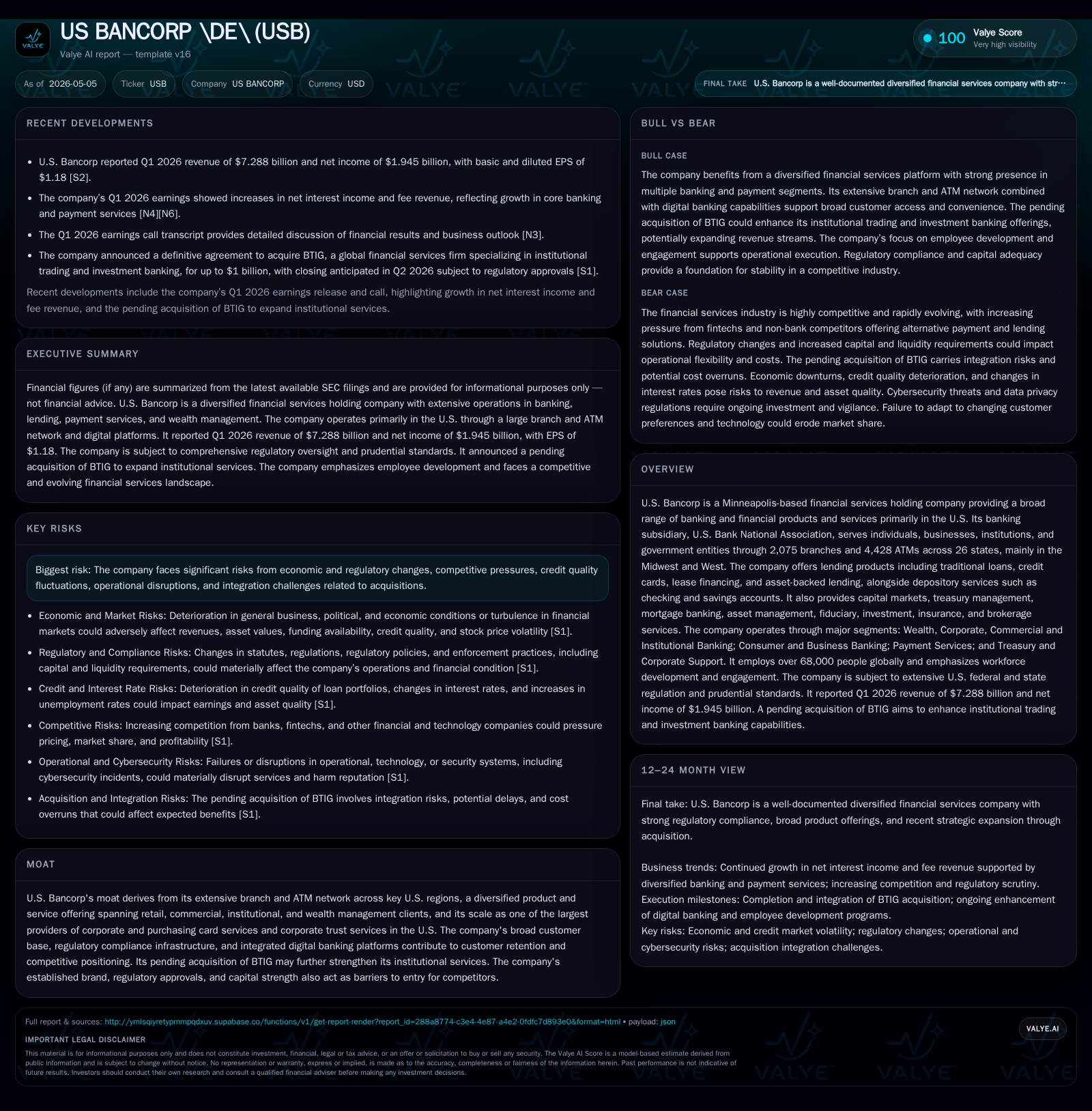
In Q1 2026, US Bancorp reinforced its regional banking franchise through solid net interest income growth driven by increased loan activity and expanded fee revenue from card services and payment solutions. The strategic acquisition of BTIG promises to deepen its institutional service offerings, supporting its competitive position in capital markets. Despite a challenging regulatory environment and credit risk concerns, USB’s diversified business model and extensive Midwest and Western presence underpin stable deposit generation and cross-selling opportunities. Close attention remains warranted on the successful integration of BTIG, regulatory developments, and credit quality trends influencing near-term profitability.
Q1 2026 Operational Update: Key Developments and Implications
US Bancorp's first quarter 2026 earnings filing [S2] unveils continued momentum in core earning streams that reinforce its strategic regional foothold. Net interest income (NII) expanded, propelled by strong loan demand particularly from commercial segments, reflecting healthy credit appetite despite broader macroeconomic caution. Complementing this lending growth was a notable increase in fee income derived from card services — including consumer and business credit card portfolios — along with gains in payment processing revenues that underscore USB's dominant position in corporate purchasing cards.
A pivotal development during the quarter was progress toward closing the BTIG acquisition [S3], a $1 billion transaction announced earlier this year that targets enhancement of US Bancorp’s institutional brokerage and investment banking footprint. This deal aligns tightly with USB’s Corporate, Commercial and Institutional Banking segment focus on capital markets and brokerage service expansion. Management’s early commentary highlights anticipated synergies stemming from cross-selling BTIG’s specialized institutional trading capabilities alongside USB’s existing corporate trust services.
Operationally, these developments signal a strategic rebalancing: while core retail deposits provide funding stability anchored by an extensive branch/ATM network across key Midwestern and Western markets, incremental growth vectors are increasingly tied to institutional service innovation enabled by the BTIG platform.
Business Model Overview: Diversified Banking and Financial Services
US Bancorp operates through well-defined segments offering symbiotic revenue streams: Consumer and Business Banking delivers traditional deposit products (checking/savings) alongside diverse lending solutions including mortgages, auto loans, small business credit cards, and asset-backed financing [S1]. This segment benefits structurally from branch density—over two thousand physical locations—and a wide ATM network exceeding four thousand units, which collectively contribute to robust deposit gathering capabilities.
The Wealth, Corporate, Commercial & Institutional Banking segment serves as the company’s commercial engine with tailored credit offerings (middle market loans), treasury management solutions for cash flow optimization, capital market activities such as debt issuance advisory, asset management services for wealth clients, plus fiduciary functions—a constellation strengthened further by acquiring BTIG's capabilities [S15]. Payment Services is another critical node capturing revenue from card-based transactions including consumer cards but notably scaled corporate purchasing cards where USB ranks among the largest U.S. providers.
Revenue mechanics hinge on net interest margin generated from loans funded largely by stable retail deposits; fee income driven by transaction volumes; treasury fees based on cash management contracts; as well as asset-based fees tied to wealth management portfolios. This diversified product architecture fosters revenue stability amidst variable lending cycles since weaknesses in one area (e.g., mortgage originations) can be offset by strength elsewhere (e.g., institutional fees).
Competitive Positioning within the Regional Banking Sector
USB occupies a leading regional nexus concentrated primarily across Midwest and Western U.S. markets where it leverages physical presence as a key moat against both purely digital challengers and national banks with less localized reach. The branch/ATM density facilitates entrenched customer relationships yielding higher switching costs — an advantage Northern Trust [N1] or Bank of Hawaii [N2] operate within their own geographies but cannot easily replicate at USB scale.
In payment services’ domain especially corporate purchasing cards—as noted—USB holds a top-tier national position which complements its client retention strategies via integrated treasury solutions. Regulatory compliance frameworks provide additional barriers given the rigor expected for institutions at USB’s scale (Category III under federal tailoring rules [S1]), ensuring that new entrants face high compliance cost hurdles.
While national competitors dominate certain large metropolitan centers or digital-first niches, USB balances with mid-cap agility combined with broad product depth across several customer verticals: retail consumers to institutional investors.
Institutional Growth via Strategic Acquisition: The BTIG Deal
Announced January 2026 [S9][S10], the BTIG acquisition marks a decisive move for USB into higher-value-add institutional financial services encompassing trading execution platforms, equity research support, investment banking advisory, and global brokerage operations. Valued up to $1 billion—including upfront cash plus contingent payments over three years tied to performance milestones—this transaction signals USB’s intent to cross-leverage BTIG’s specialized capabilities into its established commercial banking channels.
BTIG's global reach enhances US Bancorp’s ability to serve large corporate clients requiring premium capital markets insights not previously within USB’s core service array. However, this integration invites execution risks typical of sizable financial mergers: aligning cultures, systems compatibility between legacy platforms, regulatory approvals timing uncertainties [S10], plus potential dilution risks from new stock issuance strengthening initial funding.
Realizing the full potential depends on effective cross-selling initiatives between BTIG’s brokerage clientele and USB’s treasury/asset management disciplines—manifesting higher wallet share per client—while ensuring operational discipline maintains profit margins amid onboarding costs.
Growth Drivers: Digital Integration, Card Services, and Treasury Offerings
USB's growth levers center around deepening digital adoption facilitating seamless omni-channel access for consumers and businesses alike [S1]. Transactional volumes on mobile/online platforms have increased materially enabling more efficient deposit penetration combined with enhanced customer experience metrics.
Expanding cardholder bases for both consumer credit cards and especially institutional purchasing cards remain pivotal. Given USB’s significant role in corporate payment ecosystems coupled with continuing economic activity recovery post-pandemic cycle observations underlying this volume growth appear structural rather than episodic.
Treasury management advances integrating automation to streamline cash flow forecasting/payment processing deliver productivity gains that may amplify fee income yields while cutting operational overheads — important in tightening margin environments.
Challenges Ahead: Credit Risk, Regulatory Environment, and Market Pressures
Persistent uncertainties cloud credit risk profiles particularly for commercial loans linked to vulnerable sectors such as real estate amid fluctuating occupancy rates [S2][S29]. Credit loss provisioning will require vigilant scrutiny during upcoming quarters given economic volatility patterns.
On the regulatory front AML program amendments proposed jointly by OCC/Fed/FDIC amplify compliance demands necessitating ongoing investments in risk-deterrence technologies with attendant cost impact risks [S1]. Enhanced prudential standards applicable as Category III institution impose capital requirements constraining rapid balance sheet expansion while supervision intensifies post-banking sector turbulence.
Potential FDIC assessment increases following recent systemic bank failures heighten expense pressures threatening net interest margins. Moreover, continual CFPB oversight shifts—even amidst staffing reductions—introduce evolving consumer protection compliance complexity [S29].
Finally integration timing for BTIG carries execution risk with delays or cost overruns possibly impacting near-term earnings outlooks adversely.
Forward Look: Milestones, Guidance, and Execution Risks
Key investor milestones include anticipated closure of the BTIG acquisition expected during Q2 2026 subject to regulatory clearances [S3]. Subsequent quarters will shed light on integration progress through updates on realized cost synergies alongside revenue synergy captures detailed inside subsequent quarterly call disclosures [N3].
Ongoing IT platform upgrades underpin strategic aims around customer experience enhancement required to sustain engagement amid intensifying digital competition.
Credit quality monitoring metrics emerging across Q2/Q3 periods will be pivotal early-warning signals for capital adequacy adjustment needs or loan portfolio recalibration requests.
Given the heavy emphasis on regulatory compliance upgrades internally mandated risk management capacity must evolve swiftly minimizing supervisory friction whilst safeguarding operational continuity.
Financial Summary: Supporting Evidence from Latest Filings
Q1 2026 filings confirm sustained NII growth supporting operating leverage gains consistent with robust loan portfolio expansion documented in commercial categories [S2]. Fee income trajectory reflects strong card/payment services performance revealing durable client volume traction through merchant processing activities.
Provision for credit losses showed modest elevation cognizant of macro environment caution flags yet remained manageable without material earnings strain noted so far.
Capital adequacy ratios conform comfortably within Category III regulatory thresholds signaling sound buffer maintenance compatible with planned BTIG transaction financing structures outlined earlier this year [S1][F1].
This analysis reflects information available as of May 2026 anchored fundamentally on disclosed SEC filings augmented by market intelligence context. It emphasizes operating fundamentals shaping U.S. Bancorp's evolving competitive positioning while highlighting material execution challenges within its growth strategy framework. Readers should consider these factors dynamically amid shifting macro-financial conditions without presuming static outcomes.
Disclaimer: This is research-only, informational analysis and not investment advice. It may include AI-generated interpretation and general industry context. Always verify important details using primary sources.

Comments