
Blaize Holdings Advances AI Chip Development Amid Concentrated Customer Base and Supply Chain Risks
Recent contract wins and equity raises underscore Blaize Holdings' push to commercialize its proprietary AI platforms despite significant operational challenges.
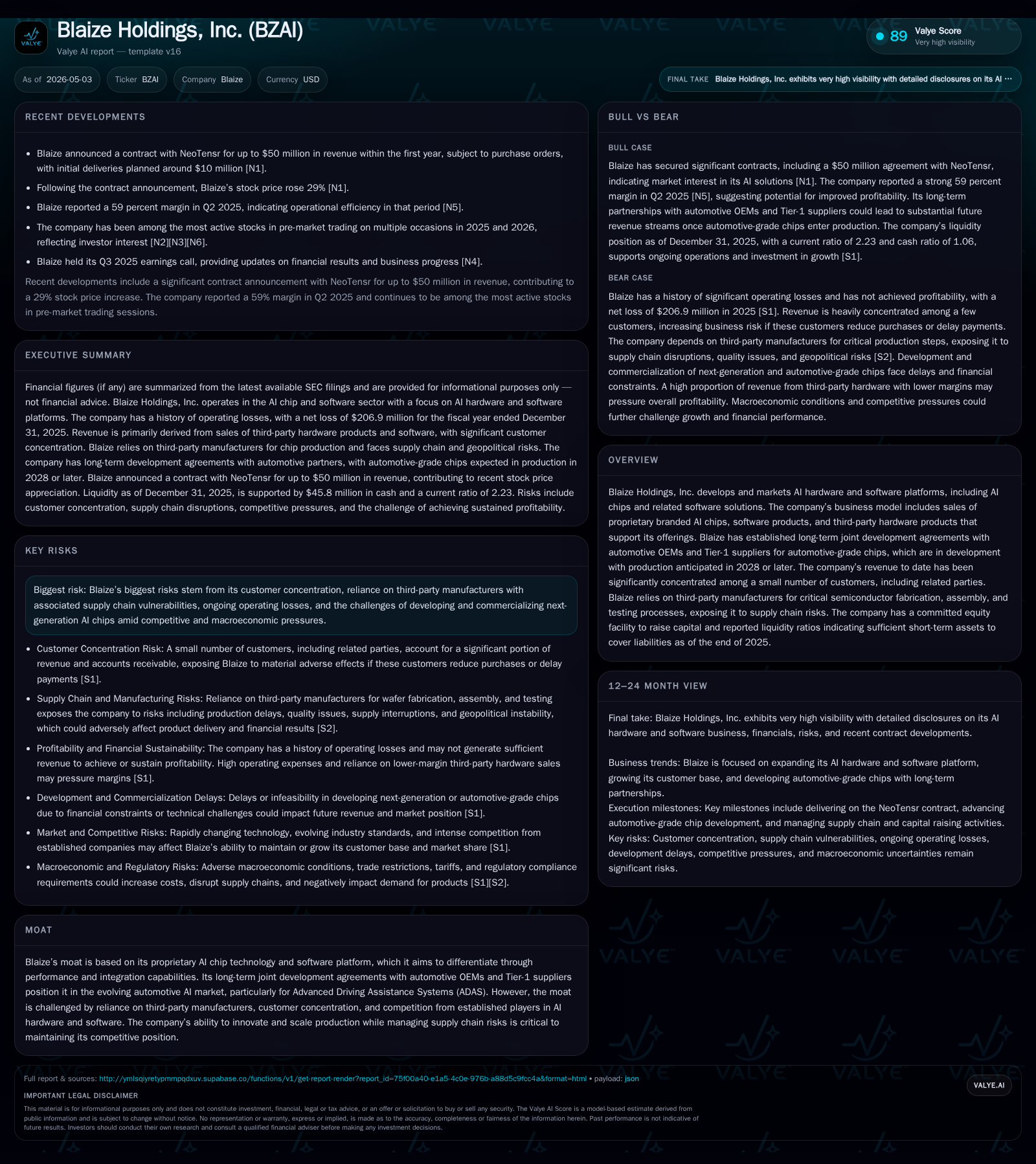
Blaize Holdings, Inc. is progressing its AI-centric chip and software platform development with a notable new contract potentially worth up to $50 million in its nascent commercialization phase. The company’s revenue remains highly concentrated among a few customers, exposing it to customer risk, while it faces supply chain vulnerabilities due to reliance on third-party semiconductor manufacturers. Strategic partnerships with automotive OEMs for next-generation automotive-grade chips are in early stages, with production expected by 2028 or later. Blaize’s growth hinges on successfully scaling manufacturing, diversifying its customer base, and navigating competitive pressures from established AI hardware players.
Recent Operating Update
Blaize Holdings’ latest SEC filings paint a picture of a company at an inflection point in its commercialization journey. The most recent quarterly filing dated November 13, 2025 [S2] reported preliminary Q1 2026 revenue estimates at approximately $2.7 million [S4], signaling early but modest top-line growth consistent with a company moving from development toward volume sales. The preceding quarter included $23.8 million in revenue from a significant purchase order by NeoTensr, which Blaize anticipates adding to under a new contract announced April 2026 that could bring up to $50 million in revenues depending on NeoTensr's issuance of purchase orders [N1][S4]. This marks a potentially transformative commercial milestone given previously limited revenue scale.
On the capital front, Blaize secured gross proceeds of about $30 million via a private placement agreement with Polar Asset Management in late 2025 [S7]. The company also relies on an ongoing Committed Equity Facility with B. Riley Principal Capital (up to $50 million capacity), having sold over 8 million shares for $33.4 million through October 2025 [S10][S22]. Cash balances stood at approximately $45.8 million at year-end 2025 against minimal debt ($1.5 million) [F1], giving the company liquidity runway critical for ongoing R&D and commercialization investments.
A key governance move was the April 22, 2026 adoption of a Rights Agreement with associated Series A Junior Participating Preferred Stock issuance [S3][S26][S27][S28]. This act safeguards against hostile takeovers by imposing substantial dilution for any party acquiring more than 10% ownership without board approval—a strategic layer reflecting heightened sensitivity to control amidst growth uncertainty.
Business Model
Blaize operates primarily as a developer and marketer of AI-specific semiconductors and accompanying software platforms that enable edge AI applications across sectors such as automotive and enterprise computing [S1]. Its revenue sources break down into:
- Proprietary branded AI chips designed for diverse AI workloads; these carry higher gross margins but remain under scaled currently.
- Software solutions that accompany chip selling—designed to optimize deployment efficiency and ease integration—offering stickiness and differentiation.
- Third-party hardware product sales that supplement the offering but yield lower margins.
Revenue realization depends heavily on long sales cycles typical in semiconductor industries, highly customized client requirements especially from automotive OEMs, and conversion from R&D-stage collaborations into actual volume shipments. The business model is further complicated by reliance on external foundries such as Samsung Foundry for wafer fabrication and Plexus for assembly/testing—critical non-core processes that introduce vulnerability to supply chain disruptions [S2].
Customer concentration is acute; two customers (including one related party) accounted for nearly all revenues recently [S6][S9], presenting material risk if any reduce orders or switch suppliers given their negotiation power.
Industry Structure and Competitive Position
The AI chip industry is intensely competitive, dominated by large incumbents with substantial R&D budgets—NVIDIA, AMD, Intel—and emerging pure-play startups innovating specialized architectures. Blaize positions itself strategically around proprietary SoC designs tailored for edge inference tasks combined with integrated software platforms aimed at reducing deployment complexity.
Long-term joint development agreements with Tier-1 automotive suppliers and OEMs signal a targeted approach towards advanced driver assistance systems (ADAS) where latency, power efficiency, and integration are paramount [S1]. However, production timelines extend out until at least 2028 due to stringent qualification standards in automotive supply chains.
Blaize’s moat rests on unique integration capabilities between hardware performance characteristics and software flexibility. Yet this advantage is challenged by scale limitations—particularly manufacturing rollout dependent on third parties—and customer concentration which dampen bargaining strength versus larger competitors.
Growth Drivers
Several distinct factors underpin Blaize’s path forward:
- Commercial Contract Conversion: The newly announced NeoTensr deal represents validation of the platform’s market relevance and should drive near-term revenue growth if purchase orders materialize as outlined [N1][S4].
- Automotive Chip Development: Ongoing collaborations for automotive-grade chips open potential multi-year opportunities tied to ADAS adoption trends; however, this remains developmental with commercial production targeted post-2028 [S1].
- Software Ecosystem Expansion: Enhancing the value-add through software that accelerates customer deployment reduces switching costs and can broaden addressable markets within edge AI verticals.
- Capital Infusion: Access to committed equity capital supports further R&D investment crucial for sustaining innovation cadence necessary against industry giants.
- Market Adoption Trends: Macroeconomic factors driving pervasive AI implemention in automation provide structural tailwinds; demand is more structural than cyclical given emerging use cases across industries.
Risks / Watchpoints / Growth Constraints
Key risks bear watching:
- Customer Concentration: Heavy dependence on a small client base generates outsized exposure to order variability or renegotiation pressure [S6][S9].
- Supply Chain Vulnerabilities: Single-source dependency on external foundries creates risk of delays or quality issues impacting product launch timing or costs [S2].
- Operating Losses and Capital Needs: Large operating deficits (net loss approx. $207 million in FY2025) highlight need for continued financing which could dilute shareholders or constrain agility if conditions tighten [F1][S1].
- Extended Sales Cycles: Complex sales processes especially in automotive segment may delay revenue realization despite technical milestones.
- Competitive Pressure: Well-capitalized rivals accelerating their own AI silicon advances could erode Blaize’s niche positioning if scale or ecosystem breadth lag.
- Regulatory & Geopolitical Factors: Tariffs or trade restrictions impacting global supply chain components could cause cost inflation or sourcing delays [S9].
What to Watch Next
Investors should monitor several upcoming milestones:
- Actual purchase order volumes generated under the NeoTensr contract over remainder of 2026 will indicate market traction beyond headline deal value [N1][S4].
- Progress toward automotive-grade chip qualification including any public announcements from joint development partners signaling timelines revisions or expansions [S1].
- Additional capital raising events or equity sales impacting liquidity runway given existing operating deficits [S10][S22].
- Customer diversification efforts via new contracts beyond dominant clients that would mitigate concentration risk.
- Any guidance updates following Q1 2026 close should clarify trajectory toward sustained profitability or scale expansion.
- Developments related to supply chain risks such as alternative foundry arrangements or component sourcing strategies.
Financial Profile Summary (Latest Snapshot)
Latest financial snapshot
| Metric | Value | Period |
|---|---|---|
| Cash & equivalents | $46mm | |
| 2025-12-31 | ||
| Current assets | $97mm | |
| 2025-12-31 | ||
| Current liabilities | $43mm | |
| 2025-12-31 | ||
| Current ratio | 2.23x | |
| 2025-12-31 |
Source: SEC companyfacts cache [F1].
Liquidity appears sufficient with solid cash reserves relative to low debt levels [F1], though operating losses significantly outpace revenues highlighting dependence on external capital inflows and operational execution improvement.
Disclaimer: This analysis is for informational purposes only and does not constitute investment advice or recommendations regarding any securities discussed herein.
Disclaimer: This is research-only, informational analysis and not investment advice. It may include AI-generated interpretation and general industry context. Always verify important details using primary sources.

Comments