
GeneDx Advances Genomic Diagnostics with New Data Integration and Q1 Operating Update
GeneDx's latest quarter reflects growth in exome/genome testing and strategic expansion via software integration amid financial covenant constraints.
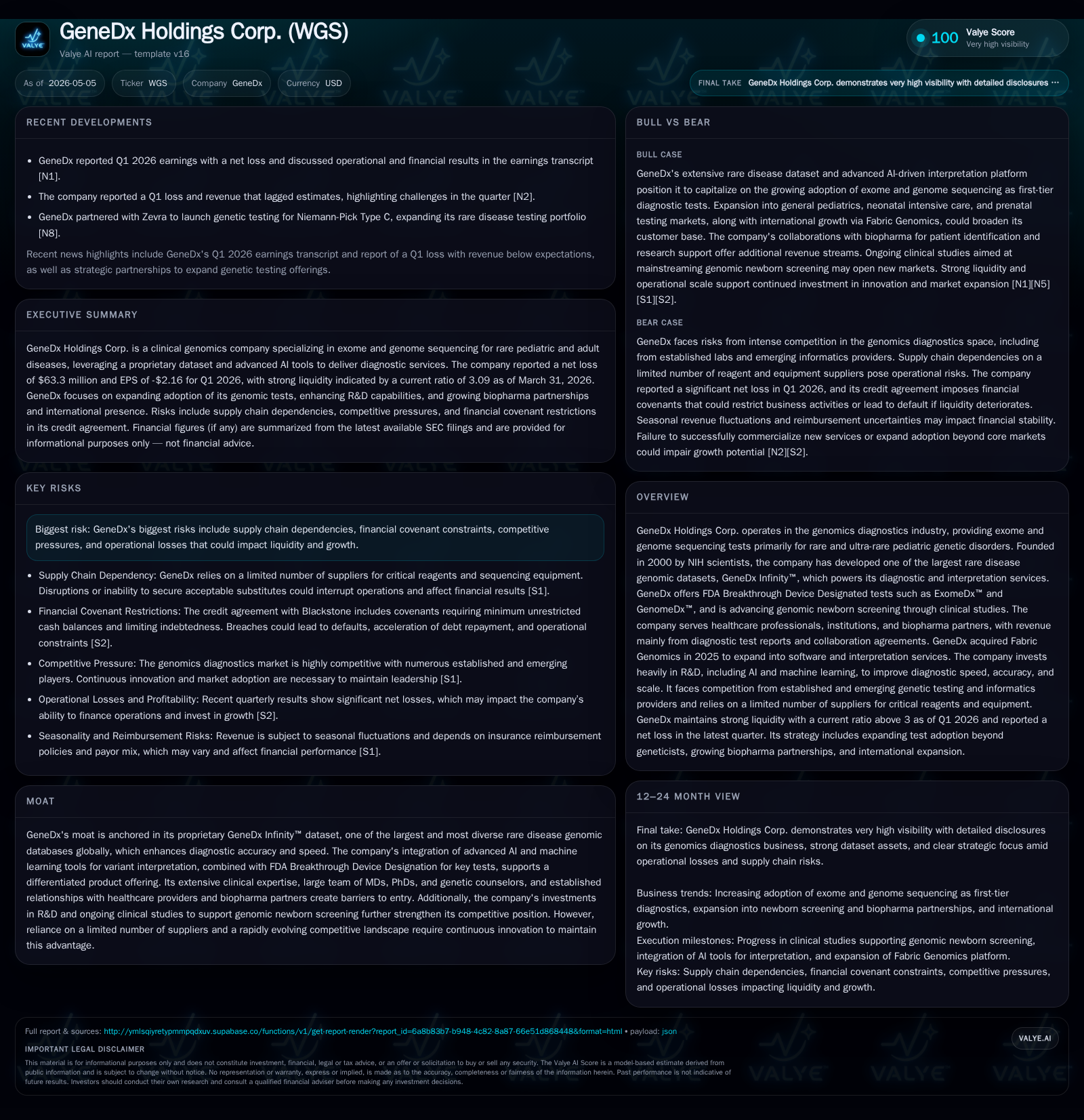
In Q1 2026, GeneDx continued to scale its core exome and genome sequencing test volumes, expanding its proprietary GeneDx Infinity™ dataset and integrating Fabric Genomics’ software assets to enhance diagnostic interpretation. The company faces cost pressures and reimbursement challenges typical of the genomics diagnostics industry but leverages FDA Breakthrough Device Designation status and biopharma collaborations to differentiate its offerings. While its credit agreement imposes restrictive covenants, GeneDx maintains strong liquidity and a healthy current ratio, positioning it to support ongoing R&D investments critical for sustaining competitive advantage. Key near-term milestones center on reimbursement expansion, clinical newborn screening progress, and operational leverage improvements.
Latest Quarterly Operational Trends and Strategic Highlights
GeneDx’s Q1 2026 filing ([S2]) reveals persistent volume acceleration in exome and genome sequencing tests—key revenue drivers that directly enlarge its GeneDx Infinity™ database. This ongoing volume growth is critical as it enriches genomic data diversity, enabling more rapid identification of variants of unknown significance crucial in diagnosing rare pediatric diseases. The company reported broader revenue growth fueled by these clinical services while incurring notable cost pressures linked to both operational scaling and reimbursement delays common within the genomics diagnostics field ([N1]).
Fabric Genomics integration continues post-acquisition from mid-2025 ([S3]), enabling GeneDx to expand its diagnostic service offering by incorporating advanced interpretation software tools into its clinical workflows—a notable step toward solving bottlenecks in variant analysis using AI-powered automation.
While positive momentum is apparent in test adoption and technology integration, management highlighted near-term challenges: reimbursement complexities delaying cash flow recognition under evolving third-party payor policies, alongside incremental operating costs related to increased R&D investment in AI/ML capabilities ([S2]). The event filing ([S3]) notes progress in clinical studies targeting genomic newborn screening applications—an emerging segment poised to become a structural growth driver through earlier patient intervention.
Business Model and Core Product Differentiation
GeneDx generates the majority of its revenues through diagnostic testing services based on whole exome (ExomeDx™) and whole genome sequencing assays (GenomeDx™) billed primarily to healthcare providers and insurance payors ([S1]). Its proprietary asset—GeneDx Infinity™, one of the largest rare disease genomic databases globally—is central to enhancing diagnostic accuracy through improved variant interpretation powered by machine learning.
The company's FDA Breakthrough Device Designation for key tests facilitates a preferred regulatory positioning that supports accelerated review pathways and fosters clinician trust in their assays’ clinical utility ([S24]). Besides direct-to-provider sales, GeneDx has strategically broadened revenue streams through collaboration agreements with biopharma partners who leverage the GeneDx Infinity™ dataset for drug discovery and clinical trial enrichment.
Customer segments include hospitals, genetic counselors, pediatric specialists, and biopharma clients seeking integrated genomic intelligence rather than standalone laboratory results. Although dependent on external suppliers for reagents and data storage infrastructure ([S1]), GeneDx places significant emphasis on delivering actionable reports with clear clinical interpretations designed for clinicians without specialized genetics training.
Competitive Genomics Industry Structure and Barriers
The molecular diagnostics sector features aggressive competition among players offering various genetic tests ranging from targeted panels to full exome/genome sequencing. However, GeneDx’s moat is distinctly fortified by the scale of its genomic dataset combined with sophisticated AI-driven variant analysis capabilities that accelerate diagnostic throughput relative to smaller or less integrated rivals ().
This sizable dataset not only improves variant pathogenicity resolution but also supports efforts toward population-specific insights that are critical in rare disease diagnosis. The industry’s pricing environment remains complex due to fragmented reimbursements wherein each payor independently determines coverage policies; this compels companies like GeneDx to invest continuously in reimbursement navigation resources ([S16]).
Operationally, reliance on third-party suppliers introduces supply chain risks which could constrict capacity or elevate costs if component availability suffers—a structural constraint that demands vigilant vendor management ([S1]). Compliance with FDA regulations under Breakthrough Device pathways requires substantial quality control investments but grants market advantage through more interactive regulatory dialogue ([S24]).
Growth Catalysts: Innovation, Dataset Expansion, and Partnerships
Structural demand for comprehensive exome/genome testing is rising as healthcare shifts towards proactive genetics-informed care rather than reactive panel testing which often yields inconclusive diagnoses. GeneDx stands well-placed to capture this trend given its leading dataset growth trajectory—97k exome/genome tests resulted in 2025 compared to 74.5k in 2024—and its continuous improvement in reimbursement rates enhancing revenue per test ([S1]).
Investments into R&D focus heavily on AI/ML innovations enabling faster variant classification accuracy—a necessary evolution considering the increasing complexity of interpreting whole genome data beyond targeted panels ([S15]). The acquisition of Fabric Genomics expands software capabilities into variant interpretation pipelines more amenable for large-scale deployments across hospital networks.
Moreover, GeneDx is advancing multiple clinical trials aimed at integrating genomic newborn screening into routine pediatric assessments—potentially a transformative catalyst unlocking earlier diagnosis for life-threatening disorders ([S3]). This aligns with management’s vision of “sequence once, analyze for life” supported by longitudinal patient data access plans that can foster recurring engagement.
The company also deepens biopharma collaborations leveraging proprietary genomics intelligence to support precision therapeutics development—diversifying revenue sources beyond diagnostic testing alone ().
Risks and Structural Constraints on Growth Trajectory
GeneDx faces several constraints intrinsic to the capital-intensive molecular diagnostics industry. Its credit agreement with Blackstone Alternative Credit Advisors includes restrictive covenants requiring the maintenance of a minimum $50 million unrestricted cash balance—a non-trivial obligation restricting financial agility amid operating losses reported over recent periods ([S2]). Failure to comply risks accelerating debt repayment or loss of lender commitments that could destabilize operations.
The reimbursement landscape remains unpredictably complex with individual payors routinely revising coverage criteria resulting in delayed or denied payments impacting revenue visibility ([S16]). Third-party audits occasionally necessitate retroactive refunds threatening revenue adjustments.
Competitive innovation pressures require sustained high R&D expenditure; failure to keep pace could erode product differentiation. Moreover, supply chain dependencies on selected vendors impose capacity risk if disruptions arise.
Operating losses weigh on near-term liquidity despite strong cash reserves; cost structure scaling must improve toward operating leverage ideally driven by higher test volumes and mix shift toward higher reimbursed genome assays ([N2]).
Key Milestones and What to Monitor Next
Near-term focus points include quarterly test volume trends relative to guidance—a key indicator linking database growth scalability—with careful attention toward any shifts in payer reimbursement coverage expansions especially within Medicaid or commercial insurance domains.
Clinical readouts from newborn genomic screening studies will be pivotal for validating this emerging application’s commercial viability.
Integration metrics from Fabric Genomics’ software platform post-merger—including adoption rates within existing hospital networks or biopharma collaborations—will gauge cross-selling efficacy.
Additionally, monitoring operating expense trends against revenue growth signals progress toward improved operating leverage vital for financial sustainability amid capital intensity.
Finally, compliance updates regarding financial covenants in upcoming filings will signal risk management effectiveness around capital structure constraints.
Financial Snapshot: Liquidity, Leverage, and Profitability Overview
Latest financial snapshot
| Metric | Value | Period |
|---|---|---|
| Cash & equivalents | $94mm | |
| 2026-03-31 | ||
| Total debt | $100mm | |
| 2026-03-31 | ||
| Net debt | $6mm | |
| 2026-03-31 | ||
| Current assets | $271mm | |
| 2026-03-31 | ||
| Current liabilities | $88mm | |
| 2026-03-31 | ||
| Current ratio | 3.09x | |
| 2026-03-31 |
Source: SEC companyfacts cache [F1].
As of March 31, 2026, GeneDx held $93.9 million in cash & equivalents against total debt of approximately $100 million yielding a modest net debt position near $6.1 million with a robust current ratio above 3.0 indicating strong short-term liquidity headroom ([F1]).
Despite recording a net loss nearing $21 million for FY 2025 reflecting high investment levels across R&D and SG&A functions along with legacy operational inefficiencies incorporated post-acquisition ([F1],[S12]), the company has steadily improved adjusted gross margins driven primarily by higher volumes of profitable exome/genome assays paired with better average reimbursements ([S10],[S19]).
All financial figures derive from latest SEC filings or validated company data sources indicated. Readers should consider forward-looking statements' inherent uncertainty regarding regulatory approvals or market dynamics affecting biological diagnostics corporations such as GeneDx Holdings Corp.
Disclaimer: This is research-only, informational analysis and not investment advice. It may include AI-generated interpretation and general industry context. Always verify important details using primary sources.

Comments