
ADC Therapeutics Advances Label Expansion and Streamlines R&D After Q1 2026 Update
Strong liquidity supports ADC Therapeutics’ focus on expanding ZYNLONTA's indications amid restructuring.
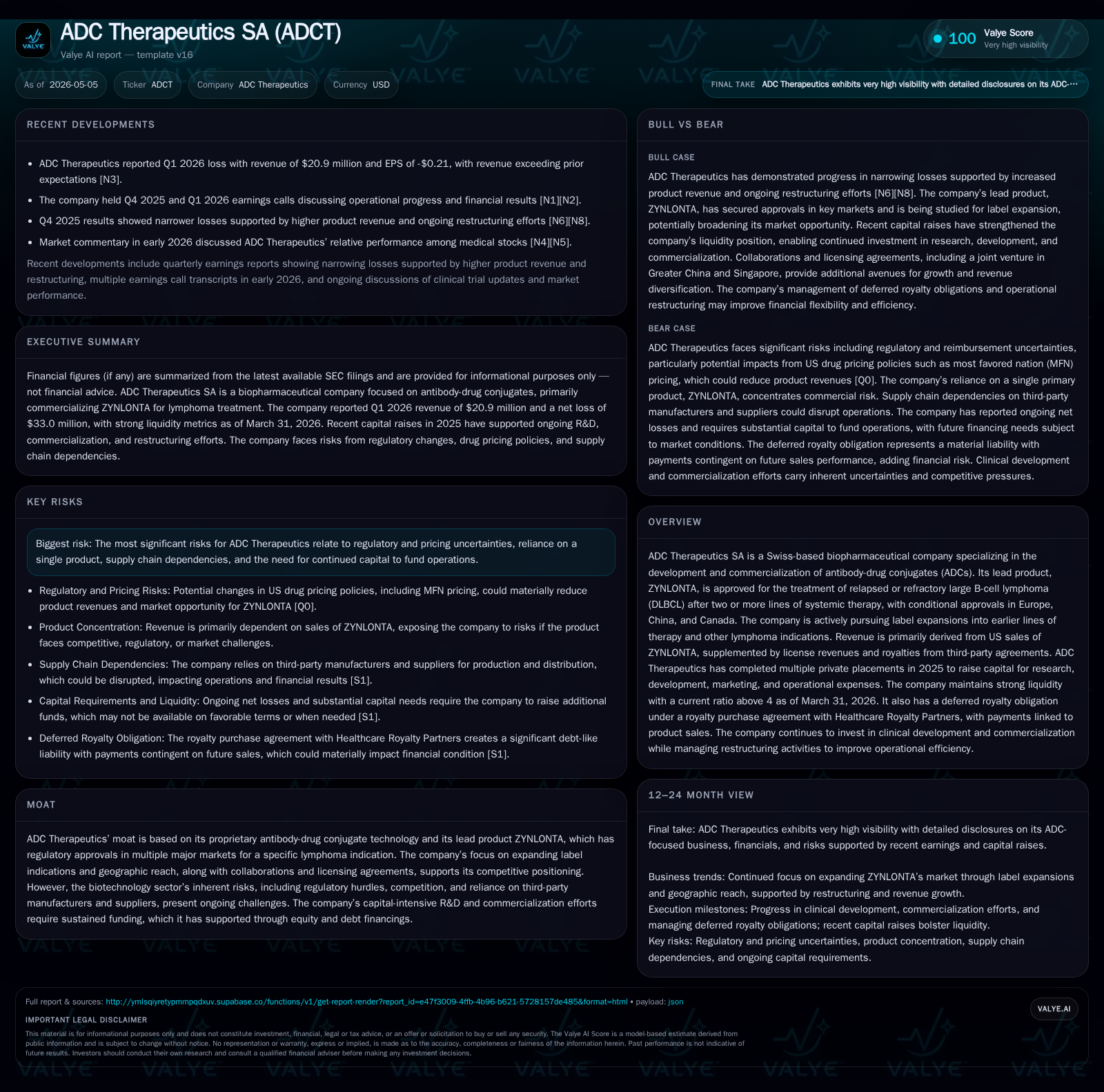
In its Q1 2026 filing, ADC Therapeutics reported sustained investment in its lead ADC product ZYNLONTA and ongoing efforts to expand its label into earlier lymphoma lines, while executing a strategic restructuring that reduced global workforce and discontinued certain preclinical programs. The company’s business model centers on commercial sales of ZYNLONTA, supplemented by licensing income, supported by proprietary ADC technology. Despite operating losses typical of biotech growth phases, ADC maintains a healthy liquidity position with over $230 million in cash and a strong current ratio. Key growth drivers include label expansions, geographic approvals, and pipeline advancement of PSMA-targeting ADCs. Risks stem from regulatory hurdles, a concentrated product portfolio, and reliance on third-party manufacturing. The evolution of royalty obligations and warrant structures illustrate ongoing financial strategic maneuvers. Upcoming milestones to watch include clinical trial readouts for new indications, regulatory decisions, and capital deployment efficiency.
Recent Operating Update: Q1 2026 Highlights
ADC Therapeutics filed its latest Form 10-Q on May 4, 2026 [S2], detailing operational developments through March 31, 2026. The quarter reinforced its strategic emphasis on advancing ZYNLONTA (loncastuximab tesirine-lpyl), the company's only approved product targeting relapsed/refractory large B-cell lymphoma (DLBCL) after at least two prior systemic therapies. The company continues to actively pursue label expansions into earlier treatment lines and other lymphoma indications. The quarter's results also reflect the impact of a comprehensive restructuring initiated mid-2025 which consolidated R&D efforts and reduced headcount by approximately 30%, including closure of the UK facility. This realignment targets enhanced focus on the commercialization of ZYNLONTA and development of the PSMA-targeting ADC while discontinuing other early-stage preclinical solid tumor programs [S21].
The restructuring resulted in accrued severance costs ($0.6 million outstanding as of quarter-end) and related expenses fully recognized in prior periods [S21]. Financially, the company reported a net loss for Q1 but maintained significant liquidity resources with cash and equivalents at $231 million as of March 31, 2026 [F1]. This strong cash position backs ongoing clinical activities and commercial operations despite continued net operational outflows.
Business Model
ADC Therapeutics operates as a biopharmaceutical entity specialized in antibody-drug conjugates (ADCs), which combine monoclonal antibodies specific for cancer targets with cytotoxic agents to selectively kill tumor cells while sparing healthy tissue. Their proprietary conjugation technology underpins their lead asset, ZYNLONTA, commercially approved for certain lymphoma patients predominantly in the U.S., but also conditionally in Europe, China, and Canada [S1], [N3].
Revenue generation flows primarily from U.S. commercial sales via wholesale distributors, supplemented by licensing fees and royalties from partnerships in territories where ADC does not directly market [S6], [S13]. The firm’s licensing agreements with major pharmaceutical players provide milestone payments and royalties tied to sales performance. Development-wise, the company invests heavily in clinical trials seeking label broadening—both into earlier therapy lines within DLBCL populations as well as other lymphoma variants that share CD19 expression profiles.
Margins reflect typical biotech dynamics: high R&D spending phases limit operating profitability; however, product sales exhibit growing scale effects as market penetration deepens. Supply chain complexity arises from reliance on contract manufacturing organizations (CMOs) for highly specialized biologic production steps [S26]. Cash flow timing is volatile due to upfront expenses for research juxtaposed against ramping product shipment revenues.
Industry Structure and Competitive Position
ADC Therapeutics occupies a niche within oncology therapeutics—specifically next-generation targeted cytotoxics addressing hematologic malignancies using antibody-drug conjugates. Key competitors include ImmunoGen, Seagen (acquired by Amgen), Seer Biosciences (partnerships with large pharma), among others developing ADCs or other targeted immunotherapies like CAR-T or bispecific antibodies.
The company’s competitive edge rests in its proprietary linker-payload technology optimized for stability and potency combined with an FDA-approved commercial product that has established initial market foothold [S1]. Regulatory approvals across multiple regions lend credibility to its scientific platform.
However, the sector faces intense regulatory scrutiny given safety profiles historically associated with older ADCs plus the need for robust demonstration of efficacy in expanding indications. Manufacturing complexity for biologic conjugates often presents bottlenecks constraining rapid scale-up—a challenge faced globally by the segment.
Collaborations are strategically important; licensing agreements help spread commercial risk geographically while leveraging partners’ local expertise. Ongoing innovation is required to maintain differentiation against emerging modalities like bispecific antibodies or next-gen CAR-T treatments that aim at similar lymphoma subsets.
Growth Drivers
- Label Expansion: The foremost driver is successful clinical advancement into earlier-lines of therapy beyond currently approved relapsed/refractory cases—potentially significantly enlarging addressable patient population.
- Indication Breadth: ADC is pursuing regulatory filings for additional lymphoma subtypes expressing CD19 or related markers.
- Geographic Approvals: Extension beyond conditional European/Canadian/Chinese approvals into full marketing authorization supports broader revenue diversification.
- Pipeline Advancement: Beyond ZYNLONTA, development of a PSMA-targeting ADC aims at solid tumors like prostate cancer representing longer-term growth opportunities.
- Partnership Revenues: Monetizing licenses via royalties from regional collaborators can yield non-dilutive revenue streams steadily complementing direct sales.
- Capital Availability: Recent private placements totaling over $150 million net proceeds in 2025 bolster funding runway needed for late-stage trials and commercialization investments [S1].
Risks / Watchpoints / Growth Constraints
- Regulatory Risk: Transitioning from conditional approvals or achieving label expansion depends heavily on successful clinical data readouts often subject to FDA/EMA discretion.
- Product Concentration: Revenue concentration on one commercial product exposes ADC to downside if competitors displace ZYNLONTA or if adverse safety events emerge post-launch.
- Manufacturing Dependencies: Outsourcing critical biologic production components introduces supply chain fragility affecting both cost structure and delivery timelines.
- Capital Intensity: Protracted R&D cycles necessitate periodic capital raises diluting shareholders or increasing leverage; sustained access to financing markets is crucial.
- Pricing & Reimbursement: Given specialty oncology pricing pressure trends globally plus payer scrutiny around novel agents’ value proposition may constrain achievable net pricing.
- Royalty & Debt Obligations: Significant deferred royalty liabilities ($~305 million long-term as per latest filings) add financial leverage risk tied to future revenue performance [S23], [S25].
What To Watch Next
Investors should monitor several upcoming execution points:
- Clinical trial updates particularly pivotal Phase II/III studies targeting early-line DLBCL populations or novel lymphoma subtypes,
- Regulatory announcements regarding full approvals especially outside the U.S.,
- Progress reports on PSMA-targeting ADC development,
- Updates regarding further restructuring outcomes or capex deployment efficiency,
- Quarterly revenues vs consensus forecasts evidencing uptake velocity,
- Potential new licensing deals expanding geographic reach or pipeline breadth,
- Changes in royalty purchase agreement terms or debt covenant compliance,
- Manufacturing scale-up effectiveness impacting gross margins.
Financial Profile Summary
Latest financial snapshot
| Metric | Value | Period |
|---|---|---|
| Cash & equivalents | $231mm | |
| 2026-03-31 | ||
| Total debt | $5mm | |
| 2026-03-31 | ||
| Net debt | $-226mm | |
| 2026-03-31 | ||
| Current assets | $277mm | |
| 2026-03-31 | ||
| Current liabilities | $68mm | |
| 2026-03-31 | ||
| Current ratio | 4.09x | |
| 2026-03-31 |
Source: SEC companyfacts cache [F1].
As of March 31, 2026, ADC Therapeutics exhibits a strong liquidity profile with cash & equivalents at $231 million supporting near-term operations [F1]. Total debt stands modestly at approximately $4.6 million current portion with additional term loan obligations amortizing over multiple years [F1], reflecting conservative leverage relative to cash resources.
Current assets exceed liabilities comfortably yielding a current ratio north of 4x ensuring short-term solvency [F1]. Operating losses continue characteristic of early commercial stages compounded by heavy R&D outlays ($101 million annualized per latest reports), although investment focus has tightened following restructuring actions which should temper expenses moving forward [S24], [S28].
Inventory levels remain stable with write-downs representing normal biotech lifecycle adjustments due to changing demand forecasts or lot expiries [S23]. Equity issuances via pre-funded warrants have been employed recently to augment capital raising without immediate dilution but require monitoring as warrants mature and could impact shareholder base upon exercise [S1], [S22].
Ultimately, financial health supports current strategic priorities but requires continued operational execution to approach sustainable profitability horizons.
This analysis synthesizes information solely from recent SEC filings up to May 4, 2026 combined with structured financial data snapshots available as of March 31, 2026 [F1]. It reflects no investment advice but aims to provide an informed industry perspective based strictly on verifiable company disclosures.
Disclaimer: This is research-only, informational analysis and not investment advice. It may include AI-generated interpretation and general industry context. Always verify important details using primary sources.

Comments