
Centerspace Faces Strategic Alternatives Review Amid Operational Challenges in Q1 2026
Centerspace’s latest quarter reveals pressure on operating fundamentals as it pursues strategic alternatives, highlighting execution and market risks.
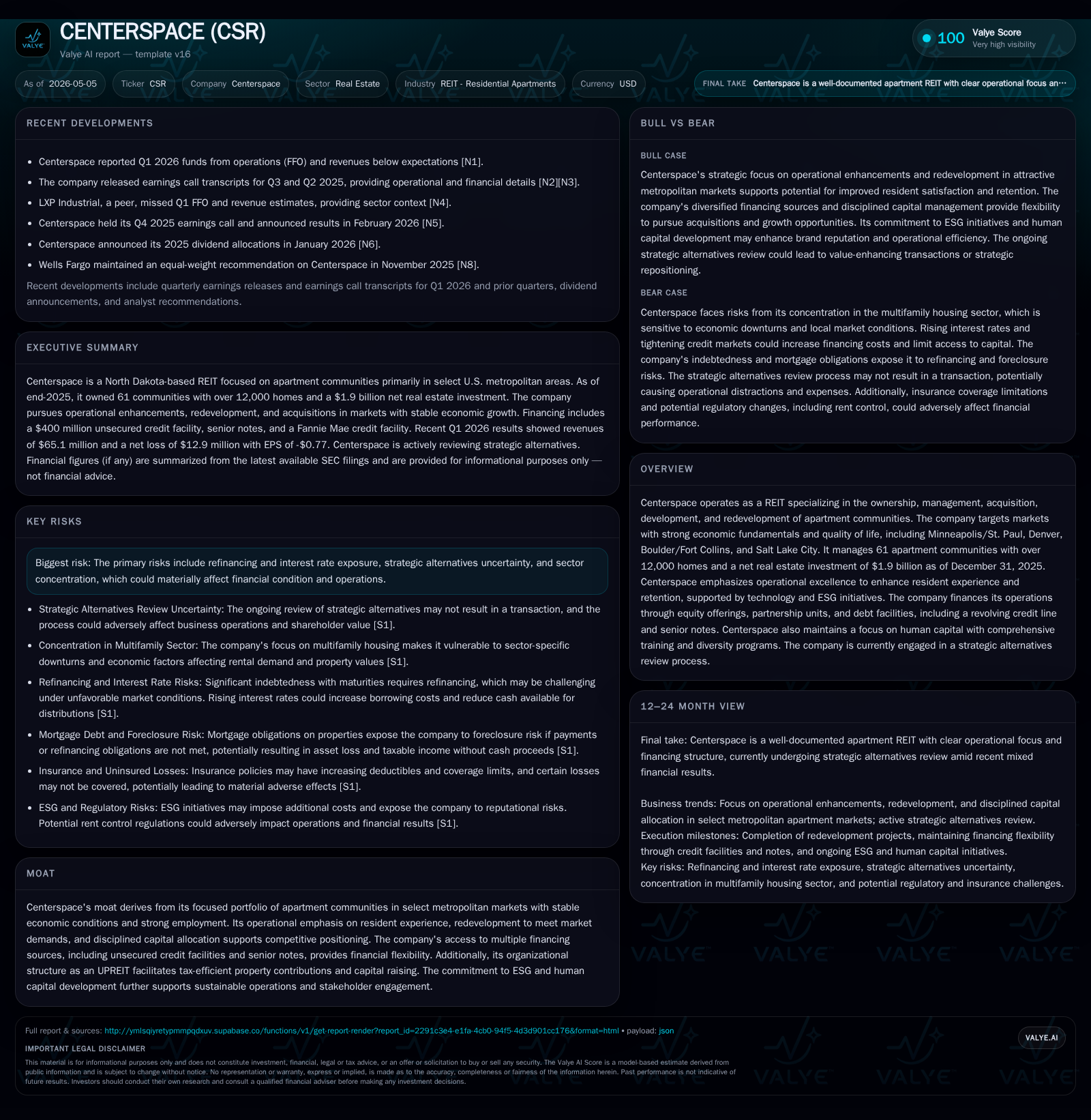
In its May 2026 quarterly filing, Centerspace disclosed a mixed operating performance with revenue and FFO below estimates, intensifying scrutiny around its ongoing strategic alternatives review. The company maintains a focused portfolio of 61 apartment communities across select Midwestern and Mountain West metros, leveraging redevelopment and operational improvements to support resident retention. While its UPREIT structure and diversified financing provide flexibility, refinancing risk and sector concentration remain critical headwinds. Key growth drivers include redevelopment projects and targeted acquisitions in strong markets but uncertainty around strategic transaction outcomes poses execution risk. Monitoring leasing trends, occupancy rates, and the resolution of the strategic review will be crucial for assessing future performance.
Latest Operating Update: Q1 2026 Performance and Strategic Alternatives
Centerspace reported its first quarter of fiscal 2026 on May 4, revealing revenue and Funds From Operations (FFO) below consensus estimates [S2][S3][N4]. Although precise figures were not restated here, external commentary confirms softness in operating income due to slower leasing velocity and higher turnover costs, which weighed on margins. This earnings miss has amplified investor focus on the company’s ongoing strategic alternatives review announced late last year [S1], which remains unresolved with no committed transaction as of the latest filings. Management articulated continued engagement with financial advisors but cautioned that the process could be prolonged and disruptive.
This juncture marks a critical inflection point where Centerspace must balance near-term operational challenges against longer-term repositioning options that may include sale, merger, or continuation of independent strategy [S1]. The announcement itself raises execution risk around capital allocation and human capital stability during what management describes as a "time-consuming" process.
Business Model: Focused Apartment REIT Operating via UPREIT Structure
Centerspace functions as a Real Estate Investment Trust (REIT), organized under North Dakota law with an Umbrella Partnership REIT (UPREIT) structure adopted in 1997 [S1]. It conducts day-to-day operations predominantly through its operating partnership, Centerspace LP, which holds all real estate assets contributed by the parent entity. The UPREIT framework enables tax-efficient property contributions from partners in exchange for partnership units redeemable for common shares or cash.
Revenue derives mainly from rental income collected across its portfolio of apartment communities—61 properties encompassing over 12,000 homes concentrated in select metropolitan areas including Minneapolis/St. Paul, Denver, Boulder/Fort Collins, and Salt Lake City [S1]. Leasing contracts are typically short term (annual leases), enabling periodic rent resets aligned with inflation or market rates but also introducing volatility linked to resident turnover.
Operational focus centers on enhancing resident experience through service quality improvements supported by technology deployment and ESG initiatives. Redevelopment efforts target repositioning older assets to meet modern amenity standards demanded by renters in competitive markets to sustain occupancy and pricing power. This mix of organic operational excellence combined with targeted acquisitions forms the core value creation engine for Centerspace.
Industry Structure and Competitive Position
Centerspace operates within the highly competitive multifamily residential sector characterized by cyclicality tied to macroeconomic factors such as employment growth, housing affordability, interest rates, and demographic trends favoring rental housing demand in urban/suburban clusters. Its geographic concentration in stable Midwestern and Mountain West metros situates it favorably against peers exposed to more volatile coastal markets but also deepens exposure to region-specific dynamics like local rent regulation or economic shifts.
Competitive advantage rests on three pillars:
- Market Selection: Investments are concentrated in metros exhibiting favorable job growth trajectories and quality-of-life indexes that enhance sustained demand.
- Operational Excellence: Emphasizing enhanced resident experience drives improved retention rates mitigating turnover costs—a key margin lever given lease terms under one year.
- Capital Structure Flexibility: Access to diverse financing sources—including revolving credit lines and senior unsecured notes—provides liquidity for opportunistic acquisitions or redevelopment capex.[S1]
However, this strategy entails tradeoffs around maintaining a focused asset base that can limit diversification benefits versus broader scale REITs with national footprints. Sector competitors increasingly invest heavily in amenity upgrades or tech-enabled services, pressuring Centerspace to maintain pace without overstretching capital.
Growth Drivers
Growth for Centerspace hinges primarily on:
Redevelopment Pipeline: Upgrading existing properties aligns supply more closely with changing resident preferences for high-quality finishes, communal spaces, and sustainability features. Active redevelopment can justify premium rents supporting NOI expansion despite broader upward pressure on operating costs.
Selective Acquisitions: Targeted purchases of communities within current markets offering accretive yield prospects underpin incremental growth while preserving geographic focus. Acquisition criteria stress economic fundamentals such as employment stability and population inflows.
Operational Enhancements: Improving tenant retention through technology-enabled property management platforms reduces vacancy duration and turnover expenses—critical given short lease durations prevalent in multifamily housing.
ESG & Human Capital Initiatives: Investments in sustainability initiatives attract socially conscious residents while comprehensive training programs enhance staff performance—both dimensions contributing indirectly to stability and brand reputation.
Risks and Watchpoints
Several risks could constrain Centerspace’s path forward:
Strategic Alternatives Uncertainty: The ongoing review may culminate in a transaction poorly received by capital markets or delayed excessively leading to organizational distraction [S1]. Failure to consummate any deal could weigh on shareholder sentiment.
Interest Rate Sensitivity: With outstanding debt exceeding $1 billion (net debt near $1.04 billion as of year-end 2025) [F1], refinancing risk amid rising interest rates could pressure margins or limit borrowing capacity for future investments.
Rent Control & Regulatory Environment: Potential introduction of rent control measures in core markets would impair rental rate growth—and consequently dividend-paying ability—posing sector-wide headwinds.
Concentration Risk: Dependence on four principal metropolitan areas heightens vulnerability should any undergo economic stress or demographic decline relative to more diversified peers.
Resident Payment Risk: Given reliance on rental income from residents’ employment-dependent ability to pay rents timely [S1], macroeconomic downturns impacting job security could increase defaults or vacancy rates swiftly due to short lease terms.
What to Watch Next
Key milestones that investors and analysts should monitor include:
- Updates concerning the strategic alternatives review timeline or outcomes; any indication of pursued transactions will materially impact valuation perception.
- Leasing metrics during peak summer months providing clarity on demand resilience amid challenging macro conditions.
- Execution progress on active redevelopment projects signaling future NOI growth potential.
- Changes in debt maturity profile or cost of borrowing reflecting refinancing environment conditions.
- Any new disclosures about regulatory developments affecting rent-setting practices within primary markets.
Financial Profile Summary
Latest financial snapshot
| Metric | Value | Period |
|---|---|---|
| Cash & equivalents | $13mm | |
| 2025-12-31 | ||
| Total debt | $1054mm | |
| 2025-12-31 | ||
| Net debt | $1041mm | |
| 2025-12-31 |
Source: SEC companyfacts cache [F1].
While operational nuances dominate the narrative currently, the financial snapshot anchors assessment of leverage capacity:
| Metric | Value (USD) | Period End |
|---|---|---|
| Cash & Equivalents | 12.8 million | |
| 2025-12-31 | ||
| Total Debt | 1.05 billion | |
| 2025-12-31 | ||
| Net Debt | ~1.04 billion | |
| 2025-12-31 |
Disclaimer: This analysis is based solely on publicly available information provided by Centerspace filings up to early May 2026 and does not constitute investment advice.
Disclaimer: This is research-only, informational analysis and not investment advice. It may include AI-generated interpretation and general industry context. Always verify important details using primary sources.

Comments