
ThredUp Strengthens Its Managed Marketplace and Technology Platform in Q1 2026
Q1 2026 results spotlight increased investment in operations and technology amid evolving financial disclosures and covenant landscapes.
In Q1 2026, ThredUp reported a 16.9% increase in operations, product, and technology expenses to $41.1 million, amounting to over half of revenue, highlighting intensified investment in its proprietary resale platform. The company’s managed marketplace model integrates technology with a customer-friendly supply acquisition process and offers Resale-as-a-Service solutions to brands, reinforcing its competitive moat. Expansion through RaaS partnerships and high buyer engagement underpin growth prospects, tempered by regulatory compliance risks and restrictive financial covenants that impose liquidity discipline. Upcoming implementation of FASB’s ASU 2024-03 will enhance operating expense transparency from 2027 onward.
Q1 2026 Operating Update and Immediate Implications
ThredUp's latest quarterly filing dated May 4, 2026 [S2] reveals a pronounced increase in operations, product, and technology expenses rising by $5.9 million or 16.9% year-over-year to $41.1 million for the three months ended March 31, 2026. This line item now represents just over half (50.3%) of revenue compared with 49.3% in the prior year quarter. Management attributes this cost escalation primarily to continued investments aimed at enhancing the company's proprietary platforms that support its managed resale marketplace. While this expenditure pressure tempers near-term margin expansion, it underscores ThredUp's commitment to technological leadership.
Liabilities related to customer site credits—virtual currency customers receive for returns—grew modestly to $4.3 million from $4.1 million at year-end but remain a significant component of accrued liabilities reflecting deferred revenue recognition until redemption [S2]. Notably, site credits establish sticky engagement loops by incentivizing repeat transactions.
An emerging accounting pronouncement relevant to ThredUp is FASB’s ASU 2024-03 (effective for fiscal years beginning after December 15, 2026) which mandates granular disaggregation of income statement expenses including labor costs, inventory consumption, depreciation, and selling expenses [S2]. This forthcoming disclosure shift will offer investors enhanced visibility into operating cost structures starting with the FY2027 reporting cycle.
ThredUp’s Business Model and Marketplace Dynamics
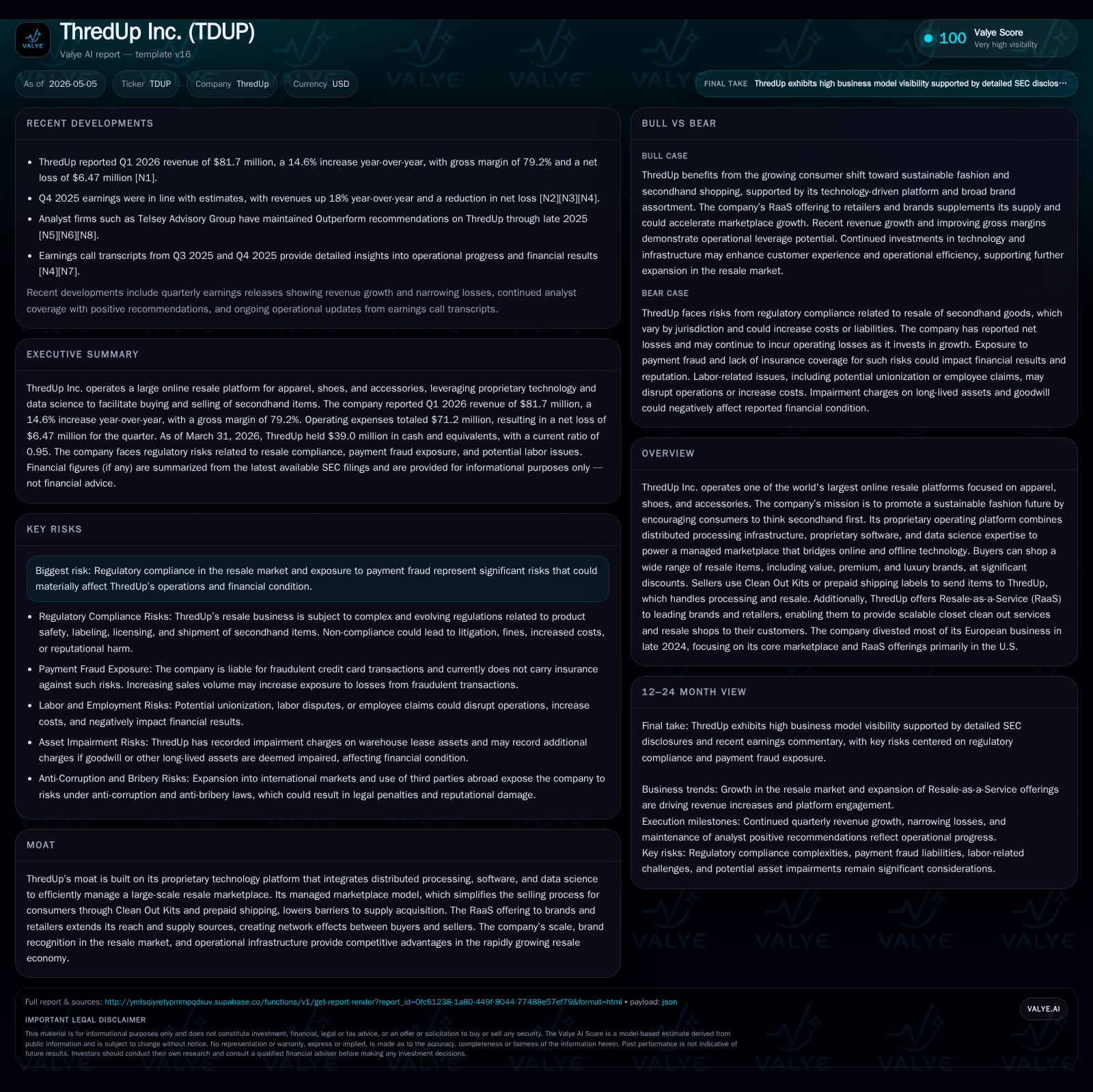
As detailed in the latest annual report [S1] and reinforced by our Valye report excerpt analysis, ThredUp operates one of the largest online apparel resale marketplaces globally. The company’s core proposition centers around facilitating consumer-to-consumer resale transactions through an integrated tech-enabled service model. Sellers engage effortlessly via Clean Out Kits or prepaid shipping labels that simplify the logistics of sending used clothing items to ThredUp's processing centers.
Back-end proprietary software coupled with sophisticated data science algorithms orchestrates inventory management across distributed processing facilities ensuring operational scale and efficiency [S1]. Buyers access a broad assortment spanning value through luxury segments at significant discounts relative to retail prices.
Additionally, ThredUp has innovated beyond consumer sales into Resale-as-a-Service (RaaS), partnering with established brands and retailers to operate scalable closet clean out services and branded resale shops integrated into partner channels. This dual-sided marketplace approach captures both supply-side inventory expansion and demand-side engagement enhancements.
Competitive Advantages Built on Proprietary Technology and Network Effects
ThredUp's moat derives from its integrated technology platform which ties together distributed processing infrastructure with sophisticated software systems managing large-scale apparel turnover efficiently. The managed marketplace lowers transaction frictions for both buyers and sellers — outsourcing cumbersome logistics like authentication, cleaning, pricing optimization, and fulfillment.
The RaaS channel extends network effects by funneling consignments from partner-branded programs into ThredUp's ecosystem. This diversifies supply beyond individual sellers alone while creating closer ties with leading retail brands looking to participate in circular fashion trends [S1]. Such network effects create barriers for entrants given the scale needed in sorting capabilities, data analytics for dynamic pricing models, and seller acquisition efficiencies.
Growth Drivers: Expanding Supply through Resale-as-a-Service and Buyer Engagement
ThredUp’s growth strategy hinges on scaling both supply acquisition through RaaS partnerships and increasing buyer monetization via enhanced engagement mechanisms [N2][S2]. Expanded RaaS contracts inject steady streams of inventory from reputable brand closets while also broadening market coverage geographically.
Additionally, site credit liabilities indicate robust usage of return credit incentives fostering loyalty and repeat orders. Higher active buyer counts recently reported support increasing order volume trajectories [S14]. Gains in processed Clean Out Kit volumes reflect improved supply pipeline health.
On the financial front, an amended loan agreement executed January 30, 2026 introduced more restrictive borrowing limits ($10 million undrawn capacity), switched interest rate benchmarks from prime plus margin to SOFR plus a higher margin floor (2.5% +3.25%), potentially elevating financing costs depending on rate volatility [S4][S24]. The agreement also imposes stringent financial covenants requiring minimum daily liquidity balances measured continuously — raising concerns about technical defaults during transient cash flow fluctuations despite overall net cash positive balance (~$21 million net cash) [F1][S24]. Noncompliance risks highlight operational flexibility constraints in capital deployment decisions versus less encumbered competitors.
Key Milestones Ahead: ASU 2024-03 Implementation and Operational Efficiency Targets
Looking ahead through late 2026 into FY2027 reporting cycles, implementation of FASB ASU 2024-03 will compel ThredUp to disclose more transparent expense breakouts which could reveal underlying cost composition nuances impacting investor assessments of scalability [S2]. Achieving expense moderation while sustaining technology platform enhancements represents a critical execution challenge given recent operational cost inflation trends.
Continued growth in RaaS participation rates and processed kit volumes will serve as pivotal KPIs signaling scaling progress alongside buyer retention metrics leveraged through site credit utilization patterns.
Compact Financial Snapshot: Liquidity, Debt Structure, and Expense Trends
Latest financial snapshot
| Metric | Value | Period |
|---|---|---|
| Cash & equivalents | $39mm | |
| 2026-03-31 | ||
| Total debt | $18mm | |
| 2026-03-31 | ||
| Net debt | $-21mm | |
| 2026-03-31 | ||
| Current assets | $60mm | |
| 2026-03-31 | ||
| Current liabilities | $64mm | |
| 2026-03-31 | ||
| Current ratio | 0.95x | |
| 2026-03-31 |
Source: SEC companyfacts cache [F1].
| Metric | Value | Period End |
|---|---|---|
| Cash & Equivalents | $38.996 million | |
| 2026-03-31 | ||
| Total Debt | $18.000 million | |
| 2026-03-31 | ||
| Net Debt | -$20.996 million | |
| 2026-03-31 | ||
| Current Assets | $60.385 million | |
| 2026-03-31 | ||
| Current Liabilities | $63.699 million | |
| 2026-03-31 | ||
| Current Ratio | 0.95 | |
| 2026-03-31 |
ThredUp maintains a healthy net cash position supported by nearly $39 million of liquid assets against total debt of $18 million [F1]. The current ratio at quarter-end stands at 0.95, reflecting working capital dynamics influenced by accrued liabilities including site credits ($4.3 million) and other accrued liabilities [F1][S2]. The company’s debt facility amendment increases interest rate risk exposure under SOFR referencing terms at potentially elevated margins compared with prior prime-based costs [S4]. Covariance breaching potential due to daily liquidity minimums adds an execution watchpoint during tight cash flow periods.
Overall expense expansion emphasizes the tradeoff between investing aggressively in scalable platform infrastructure versus near-term profitability pressures as ThredUp strives to consolidate its leadership position within the growing circular fashion economy.
This analysis synthesizes publicly filed regulatory disclosures as of May 4th/5th 2026 without offering investment advice or projections outside sourced information or explicit company statements.
Disclaimer: This is research-only, informational analysis and not investment advice. It may include AI-generated interpretation and general industry context. Always verify important details using primary sources.

Comments