
Cantor Equity Partners III Advances Merger Plans with AIR; What Investors Should Know
The company’s latest quarterly report reaffirms progress toward closing its business combination with AIR amid standard SPAC timeline pressures.
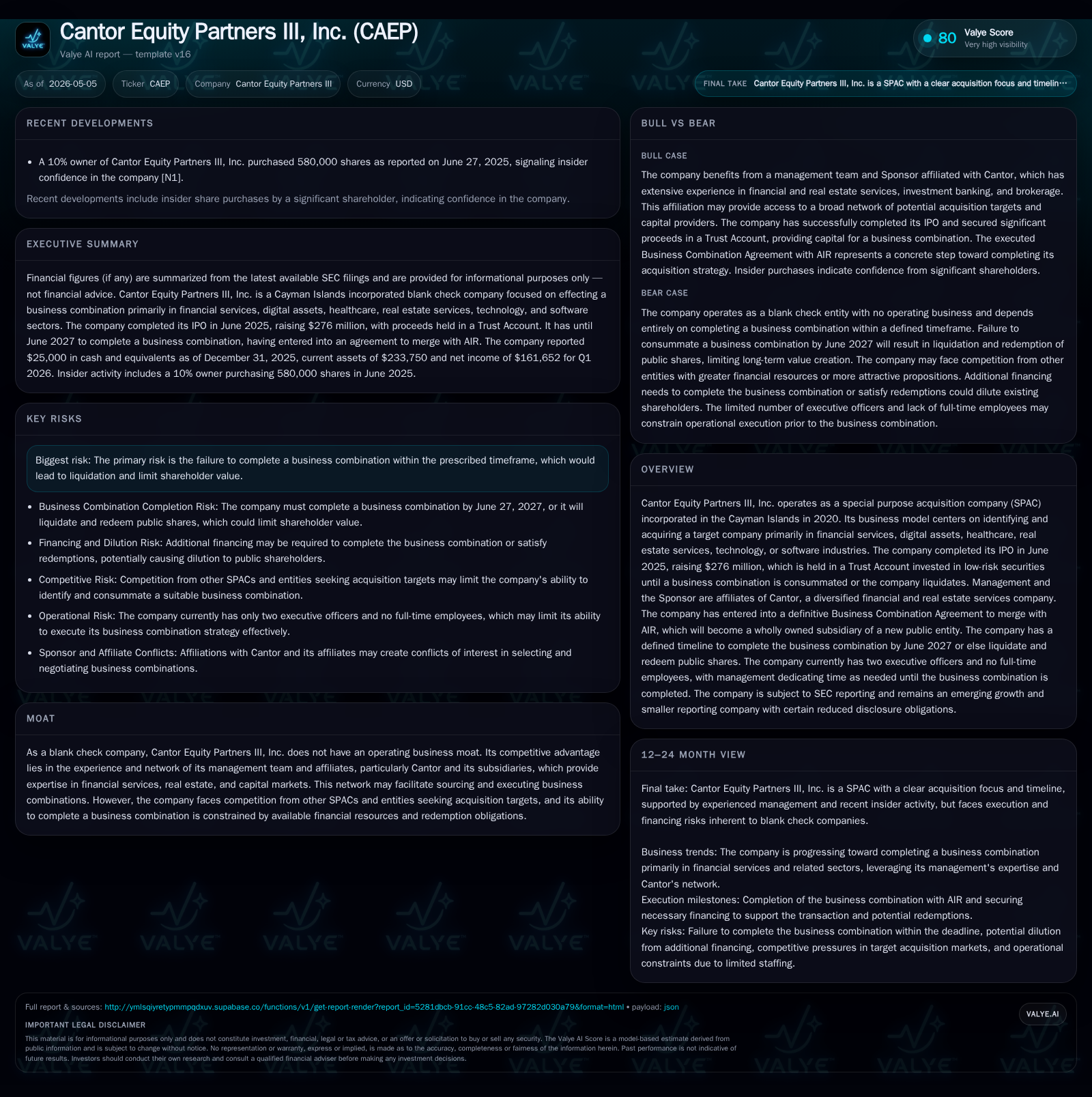
Cantor Equity Partners III, Inc. (“CAEP”) remains on course to complete its announced business combination with AIR by the June 2027 deadline, as confirmed in its May 4, 2026 quarterly filing. CAEP’s SPAC structure centers around a trust-held capital base raised in mid-2025 and benefits from the extensive network and expertise of Cantor affiliates. The impending merger with AIR represents the primary growth catalyst, transforming CAEP from a blank check shell into an operating company. Key risks include the deadline-driven liquidation risk and redemption impacts on deal economics. Investors should monitor upcoming shareholder vote approvals and closing condition announcements as defining milestones.
Latest Quarterly Update and Its Significance
Cantor Equity Partners III’s most recent SEC filing—a Form 10-Q submitted on May 4, 2026—provides crucial affirmation that the company is progressing per plan toward consummating the anticipated business combination with AIR Limited (the "AIR Business Combination"). Importantly, the filing notes there are no material changes to previously disclosed risk factors nor any operational impediments that would delay closing [S2]. This absence of new risk disclosures signals management’s compliance rigor and ongoing adherence to the planned regulatory schedule.
The quarterly update further reconfirms shareholders retain their redemption rights consistent with the original IPO documentation, underscoring that any business combination will be subject to extensive shareholder scrutiny and potential redemptions—standard for SPAC structures but critical given the potential impact on deal economics [S2]. This filing serves as a deterministic checkpoint showing steady operational status heading into what remains a highly time-sensitive transaction phase.
Cantor Equity Partners III’s SPAC Business Model and Sponsor Ecosystem
Cantor Equity Partners III operates as a Cayman Islands exempted company formed explicitly as a special purpose acquisition company (SPAC), raising gross proceeds of approximately $276 million in its June 2025 initial public offering (IPO) through issuance of Class A ordinary shares at $10 per share [S1]. Concurrently, sponsor-affiliated private placement shares contributed approximately $5.8 million more capital. This capital is deposited in a Trust Account consisting mainly of low-risk investment securities until released for the closing of a business combination or upon liquidation if no combination occurs by the deadline.
The fundamental business model here involves deploying this capital to merge with an operating company—in this case AIR—transforming CAEP from a blank check vehicle into an active market-listed enterprise in targeted sectors including financial services, digital assets, healthcare, real estate services, technology, and software [S1]. The upshot is that CAEP itself does not generate operating revenues or products prior to merger; rather it monetizes through successful identification and acquisition of a suitable target.
What differentiates CAEP is its affiliation with Cantor Group—a diversified financial services firm with deep roots in middle-market investment banking (via CF&Co.), brokerage technology (BGC Group), and commercial real estate services (Newmark Group). This relationship enhances deal sourcing potential via proprietary networks across financial technologies and real estate markets but also introduces complexities in balancing multiple Cantor-sponsored SPACs seeking overlapping acquisition opportunities [S1]. The Sponsor's capabilities bring strategic value but also require careful conflict management given the multiple affiliated vehicles concurrently pursuing deals.
Competitive Considerations in the SPAC Market and Strategic Positioning
The broader SPAC landscape remains intensely competitive, especially within sectors favored by Cantor such as financial technology and real estate services—areas that have drawn robust investor interest but also abundant capital chasing quality targets. CAEP’s advantage arises from both its Cantor-backed management team's proven acquisition acumen and access to cross-sector industry insights from affiliate companies.
However, this advantage is balanced against structural constraints inherent to all SPACs: finite timelines (CAEP must close by June 27, 2027), potential dilution from redemption activity, limited capital relative to larger institutional sponsors, and reputational challenges arising from the overall market's evolving regulatory scrutiny of blank check companies [S1][S6]. Furthermore, internal prioritization rules restrict officers’ ability to engage simultaneously in multiple Cantor-sponsored deals unless allocated fairly among entities based on timing of IPOs [S1], which can limit flexibility.
Investors should view CAEP’s position within this crowded ecosystem as solidly middling—backed by infrastructure but facing typical deal competition intensified by multiple affiliated vehicles from its own sponsor group.
Growth Catalysts: The AIR Business Combination and Market Potential
The linchpin growth catalyst for CAEP undeniably stems from its November 7, 2025 definitive Business Combination Agreement with AIR Limited and associated entities. Upon consummation—the Mergers will structure AIR as a wholly owned subsidiary beneath a new public parent entity (Pubco)—the formerly shell corporation CAEP transitions into an operating company with meaningful business operations spanning sectors aligned with investor interest [S6][S11].
The deal consideration contemplates both cash contributions from the Trust Account alongside equity issued to existing AIR shareholders structured on specific exchange ratios tied to valuation metrics approximating $1.456 billion adjusted for various factors at closing [S26]. This mix offers flexibility for structuring incentives aligned with post-merger growth strategies including potential earnouts tied to share price milestones over five-year horizons.
While detailed operational forecasts remain confidential pending registration statement filings still anticipated post-quarterly period end [S24], the transformation implicit in converting CAEP into Pubco-owned AIR suggests unlocking value through capital markets access for AIR’s underlying businesses. This also enables potential expansion via acquisitions financed through equity or debt raised contemporaneously or subsequently to the combination completion [S20]. Thus growth is predominantly structural: linkage of blank check IPO proceeds mobilized through structured M&A into an operating platform across relevant high-growth verticals.
Risks and Near-Term Challenges Ahead of Completion Deadline
Crucially, all growth hinges on timely transaction execution before CAEP’s contractually mandated business combination deadline set for June 27, 2027. Failure to close by then mandates orderly dissolution of operations coupled with full redemption of public shareholders at per-share Trust Account values—which could truncate upside permanently for investors who remain holders prior to liquidation events [S6][S2].
This deadline risk remains existential—no further extensions without shareholder approval exist—which injects urgency but also pressure that may influence negotiation dynamics with AIR or other candidates if fallback plans are contemplated. Redemption rights further complicate economics: elevated redemptions dilute public float post-merger potentially depressing stock liquidity while also increasing required cash funding thereby squeezing transaction feasibility margins.
Moreover, regulatory uncertainties affecting SPAC transactions persist broadly—including heightened SEC scrutiny over disclosure adequacy around conflicts of interest among affiliated sponsors or target diligence—that could impose delays or additional costs preventing smooth closing [S8][S1].
These events represent critical decision nodes impacting whether the transaction closes successfully or defaults into liquidation scenarios.
Summary Financial Profile Supporting Operational Context
Reflecting its SPAC nature pre-combination, CAEP carries a minimal balance sheet comprising mostly Trust Account assets earmarked exclusively for the Business Combination. As of September 30, 2025, total reported debt stood at zero reflecting no leverage use during pre-acquisition phase, and net debt was negative $25 million indicating a net cash position [F1]. Cash & equivalents were approximately $25 thousand as of December 31, 2025 [F1]. Current assets measured late Q1 ended March 31, 2026 totaled roughly $233.8 million reflecting funds held primarily as short-term investments under Trust Account rules limiting risk exposure while awaiting transaction closure [F1]. This conservative balance sheet posture aligns fully with SPAC norms designed to preserve principal capital until merger consummation.
No operational income exists at this stage consistent with zero operating business lines recorded (-$2.3 million operating loss reported annually attributable primarily to administrative overhead), while last reported net income was positive due largely to non-cash accounting items—a pattern standard among blank check companies prior to their first acquisition step [F1].
In sum, CAEP’s financial structure provides adequate liquidity solely focused on efficiently executing its planned transformative acquisition rather than supporting standalone operations.
Disclaimer: This analysis presents factual descriptions based on publicly filed SEC documents without offering investment advice or recommendations. Readers should conduct further independent due diligence before making any decisions regarding holdings in Cantor Equity Partners III or related securities.
Disclaimer: This is research-only, informational analysis and not investment advice. It may include AI-generated interpretation and general industry context. Always verify important details using primary sources.

Comments