
Apple Hospitality REIT Advances Strategic Asset Management and Capital Structure in Q1 2026
The Q1 2026 filing highlights modest asset dispositions, robust liquidity, and proactive credit facility amendments underscoring Apple Hospitality’s disciplined growth approach.
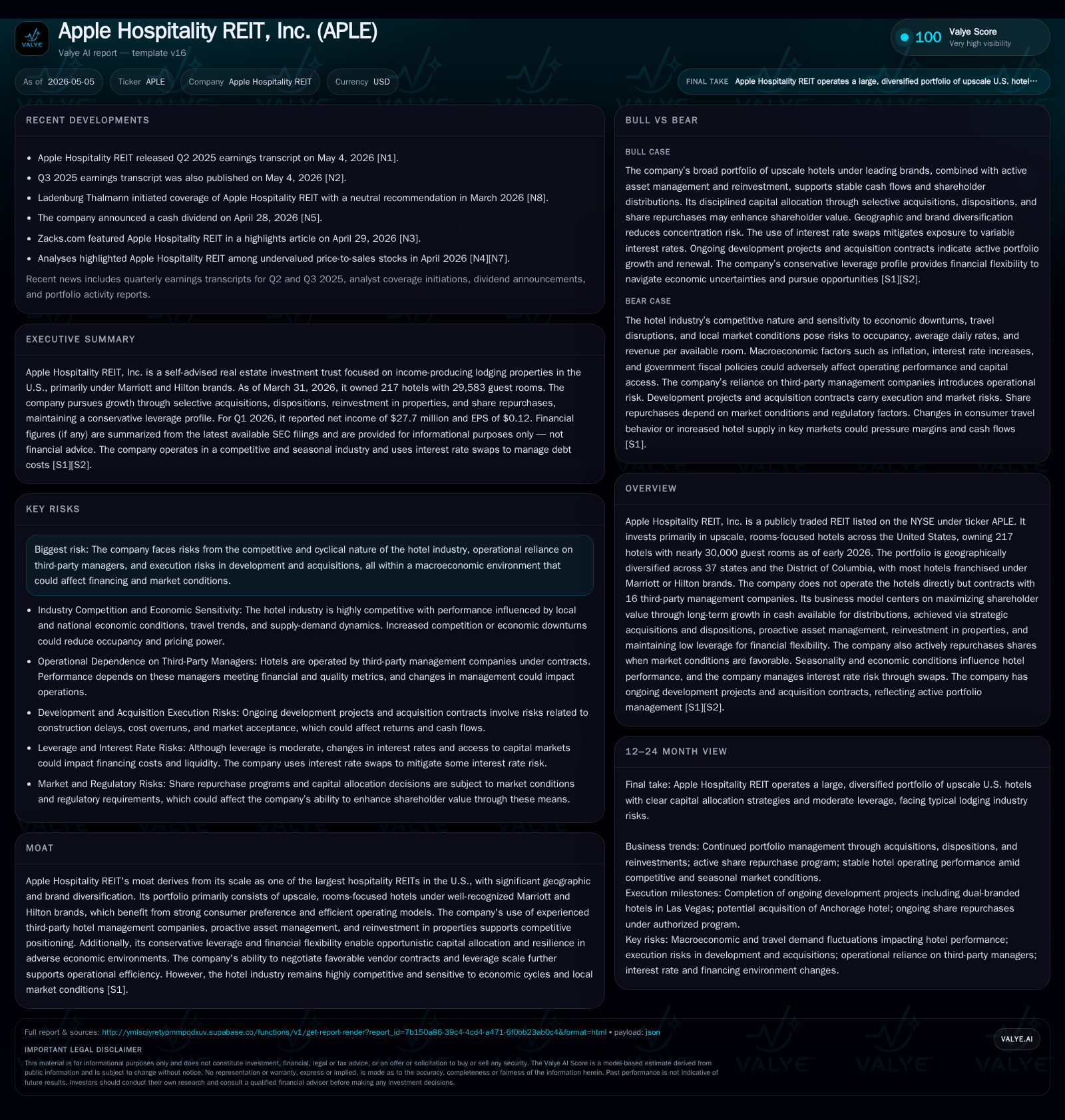
Apple Hospitality REIT's first quarter of 2026 reaffirmed its commitment to a conservative financial posture and targeted portfolio management, evidenced by minor property sales that do not shift strategic focus. The company benefits from substantial revolving credit availability and recent amendments reducing borrowing costs, positioning it well for opportunistic acquisitions and reinvestments. As a major player in the U.S. upscale lodging segment with diversified geography and strong franchise partnerships, APLE leverages third-party management to optimize asset performance. Key risks remain industry cyclicality and refinancing needs ahead of mid-year debt maturities.
Latest Quarterly Operating Update Highlights
In its Q1 2026 SEC Form 10-Q filing dated May 4, Apple Hospitality REIT disclosed the sale of one hotel that had been classified as held for sale as of March 31, 2026. This transaction follows prior dispositions in 2025 but notably does not signal any strategic shift in the company's portfolio management approach or operational focus. The divestiture is small-scale relative to APLE's vast portfolio comprising over 200 properties [S2].
Financially, Apple Hospitality commands significant liquidity and access to capital with approximately $558.8 million available under its $650 million unsecured Revolving Credit Facility which matures July 25, 2026. While the company retains the option to extend this facility by up to one year subject to covenants and fees, management has stated plans to actively pursue refinancing before maturity [S2][S7]. Importantly, recent amendments to this facility and other unsecured term loans have removed a previously embedded 0.10% SOFR spread adjustment (with exception of the $385 million term loan), effectively lowering borrowing costs in an environment marked by elevated interest rates [S6][S7].
These liquidity attributes underpin APLE's ability to sustain distributions and execute its capital allocation strategy amid uncertain macroeconomic conditions.
Business Model: Portfolio Composition and Management Strategy
Apple Hospitality REIT specializes exclusively in U.S.-based upscale lodging assets focused primarily on hotel rooms rather than ancillary services like food or event hosting. As of late December 2025–the latest full fiscal year reference point–the company owned 217 hotels encompassing nearly 30,000 guest rooms geographically spread across 37 states plus D.C., providing broad market diversification against localized demand shocks [S1].
Strategically, APLE franchises most hotels under some of the largest global hospitality brands—Marriott International and Hilton Worldwide—which provide significant consumer brand equity that translates into higher occupancy rates and RevPAR (Revenue per Available Room). This franchise alignment also reduces operating risk since Apple Hospitality contracts out property management responsibilities to a network of sixteen independent third-party operators rather than running hotels directly themselves [S1]. These third-party agreements include performance benchmarks incentivizing operational improvements.
Proactive asset management is central to APLE’s business model: management regularly evaluates hotel operating results using extensive benchmarking against internal company data and external market intelligence. This enables targeted interventions such as renovating properties or changing managers to enhance profitability. Additionally, scale advantages facilitate better vendor contract negotiations across the portfolio.
Capital reinvestment has historically averaged above $75 million annually with plans for $80-$90 million in renovations during calendar year 2026 alone—including comprehensive upgrades at approximately twenty-one properties—to maintain competitiveness within their respective markets [S4]. By consistently refreshing assets within an upscale segment favored by business travelers and leisure guests alike, APLE secures sustainable cash flow growth.
Competitive Dynamics and Industry Positioning
The U.S. hotel industry is characterized by fragmentation at the local level but increasing concentration in branded upscale categories dominated by Marriott, Hilton, Hyatt, among others. APLE’s focus on upscale rooms-focused hotels positions it competitively where brand recognition strongly influences consumer booking decisions—a notable pricing power advantage relative to unbranded or limited-service hotels.
While external economic factors heavily influence lodging demand due to discretionary travel expenditures' sensitivity to cycles, Apple Hospitality's geographic diversification mitigates localized economic downturns or tourism disruptions. Franchise arrangements impose constraints but also confer switching costs given brand standards maintenance requirements which foster stickiness. Third-party management contracts broaden operational expertise but introduce execution risk variability depending on manager effectiveness.
Industry-wide challenges include volatile labor costs (especially post-pandemic wage pressures), competition from alternative accommodation platforms like Airbnb (primarily outside luxury/full-service segments), and rising interest rates impacting financing affordability.
Growth Drivers: Capital Allocation and Asset Reinvestment
The cornerstone growth vector for Apple Hospitality remains disciplined capital deployment emphasizing opportunistic acquisitions financed through a substantial revolving credit line supplemented by strategic dispositions optimizing portfolio composition [S1][S27]. The approximately $559 million undrawn credit capacity at quarter end enables swift response to value-enhancing acquisition targets without reliance on dilutive equity issuance under current cost-of-capital conditions [S2][S7].
Reinvestment in existing assets—namely renovations—is a key organic growth driver bolstering RevPAR trends beyond inflationary gains by elevating guest satisfaction scores coupled with tactical repositioning strategies within individual markets [S4]. Renowned brands’ marketing engines further amplify this effect.
Numerous manager reviews or transitions occur leveraging analytics-informed assessments aimed at boosting net operating income margins via efficiency improvements or top-line revenue enhancement efforts executed by selected contractors skilled within brands’ frameworks.
Additionally, share repurchase activity continues as a tactical capital return mechanism during times when common shares trade below intrinsic NAV; an extended repurchase authorization through mid-2026 underscores ongoing readiness to capitalize should valuation gaps recur [S21][S27].
Risks and Constraints: Industry Cyclicality and Managerial Execution
Despite a fundamentally sound portfolio strategy, Apple Hospitality faces inherent cyclical exposures linked to macroeconomic fluctuations affecting consumer travel budgets which impinge occupancy rates and average daily rates (ADR) leading directly to volatile revenues within hospitality sectors [S25]. Unexpected recessions or geopolitical events could intensify these dynamics.
Operationally, reliance on multiple external hotel management firms introduces risks related to inconsistent execution quality or misaligned incentives despite contractual safeguards; positive outcomes require continuous oversight from corporate asset managers proactively adjusting arrangements where beneficial [S1][S25].
Legislative changes impacting tax treatment of REITs or hospitality-specific regulatory shifts represent non-operational risks that could affect profitability though currently no material proceedings are pending against the company [S25].
Looking Ahead: Key Milestones and Performance Indicators
Market participants should closely monitor resolution outcomes regarding refinancing initiatives ahead of mid-2026 revolving credit facility maturity since successful execution will underpin short-term liquidity confidence [S2][S3]. Progress reports on large-scale renovation projects slated for completion throughout remainder of CY2026 will offer clarity on their impact toward driving RevPAR improvements.
Occupancy trends post-renovations provide leading indicators of sustained competitiveness versus peer sets especially within select metropolitan clusters featuring multiple Apple Hospitality assets under different brands managed externally but coordinated corporately.
Further acquisitions or dispositions disclosed would signal continued tactical portfolio optimization aligning with stated objectives while share repurchase cadence announcements remain barometers for perceived stock valuation vis-à-vis intrinsic hotel asset values accompanied by macro environment assessments [N1][N3].
Financial Snapshot: Leverage, Liquidity, and Capital Flexibility
Latest financial snapshot
| Metric | Value | Period |
|---|---|---|
| Cash & equivalents | $7.8mm | |
| 2026-03-31 | ||
| Total debt | $1,572mm | |
| 2026-03-31 | ||
| Net debt | $1,564mm | |
| 2026-03-31 |
Source: SEC companyfacts cache [F1].
| Metric | Value |
|---|---|
| Net Debt (March 31, 2026) | $1.56 billion |
| Cash & Equivalents | $7.8 million |
| Availability under Revolving Credit Facility | $558.8 million |
As documented at March-end quarter close per latest filing disclosures including adjustments from credit agreement amendments removing SOFR spread surcharges (except on only one term loan tranche), Apple Hospitality sustains a conservative net leverage profile supportive of future capital maneuvering in dynamic cycle conditions [F1][S2][S6][S7].
In summary, Apple Hospitality REIT’s Q1 update evidences steady progress executing its core business philosophy blending scale-driven portfolio coherence with flexible financial engineering amidst evolving lodging industry cycles requiring vigilance around upcoming debt maturities.
This analysis synthesizes information strictly from public SEC filings as of May 4, 2026 ([S1]-[S29]) combined with factual company data ([F1]) without speculative assumptions or forecasts beyond cited evidence. It does not constitute investment advice.
Disclaimer: This is research-only, informational analysis and not investment advice. It may include AI-generated interpretation and general industry context. Always verify important details using primary sources.

Comments