
Transcode Therapeutics Secures Flexible $14 Million Equity Commitment to Advance RNA-Based Oncology Pipeline
A new Standby Equity Purchase Agreement enhances funding flexibility for advancing clinical-stage RNA cancer therapies.
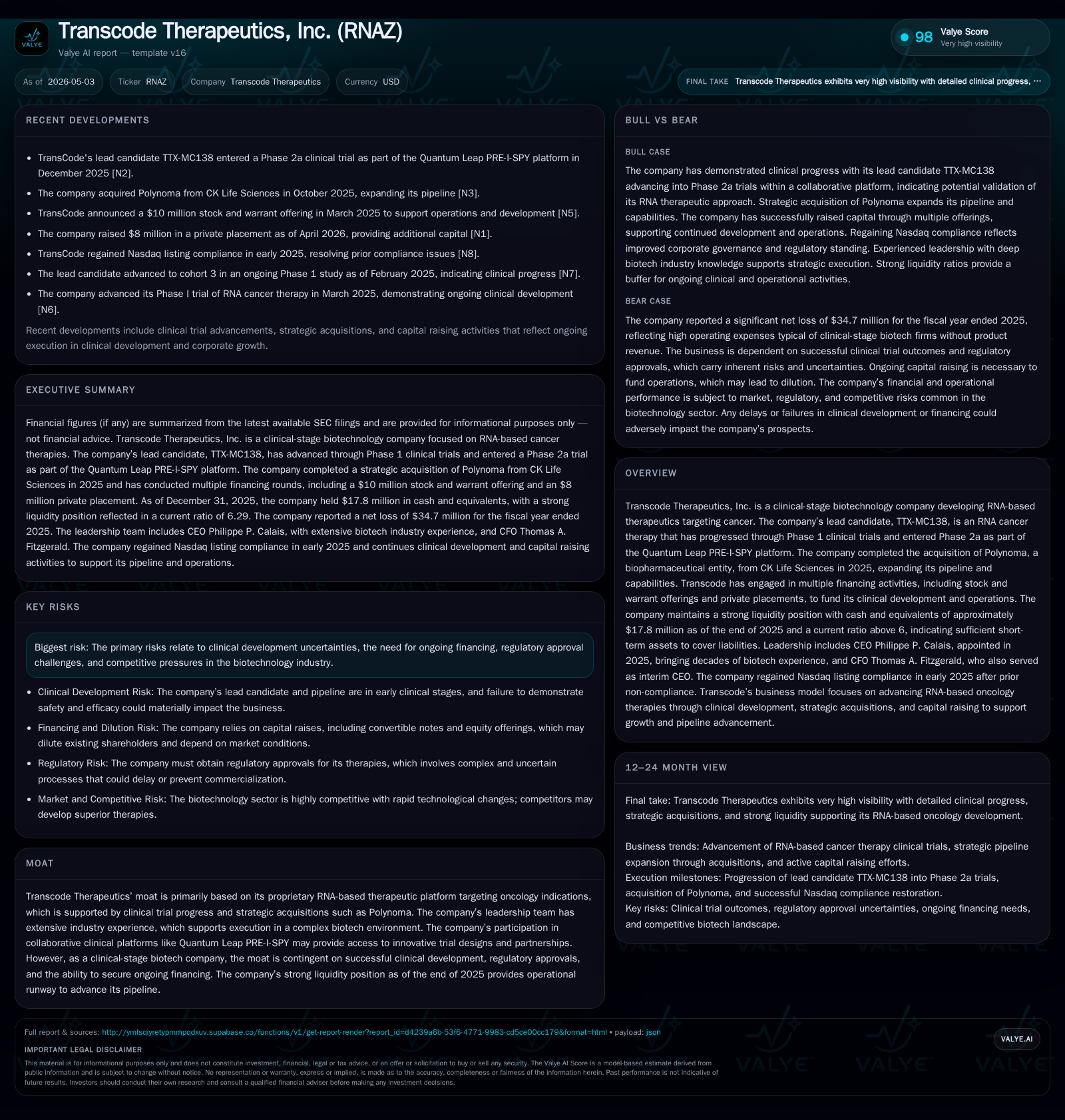
Transcode Therapeutics entered a $14 million Standby Equity Purchase Agreement with Yorkville, providing strategic capital to support its late-stage RNA-based oncology programs. The company is progressing its lead candidate, TTX-MC138, in Phase 2a clinical trials through the Quantum Leap PRE-I-SPY platform, while expanding its pipeline via the acquisition of Polynoma. With a strong liquidity position and extended financing options via convertible notes and preferred stock arrangements, Transcode aims to advance its innovative RNA therapeutics amid inherent developmental uncertainties and competitive pressures in biotech.
Recent Operating Update: Strategic Financing Bolstering Clinical Development
On April 6, 2026, Transcode Therapeutics finalized a pivotal Standby Equity Purchase Agreement (SEPA) with YA II PN, Ltd., granting the company the right to draw up to $14 million by selling shares of its common stock over time [S3]. This flexible financing mechanism enables Transcode to strategically tap public-market capital without undertaking a broad public offering immediately. Proceeds from equity sales under this arrangement will help fund ongoing clinical trials and operations related to their RNA-based therapeutic pipeline.
The SEPA terms include issuance limits—the total shares issuable cannot exceed approximately 19.99% of outstanding shares prior to SEPA execution unless stockholder approval is obtained [S3]. Additionally, Yorkville’s ownership is capped at under 10%, preserving governance balance. To supplement liquidity further, Transcode issued convertible promissory notes accruing interest at an annual rate of 5%, escalating sharply upon events of default [S3]. Maturities for these notes are set on an 18-month horizon with options for two six-month extensions.
This financing flexibility complements previous capital raising efforts including private placements announced earlier in April 2026 [N1], demonstrating continuous access to strategic investors despite typical biotech sector volatility.
Business Model: RNA-Based Oncologic Therapeutics from Pipeline Innovation to Clinical Validation
Transcode operates as a clinical-stage biotechnology company specializing in developing novel RNA-based therapies targeting various cancers [S1]. Unlike traditional small molecules or antibody therapies, Transcode’s approach leverages synthetic RNA modalities designed to modulate gene expression selectively within tumor microenvironments.
Revenue generation currently hinges on successful advancement of their pipeline candidates toward regulatory approval. The lead asset TTX-MC138 targets oncology indications and has progressed from Phase 1 studies into a Phase 2a trial under the Quantum Leap PRE-I-SPY multicenter platform—an innovative collaborative framework accelerating trial design efficiency and data sharing [S1][S23]. Participation in this collaborative offers not only expedited evidence generation but also lower trial costs compared to traditional approaches.
In November-December 2025, Transcode expanded its pipeline through the acquisition of Polynoma, enhancing depth in immuno-oncology capabilities [S8]. Moreover, in early March 2026, it secured an exclusive licensing agreement with Unleash Immuno Oncolytics to integrate preclinical genetically-engineered adenovirus candidates designed for targeted cancer immunotherapy—broadening their RNA-centric portfolio into virus-mediated immune modulation [S9][S17].
Despite lacking commercial revenues at this stage, Transcode’s business model relies heavily on ongoing financings such as equity offerings (both common and preferred), convertible notes, and strategic alliances that underpin research operations and clinical endeavors.
Industry Structure and Competitive Positioning
The biotechnology industry focusing on RNA therapeutics for oncology is intensely competitive but rapidly evolving due to transformative advances in RNA biology and delivery technologies. Key competitors range from established pharma companies investing heavily in mRNA platforms (e.g., Moderna, BioNTech) to emerging biotech firms pioneering novel RNA interference or aptamer therapies.
Transcode positions itself within this landscape as a specialized innovator emphasizing cancer-specific RNA modalities coupled with partnerships like Quantum Leap that enhance clinical access and credibility. The acquisition of Polynoma and licensing agreements help differentiate the company by expanding mechanistic diversity across gene modulation and viral immunotherapy vectors.
Execution risk remains elevated due to the early clinical stage of many assets; however, this phase also offers potential for substantive valuation growth upon positive efficacy signals or breakthrough designations. Transcode’s substantial cash reserves and limited traditional debt load afford operational stability compared with some peer emerging biotechs more reliant on frequent dilutive financing rounds.
Growth Drivers
- Clinical Advancement of Lead Candidate: Transitioning TTX-MC138 through Phase 1 safety data into Phase 2a efficacy exploration is vital. Success here can underpin subsequent late-stage development or partnership/licensing deals.
- Collaborative Trials via Quantum Leap: Participation enables adaptive trial designs that could substantially shorten timelines or allow seamless combination studies enhancing product attractiveness.
- Pipeline Expansion via M&A and Licensing: The acquisition of Polynoma (completed in late 2025) plus licensing adenoviral programs from Unleash complements organic R&D output with externally derived candidates for broader anti-cancer activity.
- Robust Financing Instruments: The newly executed SEPA provides ready access to up to $14 million in flexible capital alongside convertible note structures—critical enablers for sustained R&D spending without immediate heavy dilution.
- Regulatory Milestones: Successful IND amendments submissions and approvals pave the way for trial initiations; regulatory feedback can expedite development cycles for both lead drugs and ancillary pipeline assets.
Risks and Watchpoints
- Clinical Development Risk: As with all biotech firms at this stage, failure of clinical trials or adverse safety outcomes could materially impair future prospects.
- Financing Dilution & Investor Approval Dependencies: Shareholder consent is required for share issuances beyond certain thresholds under SEPA; failure may constrain capital access. Convertible note default provisions carry risks including elevated interest rates or accelerated payments [S3].
- Regulatory Approval Challenges: The complex FDA approval process for RNA therapeutics remains uncertain; delays or additional data requests could hinder timelines.
- Competitive Landscape Intensity: Rapid innovation elsewhere raises barriers for differentiation; larger competitors possess deeper pockets potentially outspending smaller players.
- Market Acceptance & Reimbursement: Even if approved, uptake depends on payer coverage decisions given novel modality nature impacting commercial viability long-term.
What to Watch Next
- Updates on enrollment progress and interim data readouts from the Phase 2a Quantum Leap PRE-I-SPY study featuring TTX-MC138.
- Outcomes of stockholder meetings regarding Yorkville Issuance Approval allowing share issuances above current caps.
- Effectiveness of registration statements following April filing deadlines tied to equity sale rights granted by SEPA [S22].
- Further pipeline expansions via potential acquisitions or licensing agreements extending beyond current licensed adenoviral program.
- Regulatory milestones such as IND amendments or fast track designations influencing clinical momentum.
- Management commentary on cash burn rates vis-à-vis capital raised through convertible note conversions or private placements announced earlier in Q1–Q2’26 [N1].
Financial Snapshot (As of FY Ending December 31, 2025) [F1]
Latest financial snapshot
| Metric | Value | Period |
|---|---|---|
| Cash & equivalents | $18mm | |
| 2025-12-31 | ||
| Current assets | $22mm | |
| 2025-12-31 | ||
| Current liabilities | $3mm | |
| 2025-12-31 | ||
| Current ratio | 6.29x | |
| 2025-12-31 |
Source: SEC companyfacts cache [F1].
- Note: Debt figure is best-effort from mid-2021; recent filings indicate incremental convertible notes issuance adding complexity [S3].
Transcode closed FY2025 with solid liquidity positioning characterized by substantial cash coverage of short-term liabilities and limited traditional debt load. Operational losses reflect ongoing investment into clinical development typical for clinical-stage biotechs without product sales.
This analysis reflects currently available SEC filings through early April 2026 alongside complementary market intelligence without inferring investment opinions. Given inherent uncertainties associated with early-stage biotech operations — including regulatory pathways and financing environments — continuous monitoring of upcoming milestones remains essential.
Disclaimer: This is research-only, informational analysis and not investment advice. It may include AI-generated interpretation and general industry context. Always verify important details using primary sources.

Comments