
SES AI Corp Strengthens Liquidity and Faces Legal Headwinds in Q1 2026
SES AI Corporation’s first-quarter report highlights solid liquidity amid an ongoing class action lawsuit, reflecting both operational resilience and legal risk.
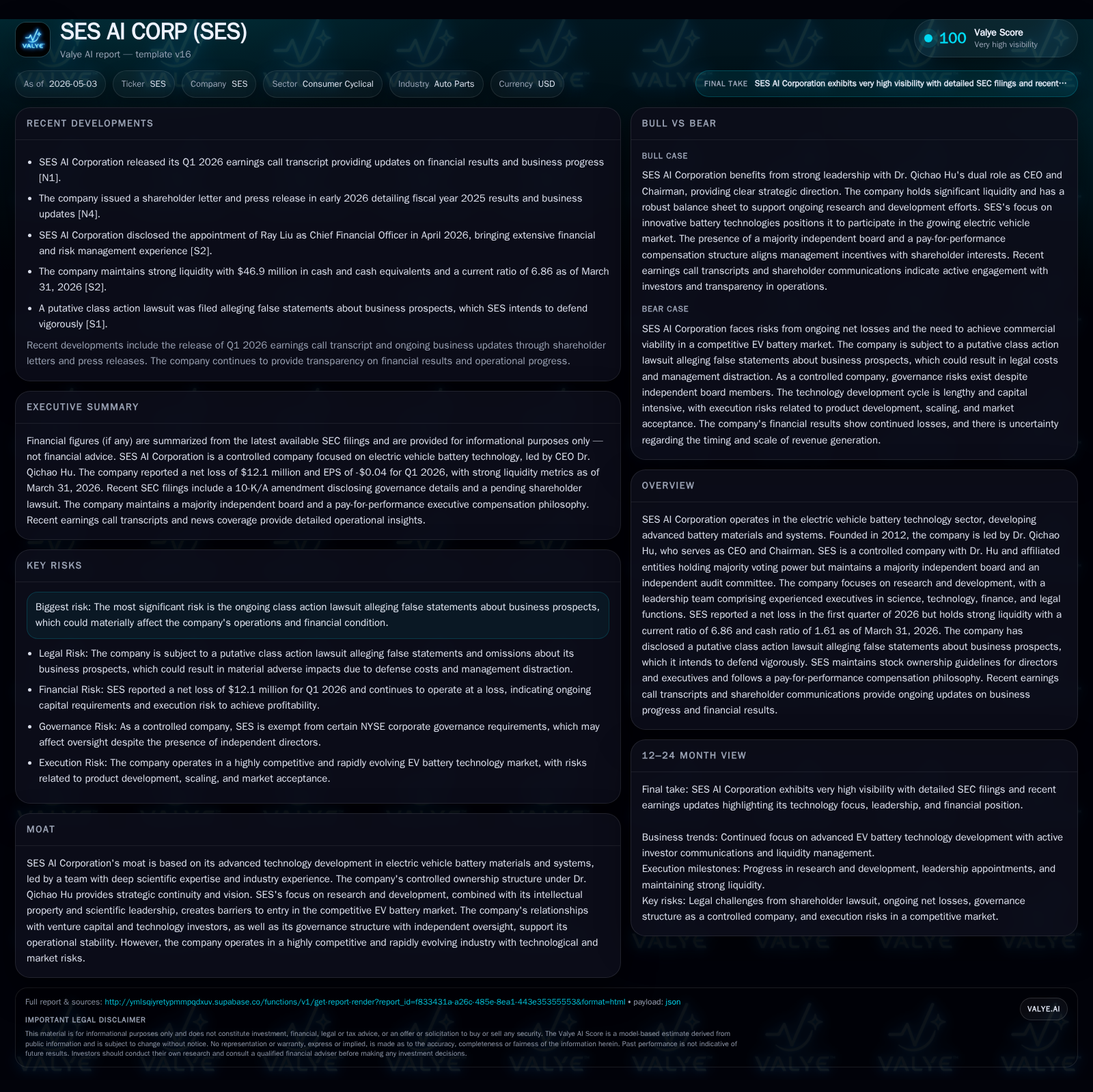
SES AI Corporation reported a net loss for Q1 2026 but maintains strong liquidity, with a current ratio near 7 and minimal debt as of March 31, 2026. The company continues to advance its electric vehicle battery material technologies, supported by deep R&D and controlled ownership under its CEO Dr. Qichao Hu. It faces significant legal risk from a putative class action lawsuit alleging false statements about business prospects. While the competitive EV battery materials market remains challenging, SES’s scientific leadership and potential partnerships underpin growth opportunities. Upcoming indicators include technology commercialization progress and lawsuit developments.
Latest Quarterly Operating Update: Key Takeaways from Q1 2026
SES AI Corporation’s recent Form 10-Q filing for the quarter ended March 31, 2026 delineates a continuation of operating losses reflective of its research-intensive phase but simultaneously underscores a robust liquidity position critical for sustaining long-term innovation efforts [S2]. The company reported no material changes to its previously disclosed risk factors during the quarter, maintaining consistency in its operating environment.
As of the quarter-end, SES held approximately $46.9 million in cash and equivalents against a nominal total debt balance near $709 thousand, yielding an approximately -$46.2 million net debt position [F1]. Current assets stood at $200.57 million versus current liabilities of roughly $29.2 million, translating to a strong current ratio of 6.86 [F1]. This buffer suggests prudent cash management amid the lengthy commercialization timelines common to EV battery technology development.
Notably, Chief Science Officer Hong Gan implemented a Rule 10b5-1 trading plan facilitating potential stock option exercises through year-end 2026, signaling confidence yet adhering to compliance frameworks for insider trading [S2]. The company also announced a CFO transition effective late April 2026, with Yi (Ray) Liu succeeding Jing Nealis; such executive changes bear watch for potential shifts in financial strategy or reporting conduct [S3].
However, SES disclosed that on April 27, 2026, a putative class action lawsuit was filed alleging false statements regarding its business prospects between January 2025 and March 2026 [S16]. This legal challenge represents a significant risk factor that will require careful navigation.
Business Model Overview: Innovation in Electric Vehicle Battery Technology
SES AI operates at the cutting edge of electric vehicle (EV) battery materials science, developing proprietary chemistries and integrated system components tailored for next-generation EV batteries [S1],. Founded in 2012 under the leadership of Dr. Qichao Hu—who retains majority voting control—the company leverages strong scientific expertise to generate intellectual property that underpins licensing arrangements or direct OEM partnerships.
Revenue generation primarily stems from delivering advanced battery materials solutions designed to improve energy density, charging speed, safety characteristics, or longevity compared with incumbent technologies. Given the specialized nature of these materials and long product development cycles inherent in battery technology innovation, SES’s model relies on substantial upfront R&D investment to establish technical superiority and secure binding customer contracts.
The firm’s controlled ownership structure ensures strategic continuity, enabling patient capital deployment toward milestones critical for clinching commercial adoption. Governance is balanced with a majority independent board and audit committee providing oversight without compromising the visionary leadership crucial in such a high-tech niche.
Competitive Environment and Industry Dynamics
The automotive battery components industry is fiercely competitive and technologically dynamic [S1],. SES competes against established players such as QuantumScape—highlighted recent earnings showing operational progress—and numerous other ventures striving to commercialize disruptive innovations [N2].
Barriers to entry include the requisite deep domain expertise in material sciences, extensive proprietary IP portfolios, regulatory qualifications for automotive OEMs, and access to capital-intensive manufacturing scale-up capabilities. Automakers driving electrification impose rigorous product validation regimes that create natural switching costs once initial qualification hurdles are overcome.
Pricing power remains nuanced; automakers seek cost-effective inputs balanced by durability demands amid tightening ESG regulations globally. Capacity constraints in large-scale cell manufacturing add timing pressure on suppliers demonstrating scalable technology.
Growth Catalysts: Expanding Demand and Technological Edge
Global EV adoption growth persists as the primary structural driver benefiting SES’s addressable market [S1],. Regulatory tailwinds favoring zero-emission vehicles alongside improving consumer acceptance magnify demand for advanced battery components with superior performance characteristics.
Strategic growth drivers include advancing technological milestones reflected in R&D pipeline progression toward commercialization-readiness. Venture capital and technology investor backing fortify SES’s innovation budget enabling rapid iteration cycles.
Potential new contracts or partnerships with automotive OEMs could transition SES from development-stage to meaningful revenue streams. Practical KPIs to track encompass backlog orders secured, renewal rates post-validation phases, price/mix improvements via product differentiation strategies, and successful scale-up of production capabilities.
Risks and Challenges: Litigation and Market Uncertainties
Foremost among risks confronting SES is the recently filed putative class action lawsuit accusing it of making false or misleading statements about its business prospects over an extended period into early 2026 [S16],. While the company intends vigorous defense efforts, such litigation carries uncertainties around financial exposure and reputational impact potentially affecting capital allocation choices or customer confidence.
Additional challenges reside in intense technological competition; failure to execute timely scale-up or achieve targeted performance benchmarks may render proprietary technology obsolete. The protracted development-to-commercialization lifecycle intrinsic to battery materials often demands sustained funding absent immediate revenue generation.
Pricing pressures induced by OEM negotiation leverage or exogenous supply chain disruptions could compress margins further. Lastly, evolving regulatory standards might necessitate additional compliance investments or product redesigns.
Near-Term Watch Points: Upcoming Milestones and Market Indicators
Investors should monitor subsequent quarterly filings for any indication of shift in revenue trajectory or margin improvement correlating with commercialization success metrics [S2]. Progress updates from R&D initiatives or patent portfolio expansions may signal advancing competitive positioning.
Legal developments around the class action complaint merit close attention given their implications for operational stability [S16]. Insider activity such as utilization of Rule 10b5-1 trading plans—like that adopted by Chief Science Officer Hong Gan—can provide sentiment clues relating to internal confidence levels [S2].
Management commentary during upcoming earnings calls will also be revealing regarding expectations for contract wins or timing of production ramp phases [N1]. The CFO transition introduces an additional execution watchpoint relevant for assessing financial stewardship going forward [S3].
Financial Snapshot: Current Liquidity, Debt Position, and Profitability
Latest financial snapshot
| Metric | Value | Period |
|---|---|---|
| Cash & equivalents | $47mm | |
| 2026-03-31 | ||
| Total debt | $709000 | |
| 2026-03-31 | ||
| Net debt | $-46mm | |
| 2026-03-31 | ||
| Current assets | $201mm | |
| 2026-03-31 | ||
| Current liabilities | $29mm | |
| 2026-03-31 | ||
| Current ratio | 6.86x | |
| 2026-03-31 |
Source: SEC companyfacts cache [F1].
| Metric | Amount (USD) |
|---|---|
| Cash & Equivalents | 46,940,000 |
| Total Debt | 709,000 |
| Net Debt | -46,231,000 |
| Current Assets | 200,570,000 |
| Current Liabilities | 29,240,000 |
| Current Ratio | 6.86 |
SES AI recorded no net income in Q1 but operates as expected given sustained investment in R&D leading to an operating loss consistent with prior periods [F1], [S2]. Its exceptional current ratio evidences ample short-term solvency while negligible debt reduces leverage-related risks [F1]. This financial positioning supports continued funding of innovation necessary to capture future revenue growth opportunities amidst competitive headwinds.
This analysis synthesizes information from SEC filings including the latest quarterly report (Form 10-Q dated April 24, 2026), recent event disclosures (Form 8-K dated April 23, 2026), annual reports (Form 10-K/A dated April 30, 2026), as well as market news sources capturing sector dynamics relevant to SES AI Corporation’s business environment. Please note this report does not constitute investment advice but aims to provide an informed examination of SES AI Corp’s operating context as of early Q2 2026.
Disclaimer: This is research-only, informational analysis and not investment advice. It may include AI-generated interpretation and general industry context. Always verify important details using primary sources.

Comments