
Surf Air Mobility Extends Debt Facility While Steering Through EAS Funding Uncertainty
Recent capital structure adjustments and federal funding concerns spotlight Surf Air Mobility’s operational and financial balancing act.
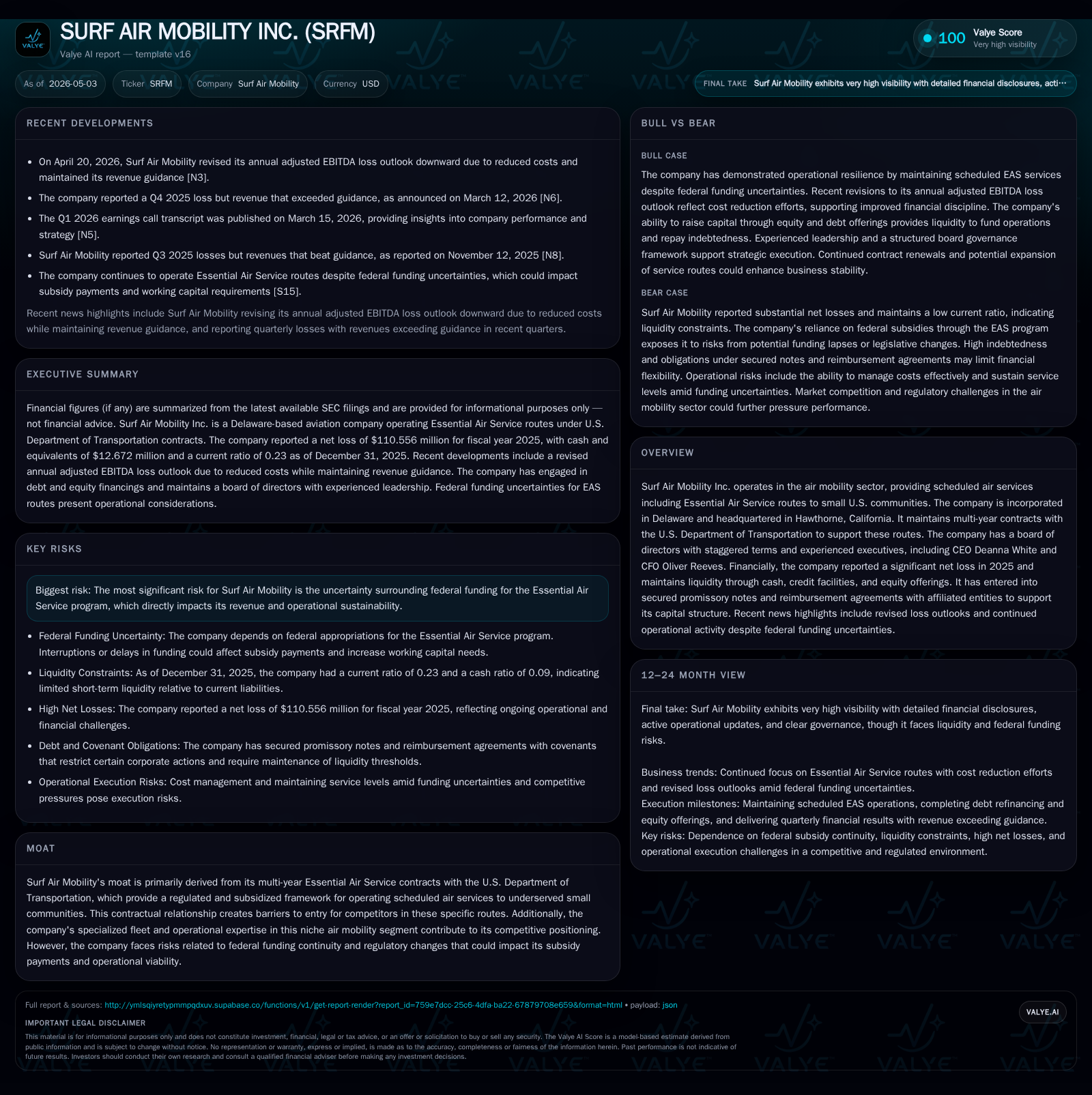
Surf Air Mobility Inc. reported continued operational activity under federally subsidized Essential Air Service (EAS) contracts despite looming lapses in federal appropriations. The company revised its adjusted EBITDA loss outlook downward by implementing cost controls while facilitating liquidity through a new $15 million secured promissory note facility. Its core business hinges on multi-year DOT contracts providing a protective moat, but the uncertain federal funding environment and a low current ratio underline ongoing financial risk. The company’s strategic focus remains on contract renewals, fleet optimization, and navigating subsidy continuity to stabilize its revenue base amid liquidity constraints.
Latest Operating Update: Quarterly Performance and Capital Developments
Surf Air Mobility's latest operating disclosures in its November 12, 2025 10-Q filing reveal an active management response to a precarious operating environment marked by federal funding uncertainty. The company revised its annual adjusted EBITDA loss outlook downwards due to successful execution of cost reduction initiatives while maintaining backing on revenue guidance despite unsteady appropriations for the Essential Air Service (EAS) program [S2][N3].
Complementary to operational adjustments, Surf Air entered into a material definitive agreement dated April 20, 2026—a $15 million secured promissory note with LamVen designed as a flexible drawdown facility capped at $5 million per consecutive 90-day period [S3][S29].
The operational tenacity amidst looming EAS program funding lapses—exacerbated by federal government shutdowns extending temporary authority only through November 18, 2025—illustrates management's commitment to service continuity on government-subsidized routes despite risk exposures [S9].
Core Business Model and Service Offering in the Essential Air Service Niche
Surf Air Mobility derives its core revenues from operating scheduled regional air services primarily under multi-year contracts awarded by the U.S. Department of Transportation's Essential Air Service program [S1]. These contracts mandate minimum scheduled air connectivity for small and remote U.S. communities otherwise underserved economically or logistically by commercial airlines.
This arrangement places Surf at the intersection of regulated government subsidy markets and niche air mobility operations where predictable federal reimbursement underwrites route economics otherwise unattractive for commercial viability. Customers benefiting include regional travelers reliant on consistent connections for business, medical access, or community engagement where alternative transportation options are limited or inefficient.
The fleet composition is tailored strategically to align with EAS route short-haul dynamics, emphasizing operational efficiency suited to lower volume airports with specialized access requirements rather than scale-focused large commercial jets [S1][S9].
Competitive Positioning within U.S. Regional Air Mobility Sector
Within the regional air mobility ecosystem, Surf Air Mobility commands a defensible position anchored in its exclusive multi-year EAS contracts which produce formidable barriers to entry on these specific routes [S1]. Unlike broader legacy carriers like Alaska Air Group or Air Canada that predominantly target high-density hubs and international/regional markets with deeper pockets for fare competition and network synergies [N1][N2], Surf operates within a tightly regulated subsidy environment.
This regulatory shelter supports revenue predictability although it constrains pricing power due to fixed subsidy formulas and close government oversight. Switching costs for contract awards further cement competitive advantages once routes are secured—new entrants face significant certification hurdles alongside bidding processes anchored in compliance and service reliability.
Operational expertise cultivating efficient small-scale scheduling, aircraft maintenance targeted at mixed-use fleets including helicopters and light planes, plus established relationships with DOT regulators enhance Surf's moat beyond purely contractual elements [S1].
Growth Catalysts: Contract Renewals, Fleet Strategy, and Revenue Diversification
Potential growth avenues rest heavily on strategic renewal of existing EAS contracts as expiration timelines approach given the typically multi-year tenor of these agreements [S1]. Maintaining high service quality metrics is critical to favorable re-award likelihood.
Fleet strategy improvements focus on increasing utilization rates of existing assets while piloting service model innovations that may broaden revenue streams beyond direct subsidies—for instance, incremental charter services or niche scheduled flights capturing underserved corridors adjacent to primary EAS routes [N3].
Management's explicit focus on rigorous cost control not only reduces losses but creates room for incremental margin improvement as operating leverage can take effect if volumes or pricing mix shift favorably within regulatory limits [N3].
Quantifiable growth must be tracked through KPIs such as backlog levels on contract bids, fleet deployment efficiency ratios, utilization rates per flight hour, and renewal success percentages where public data permits.
Risks and Headwinds: Federal Funding Uncertainties and Liquidity Constraints
The most pronounced risk centers squarely on federal funding for the EAS program following the termination of temporary appropriation authority in November 2025—the DOT has offered no guarantees of uninterrupted or retroactive payments during potential funding gaps [S9]. This exposes Surf to unpredictability in subsidy receipts critical for route economics.
Financially, this threat translates into increased working capital requirements as the company opts to continue scheduled air services during funding lapses—potentially accelerating cash burn given low liquidity cushions.
Supportive data from latest balance sheet snapshots illustrate a stressed liquidity posture: current assets totaling $30.9 million versus outsized current liabilities of $133.6 million result in a sharply low current ratio near 0.23—indicating potential short-term solvency pressures despite available cash holdings around $12.7 million as of year-end 2025 [F1].
Leverage remains material with total debt approximately $48.3 million reported at last available update (September 2024), underscoring vulnerability without steady subsidy flows or fresh financing options [F1].
Any extended interruption in federal funds could trigger default interest accruals at punitive rates (up to 15% per annum) alongside potential accelerated repayments callable by note holders under event-of-default clauses—increasing financial strain amid operational volatility.
Upcoming Milestones and Market Signals to Monitor
Key events warranting close scrutiny over coming quarters include congressional appropriations decisions impacting post-November 2025 EAS program funding continuity; these will cascade directly into Surf’s top-line visibility and cash flow timing [S9][N3].
Advances drawn against newly established LamVen promissory note facility—with maximum increments limited every quarter—will serve as proximate indicators of liquidity stress or resolution depending on draw frequency and amounts disbursed [S3][S29].
Contract renewal bids or award announcements related to expiring DOT grants will be bellwethers signaling growth trajectory viability.
Official updates in earnings guidance or cost optimization progress tied to EBITDA margins will provide interim assessments of management execution against stated financial discipline objectives [N3].
Tracking trustee sales notifications tied to collateral aircraft assets might also reveal early distress signals given note security arrangements.
Financial Overview: Liquidity Status, Debt Profile, and Profitability Metrics
Latest financial snapshot
| Metric | Value | Period |
|---|---|---|
| Cash & equivalents | $13mm | |
| 2025-12-31 | ||
| Current assets | $31mm | |
| 2025-12-31 | ||
| Current liabilities | $134mm | |
| 2025-12-31 | ||
| Current ratio | 0.23x | |
| 2025-12-31 |
Source: SEC companyfacts cache [F1].
| Metric | Value | Period End |
|---|---|---|
| Cash & Equivalents | $12.7 million | |
| 2025-12-31 | ||
| Current Assets | $30.9 million | |
| 2025-12-31 | ||
| Current Liabilities | $133.6 million | |
| 2025-12-31 | ||
| Total Debt | $48.3 million | |
| 2024-09-30 | ||
| Current Ratio | 0.23 | |
| 2025-12-31 | ||
| Operating Income | -$76.9 million | |
| 2025-12-31 | ||
| Net Income | -$110.6 million | |
| 2025-12-31 |
Financial results reflect sustained operating losses widening net income deficits driven largely by elevated fixed costs inherent to certified operator status combined with uneven revenue recognition tied closely to subsidy reimbursements [F1][S1]. Cash reserves remain modest relative to near-term liability obligations indicating potential reliance on financing arrangements such as the newly negotiated secured promissory notes executed in April 2026 to sustain operations without dilutive equity issuances immediately pressed into service [S3][S29].
Disclaimer: This analysis is based exclusively on publicly available SEC filings up to May 2026 and corroborated news reports; it does not constitute investment advice or recommendations. Forward-looking statements have not been speculated upon beyond verified disclosures.
Disclaimer: This is research-only, informational analysis and not investment advice. It may include AI-generated interpretation and general industry context. Always verify important details using primary sources.

Comments