
Pulse Biosciences Advances Cardiac Catheter Innovation Amid Clinical and Organizational Milestones
Recent clinical trial progress and organizational realignment position Pulse Biosciences at a pivotal point in its cardiac ablation and soft tissue ablation endeavors.
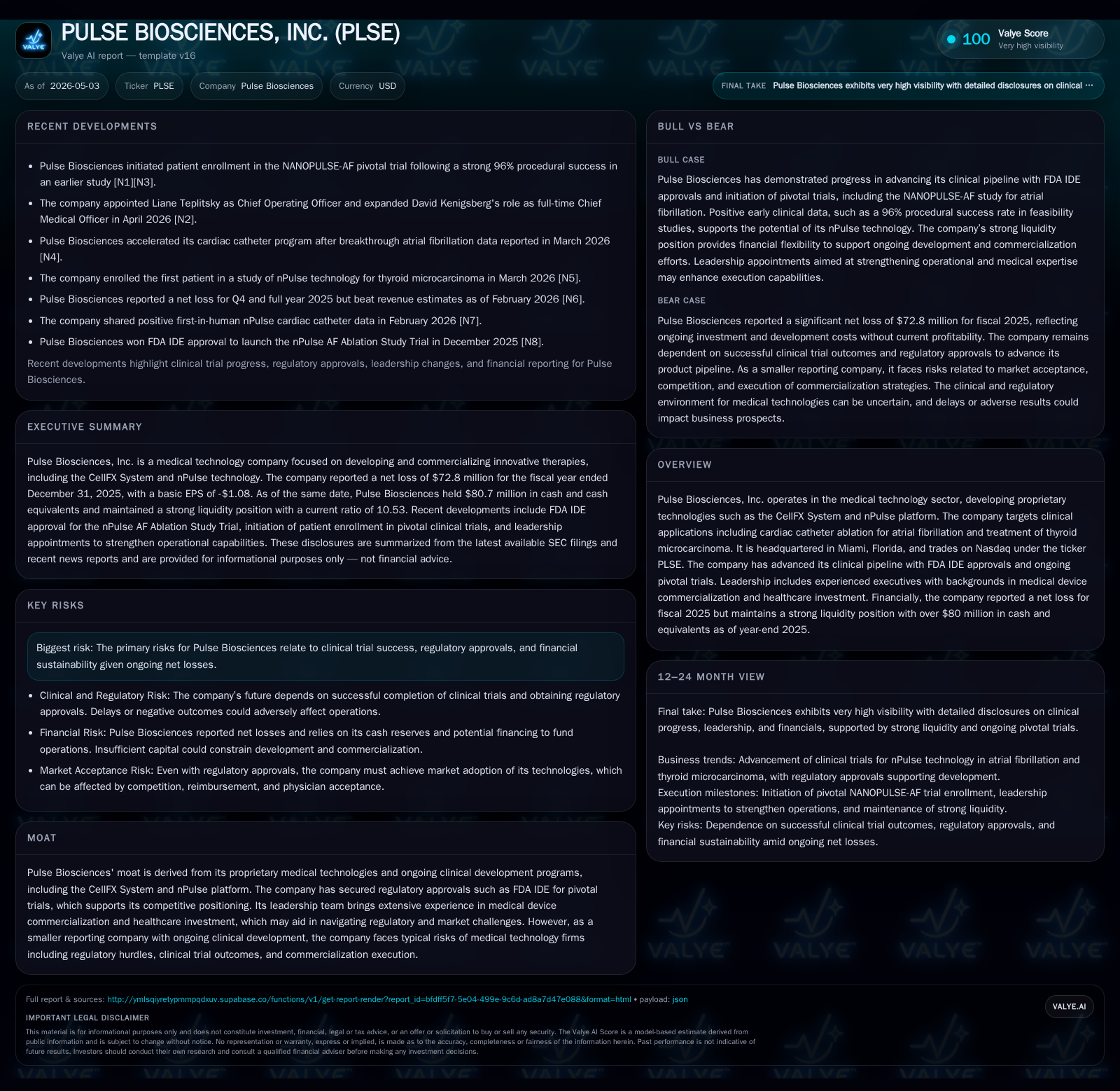
Pulse Biosciences, Inc. has showcased significant advances in its nPulse Cardiac Catheter System for atrial fibrillation treatment, highlighted by strong procedural success rates in first-in-human studies and initiation of pivotal trials. The company’s strategic focus sharpened with an organizational realignment aimed at accelerating cardiac electrophysiology product development while balancing cost structures. Its proprietary nanosecond pulsed field ablation (nsPFA) technology underpins key product platforms targeting both cardiac arrhythmias and oncologic applications. Despite ongoing net losses, Pulse maintains robust liquidity to support clinical development and commercialization execution over the near term.
Recent Operating Update: Clinical Progress and Organizational Realignment
Pulse Biosciences filed a Current Report on Form 8-K dated April 27, 2026 [S3], spotlighting key late-breaking data presented at Heart Rhythm 2026 regarding its nPulse™ Cardiac Catheter System. The findings demonstrated a compelling 96% procedural success rate at one year among evaluable patients treated for paroxysmal atrial fibrillation (AFib), reinforcing the earlier reported flawless six-month success [S21][S18]. This first-in-human feasibility study involved 165 patients across multiple European sites with favorable safety outcomes (1.3% serious adverse events related to primary endpoints) showcased [S20]. Concurrently, Pulse initiated enrollment in its pivotal NANOPULSE-AF IDE clinical trial aiming to recruit approximately 215 patients with recurrent drug-resistant symptomatic paroxysmal AFib [S27][N1].
April’s filings also revealed that Pulse updated its investor presentation to articulate a clearer roadmap for product innovation in electrophysiology, including descriptions of next-generation catheter designs under development [S15][S21]. Notably, the company announced an organizational realignment effective March 2026 focused on prioritizing nsPFA electrophysiology catheter advancement while streamlining sales and marketing resources [S14]. This indicates a pivot towards deepening clinical development capabilities over immediate commercial expansion.
Business Model: Proprietary Nanosecond PFA Platforms Driving Revenue Potential
Pulse operates primarily as a medical technology innovator developing nanosecond pulsed field ablation (nsPFA) based device platforms that enable precise ablation therapies. Revenue generation is anticipated through sales of capital equipment — such as the CellFX®, nPulse™, and Vybrance™ systems — along with sale of consumable components like disposable catheters or electrodes used during procedures. Buyers are predominantly hospital electrophysiology labs, specialty cancer treatment centers, and clinics requiring minimally invasive soft tissue ablation solutions.
The CellFX System currently targets dermatological indications through soft tissue ablation leveraging nsPFA's ability to selectively disrupt cellular structures nonthermally without collateral damage typical of thermal ablation technologies [S1]. The Vybrance Percutaneous Electrode System extends this platform into oncologic applications such as papillary thyroid microcarcinoma treatment under an FDA IDE study [S29].
Strategically most significant is the nPulse Cardiac Catheter System focusing on treatment of atrial fibrillation — the largest market within cardiac rhythm management. The technology offers single-cycle circumferential lesion formation using proprietary nsPFA energy delivery designed to reduce procedural complexity and improve safety compared with conventional radiofrequency or cryoablation methods. Early clinical data showing reduced fluoroscopy times and high acute success rates enhance adoption potential as procedural efficiency is a critical factor for hospital buying decisions.
Industry Structure and Competitive Position
The cardiac ablation device industry is dominated by established firms offering radiofrequency (RF), cryothermal, laser-based, or pulsed field ablation technologies. Pulse’s nsPFA represents a next-generation energy modality claiming faster lesion formation cycles without thermal injury risks. While this differentiation is promising, the industry requires extensive confirmation through rigorous pivotal trials before broad adoption can occur.
Competitors include major players who have pushed pulsed field ablation (PFA) into the mainstream but typically utilizing microsecond pulse durations unlike Pulse’s nanosecond domain which may offer distinct biophysical advantages. Securing intellectual property around pulse parameters confers moderate moat protection but continued innovation pace will be critical to fend off later entrants.
In soft tissue oncology ablation, Pulse faces competition from thermal ablative tools as well as emerging focal therapies including high-intensity focused ultrasound (HIFU). Its nonthermal approach aims to reduce side effects related to heat propagation but must demonstrate consistent efficacy across indications.
Growth Drivers
- Clinical advancement: Completion of pivotal NANOPULSE-AF study enrollment with primary endpoint evaluations scheduled at six and twelve months post-ablation is a definitive growth catalyst. Successful trial results would unlock FDA approval pathways enabling commercial launches.
- Regulatory milestones: Continuation of FDA IDE clearances supporting cardiac catheter development alongside expansion into oncology applications will broaden addressable markets.
- Product pipeline innovation: Development of next-generation nPulse catheters improving usability or expanding indication scope can accelerate uptake among electrophysiologists seeking superior therapeutic options.
- Physician adoption and training: Establishing strong investigator relationships via multi-center studies supports diffusion into mainstream practice; realignment towards product development strengthens focused training resources.
- Market demand dynamics: Structural growth drivers stem from increasing prevalence of atrial fibrillation globally due to aging demographics representing a persistent unmet need for safer ablative modalities.
Risks / Watchpoints / Growth Constraints
- Clinical trial risks: Regulatory approvals hinge on positive reproducibility of efficacy/safety data; setbacks could delay commercialization timelines or require costly additional studies.
- Commercial execution: Current organizational downsizing within sales functions may constrain early-stage market penetration especially given dominance of incumbents with entrenched customer bases.
- Capital sufficiency: Although current liquidity is solid, ongoing operational losses necessitate prudent cash management or further capital raises during an unpredictable regulatory trajectory.
- Competitive intensity: Established device companies continue investing heavily in PFA variants; Pulse must maintain technological leadership while managing pricing pressures typical for novel med-tech offerings.
- Adoption barriers: Switching costs for hospitals adopting new energy sources include staff retraining and integration challenges which might slow volume ramp if not carefully managed.
What to Watch Next
- Enrollment velocity updates from NANOPULSE-AF pivotal study signaling commercial readiness timing.
- Interim Six- and twelve-month data releases measuring primary safety and procedural success endpoints.
- Regulatory filings seeking expanded indications or full marketing approvals especially in U.S. and Europe.
- Commercial partnership announcements or distribution agreements accelerating go-to-market capacity post-approval.
- Product launch cadence updates for next-gen catheter iterations revealing responsiveness to clinician feedback.
- Financial commentary regarding cash burn rate adjustments following recent realignment impacting runway duration.
Financial Profile Snapshot (As of End FY 2025) [F1]
Latest financial snapshot
| Metric | Value | Period |
|---|---|---|
| Cash & equivalents | $81mm | |
| 2025-12-31 | ||
| Current assets | $83mm | |
| 2025-12-31 | ||
| Current liabilities | $8mm | |
| 2025-12-31 | ||
| Current ratio | 10.53x | |
| 2025-12-31 |
Source: SEC companyfacts cache [F1].
| Metric | Value | Period End |
|---|---|---|
| Operating Income | -$76.9 million | |
| 2025-12-31 | ||
| Net Income | -$72.8 million | |
| 2025-12-31 | ||
| Cash & Equivalents | $80.7 million | |
| 2025-12-31 | ||
| Current Ratio | 10.53 | |
| 2025-12-31 |
Financials reflect sustained R&D investment with operating losses consistent with early-stage medical technology development phases. Strong cash reserves provide significant runway for conducting ongoing clinical trials but emphasize continued need for disciplined funding strategies until revenue contribution grows materially.
The progress Pulse Biosciences has made through April 2026 reveals an inflection point where advanced proprietary technology meets focused organizational realignment aimed at capturing niche yet growing segments within cardiac electrophysiology and oncology. While fundamental uncertainties remain inherent to novel med-tech enterprises—clinical validation correctness, timely regulatory approvals, and effective commercialization—the company’s concentrated development efforts backed by promising early study data underscore its potential significance in evolving cardiac ablation treatments using nanosecond pulsed field energy.
This analysis is intended strictly as an industry-focused company assessment without investment guidance.
Disclaimer: This is research-only, informational analysis and not investment advice. It may include AI-generated interpretation and general industry context. Always verify important details using primary sources.

Comments